Interview | From Short Film to Visual Novel: Julieta De Armas on Creating The Death Night Show
Our current media landscape is full of video games making the leap to film and television. Game adaptations have become blockbuster movies and prestige TV series, while announcements of screen adaptations can sometimes arrive before the games themselves have even been released. In an era increasingly defined by the journey from screen to silver screen, it is refreshing to look at the reverse: what happens when a film becomes a game?
For Julieta “Cheddy” De Armas, that transition began with an idea about Death, a late-night talk show, and a short film that no longer exists.
I spoke with De Armas about her game development journey and the creation of The Death Night Show, a visual novel that grew out of a project she first developed while in high school. A veritable jack-of-all-trades, De Armas works across character design, 2D art, illustration, social media management, production, and content marketing. That range of skills has proven particularly useful in indie game development, where the boundaries between roles are rarely as rigid as they might be in a larger studio.
A lifelong gamer, De Armas’ foray into development began in a somewhat unlikely place: film school. She attended a high school that combined traditional subjects with an emphasis on film education. While studying there, however, she quickly realised that her own creative interests lay outside film. Rather than abandoning what she had learned, she started thinking about how those skills could be applied to video games.
In her final year of school, she laid the groundwork to do exactly that. She created The Death Night Show, a short film built around a simple comedic premise: Death as the host of a late-night television show. Due to a damaged hard drive, the film itself has unfortunately been lost in the years since its creation. Its central idea, however, proved considerably harder to kill.
Years later, De Armas reanimated the concept through a different medium.
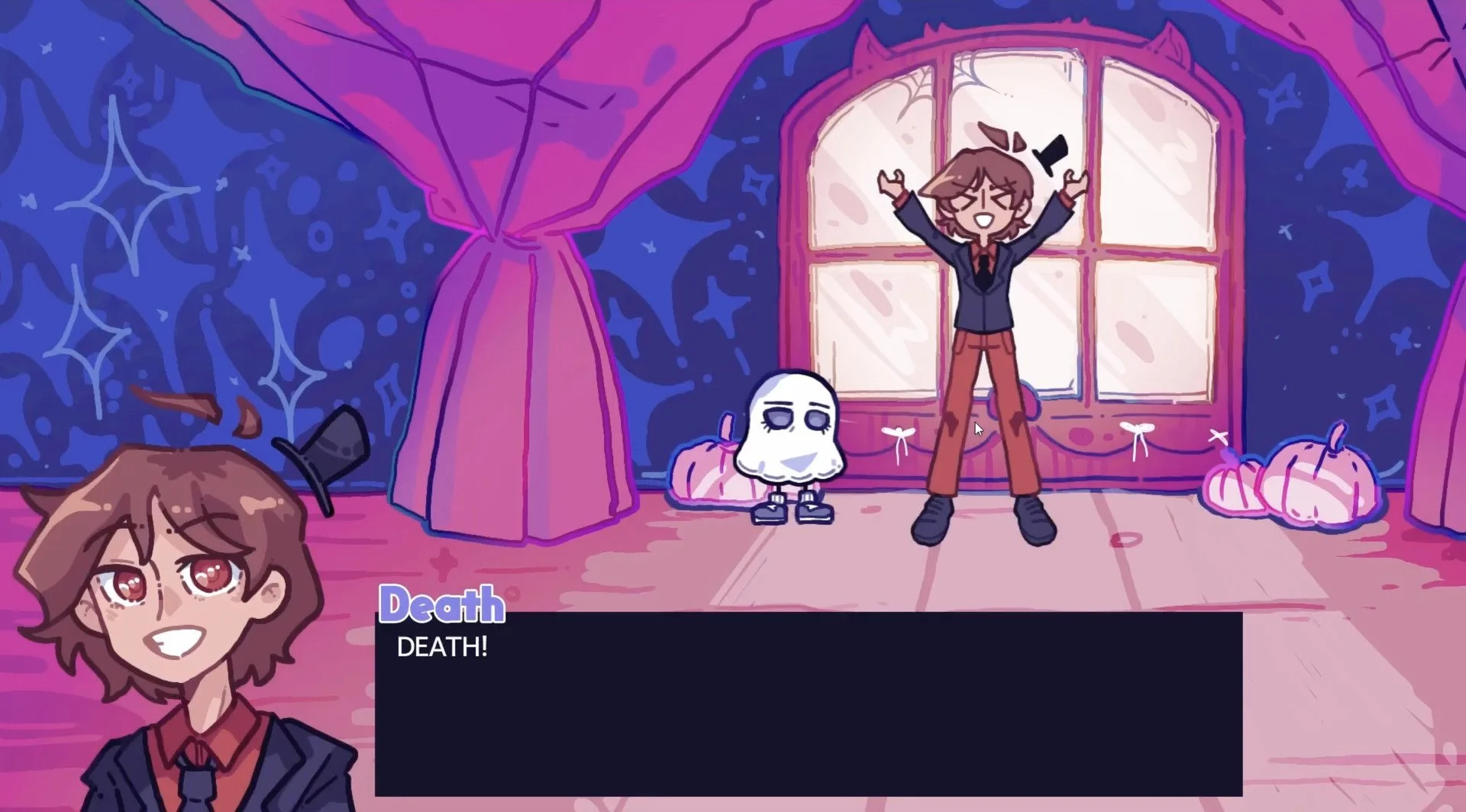
In 2024, during the annual Spooktober Visual Novel Jam hosted on itch.io, she transformed The Death Night Show into a game prototype. Using the same basic concept as the short film, the new Death Night Show became a visual novel in which players take the role of a recently deceased soul who must avoid eternal punishment by keeping an audience entertained on a program hosted by Death.
The game jam version was created in just one month, giving De Armas and her collaborators a chance to test whether an idea originally conceived for film could work as an interactive experience. That same year, the project received a grant from ACAU, the Agencia del Cine y el Audiovisual del Uruguay. The funding, De Armas recalls, “let us prototype and experiment”.
Experimentation has been central to the project ever since. Moving from film into games did not mean discarding De Armas’s earlier creative experience. Instead, film gave her a foundation from which she could determine what she did — and did not — want to make. Describing the transition, she explains that “knowing that I like video games, I started experimenting with other ideas and making my characters and stories and art”.
That experimentation gradually turned a month-long jam project into a much larger production. By 2026, De Armas and programmer Leyla Agustina Nogués Cesario had substantially reworked the game, producing two vertical slices as they refined its design, presentation, and scope. “The times are crazy to me”, De Armas exclaims when discussing the difference between the two vertical slices. The first one took roughly a year to produce, while the second took only three months.
That acceleration reflects not only greater familiarity with the project, but a development process that has changed alongside the game itself. The Death Night Show has now existed as a short film, a game jam prototype, and a more ambitious commercial project. At each stage, De Armas has had to reconsider which parts of the original idea still work and which need to be reshaped.
The initial concept was deliberately straightforward and humourous. “I literally said something along the lines of ‘what if Death hosted a late-night show?’” she says. That sense of humour remains fundamental to the game, even as its world has expanded around the original premise. Visually, De Armas describes its inspiration as partly coming from anime, with a “fun, intense Cartoon Network flavour”. She attributes much of that influence to “growing up entirely with Adventure Time and Regular Show”.
The CN influence goes beyond character designs or visual style. The self-contained storytelling of those shows also helped inform the structure of The Death Night Show, which lends itself naturally to an ensemble of strange characters and self-contained scenarios within a larger narrative.
The Addams Family became another visual and narrative touchstone, particularly for the game’s “silly, Halloween, spooky” atmosphere and the “crazy characters” who populate its world. There is one amusing complication to that influence: De Armas laughingly admits that she has never actually watched any versions of The Addams Family.
As development has continued, however, the project’s reference points have increasingly shifted towards games themselves. While writing the story and designing new characters, De Armas has found inspiration in point-and-click games, particularly in the way they combine narrative with exploration and small objectives. In a sense, the project’s influences have followed the same trajectory as the project itself. An idea born in film and shaped by television and animation has gradually become more informed by the language of games.
That change can be seen in the evolving core loop. The current version incorporates errand-running and task completion alongside the central show, giving players more to do beyond progressing through dialogue. These elements echo the structure of point-and-click adventures, where interacting with environments, completing objectives, and exploring spaces are as important to the experience as the narrative itself.
Adapting a film concept into a game, though, has not been the project’s only major transition. The Death Night Show has also undergone a transformation familiar to many developers in the indie space: the move from a game jam project to a commercial game.
A jam imposes constraints by design. There is a deadline, a defined production window, and an immediate goal. Those restrictions can be creatively useful. A commercial project, by comparison, creates an entirely different problem. With more time comes more possibilities, but also more uncertainty about how that time should be organised. For De Armas, one of the most difficult aspects of expanding The Death Night Show was learning how to manage its increased scope. The month-long Spooktober prototype had a natural endpoint. Longer-term development does not.
During the year-long development of the first vertical slice, De Armas found it much harder to break the project into manageable timelines. Tasks that were relatively easy to prioritise during an intensive game jam became more difficult to conceptualise while the project itself continues to evolve. The experience led to a new workflow for the second vertical slice. Rather than treating development as one long production period, De Armas began dividing tasks monthly while establishing broader goals for each year. “Thinking of it productivity wise month by month, it’s like doing a couple of game jams for the same game”, she says. The updated approach appears to have made a substantial difference, giving De Armas a way of translating the urgency and clarity of a game jam into a workflow that could be sustained over a much longer production.
There is another challenge, however, that no production schedule can entirely solve. Like many independent developers, De Armas has had to balance making a game with additional work that makes developing the game possible in the first place. Until 2025, she worked as a community manager, with that job supporting her throughout much of the development of The Death Night Show. She now takes on freelance social media management work, accepts art commissions, and is seeking out funding for the game. Development therefore exists alongside the practical realities of maintaining a freelance career.
Those pressures are not unique to De Armas. They also affect the people she works with. Her teammate Nogués was unable to join our conversation because of personal responsibilities, reflecting a broader reality of independent production, where development schedules must coexist with jobs, family commitments, and everyday life.
The result is that The Death Night Show has been shaped not only by its creative influences but by the conditions under which it is being made. Its development history is one of adaptation in almost every sense: adapting a film into a game, a game jam prototype into a commercial project, and a short-term production method into a sustainable workflow.
When I asked De Armas what an ideal future might look like for both herself and the project, her answer was not about leaving freelance work behind entirely. Instead, she described a future in which she could divide her time between developing her own projects and taking on work for others.
More immediately, her goal is to secure additional funding and find a publisher for The Death Night Show. She would also like to continue producing art for other games and creative projects, something she already does through freelance commissions.
For now, development continues. De Armas and Nogués are updating the game’s Steam page to better reflect its redesigned form while searching for funding that would allow them to bring an audio team member onto the project. The Death Night Show has come a long way from the short film De Armas created during her final year of school, yet the original idea has remained remarkably persistent throughout those changes. The film itself may have been lost, but its central question survived: what if Death hosted a late-night show?
De Armas is still finding new answers.