Feature | 1000xRESIST, The Game That Should Remain
An oppressive feeling that I am far too familiar with is the one that everything matters. Every decision I make affects my relationships, my career, my prospects, and my mental health. Everything is connected, I take everything with me at all times, and I have to fit everything into my backpack so that the weight of all things is a constant burden on my shoulders. There is a chance that you’ve felt this too. For many, this feeling became prominent during the first COVID-19 pandemic, where every connective string in someone’s life became far thinner and more stretched, and how they spent the day no longer included time outside of the house. For others, these anxieties may have come about during times of political unrest and protest, where it feels like — and may be the case that — the future is at stake. Many people found comfort in works of art that spoke to these experiences since, from films to games and more. Over the past few years, the small pool of media that validate and expand on these experiences for me has grown to include Goodnight Punpun, I’m Thinking of Ending Things (both the original text and its film adaptation), Mirrored Mind, Signalis, and Citizen Sleeper.
After playing the game on my Nintendo Switch a year ago and again recently on the Xbox Series X, 1000xRESIST has become another one of these pieces of media. Playing through it has convinced me to improve myself, to revamp my worldview, and to let some things go. After experiencing the game twice, I feel lighter, and I’ll be taking it with me into the future.
At a time when many high-budget video games and commercial indies have begun to feel homogeneous in their storytelling, failing to demonstrate the strengths of interactive narratives, Sunset Visitor’s 1000xRESIST is the definitive argument in the medium’s favour. At a time where mainstream art frequently shies away from meaningful political statements in favour of frictionless and digestible themes and commentary, 1000xRESIST is a powerful statement that defends radicalism and pillories the forces that create prejudice through all of its overt and discreet components.
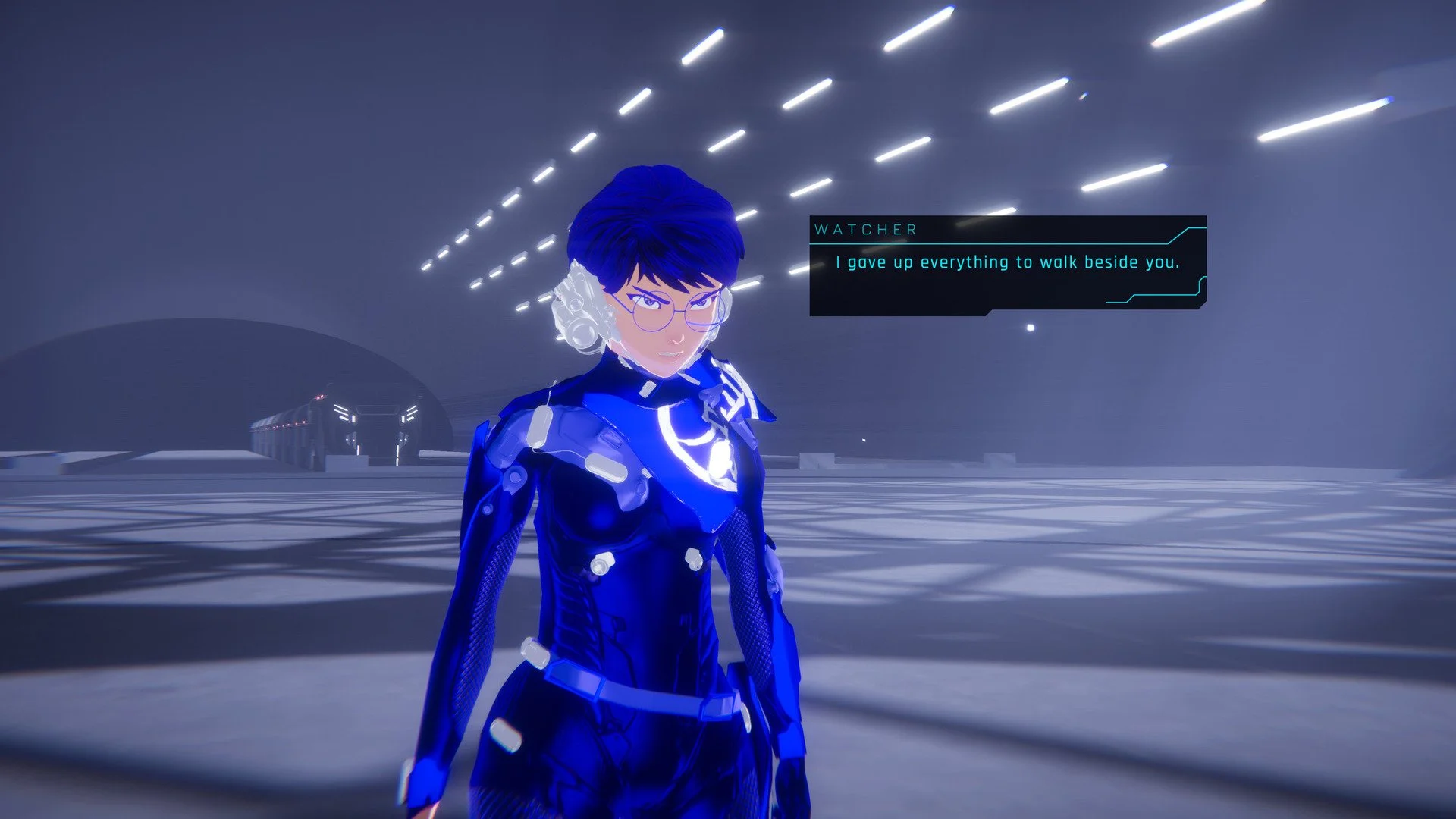
The game starts in a memory, one in 1000xRESIST’s distant past and our real-world near-future. You begin by controlling Watcher, the game’s protagonist. She has the ability to commune with the memories of her peers and ancestors. Watcher immerses all of herself into these communions, creating various playspaces both representing concrete physical locations and more figurative, surreal ones, and introducing the more philosophical puzzle of what in-game experiences should be taken with you to the end and which should be left behind.
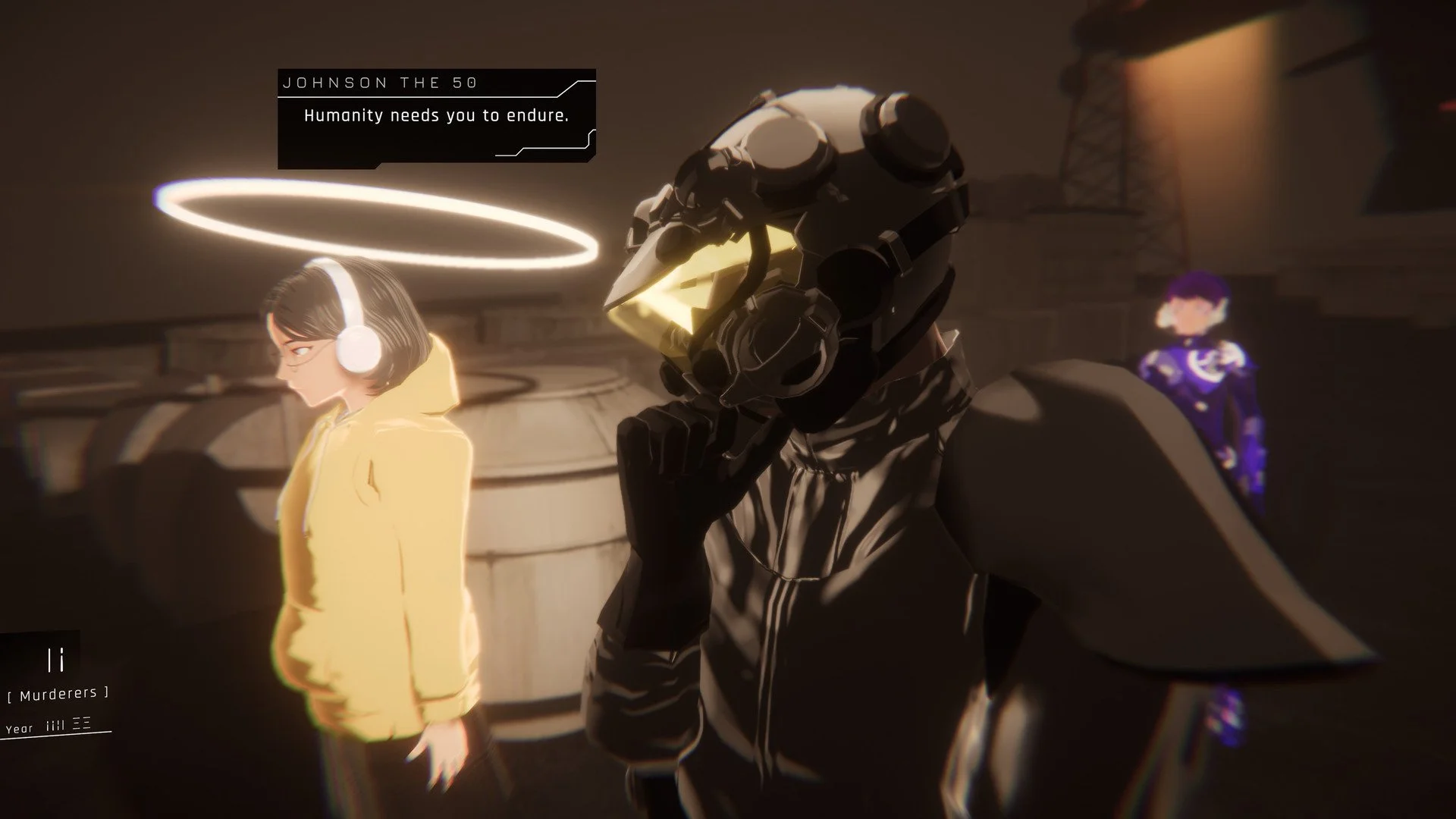
1000xRESIST’s gameplay swaps between two modes. You explore the past through communion, or wander through Watcher’s present, choosing what characters to talk to in order to progress the story. Some characters are necessary interlocutors and sometimes the player can choose between dialogue prompts, but most conversations are optional and non-interactive beyond pressing a button to progress. Between paragraphs or phases of dialogue, the camera will often change to show different stills of the characters in a selection of poses, creating minimalist cutscenes to retain player engagement or recontextualise key moments.
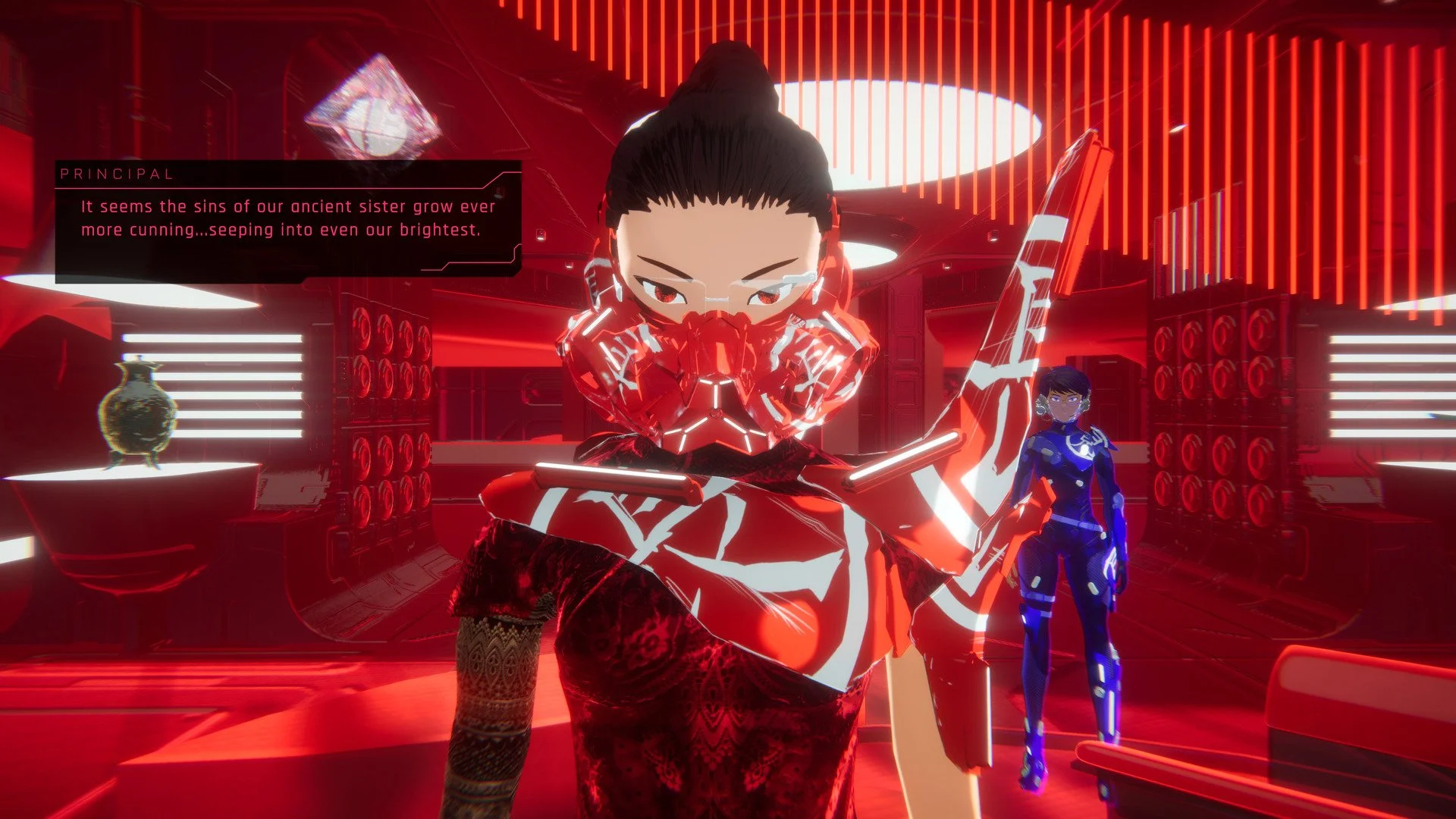
These stills are one of many components that depict an artistic tact that elevates 1000xRESIST’s themes and narrative. The composition and framing of these stills throughout the game is vital to what the player takes away from them and how any given scene is engaged with. Art director Kodai Yanagawa and animators Earth and Abhinav S. demonstrate a robust understanding of how to employ negative space to control how surreal or uncomfortable scenes feel. The already gorgeous shots are enhanced both by the employment of bullet time and gesturing to imply movement, and the fact there are rarely more than three subjects on the screen, which many times line up to the rule of thirds in their framing. Where the player should be looking feels guided by the game’s application of textbox and character placement and even depth of field — the dialogue is often performed to follow the events of a still as the game allows you to process the visuals of events and perceive character’s expressions before hearing their emotions and reactions in the accompanying speech. Particularly in the game’s latter half, the placement of subjects, camera positions, and lighting are all used to great effect to create or break down perceived hierarchies and relationships between characters.
The story being told by the impressively intelligent cinematography and dialogue is one that spans a vast amount of time. The game’s chronology starts with the real-world 2019-2020 Hong Kong protests, sometime after which is followed by an apocalyptic event that nearly wipes out all of humanity. At the beginning of the game Watcher communes with the memories of Iris, a teenager experiencing the latter catastrophe who is the daughter of parents who left Hong Kong for Canada at some point during or after the protests. In Watcher’s present, Iris is worshipped as a god called the Allmother (or “Allmo”) and most characters in the game are from her family, including her clones — the group which the player character is pulled from.
The aspect that first drew me to 1000xRESIST was how it conversed with the themes of religious identity and pursuit. I quickly found that the game was going to be about much more than just this, although Sunset Visitor still saw fit to far surpass my expectations on how the topic would be handled. Watcher, the first protagonist, lives under a theocracy wherein the game’s most powerful figures are divinely chosen (by the Allmother) and individuals’ roles in society are predesignated before their births. This system is one that must be resisted against in the narrative. Later in the story, the player finds themselves living under a totalitarian regime with a strong sense of despotism, and is guided towards helping represent and nurture marginalised groups, including fighting for religious people. With more nuance than is typically deployed in conversations about the impact of religious pursuit, 1000xRESIST outlines that governing bodies with a predominant presence of theism cannot be progressive or subject to revision or scrutiny because mythologies that are unfalsifiable are also unchallengeable and stagnant. However, the events in the latter half of the plot also portray how societies that do not accommodate religion do not allow diverse communities to emerge and flourish, nor allow individuals to pursue their own means of resolving existential anxieties.
With a story with so many elements told through written and voiced dialogue and cinematic stills, why is 1000xRESIST a video game? Simply put, the game’s themes of autonomy, protest, choice, and intimacy — among much else — are best evoked by the interactive medium.
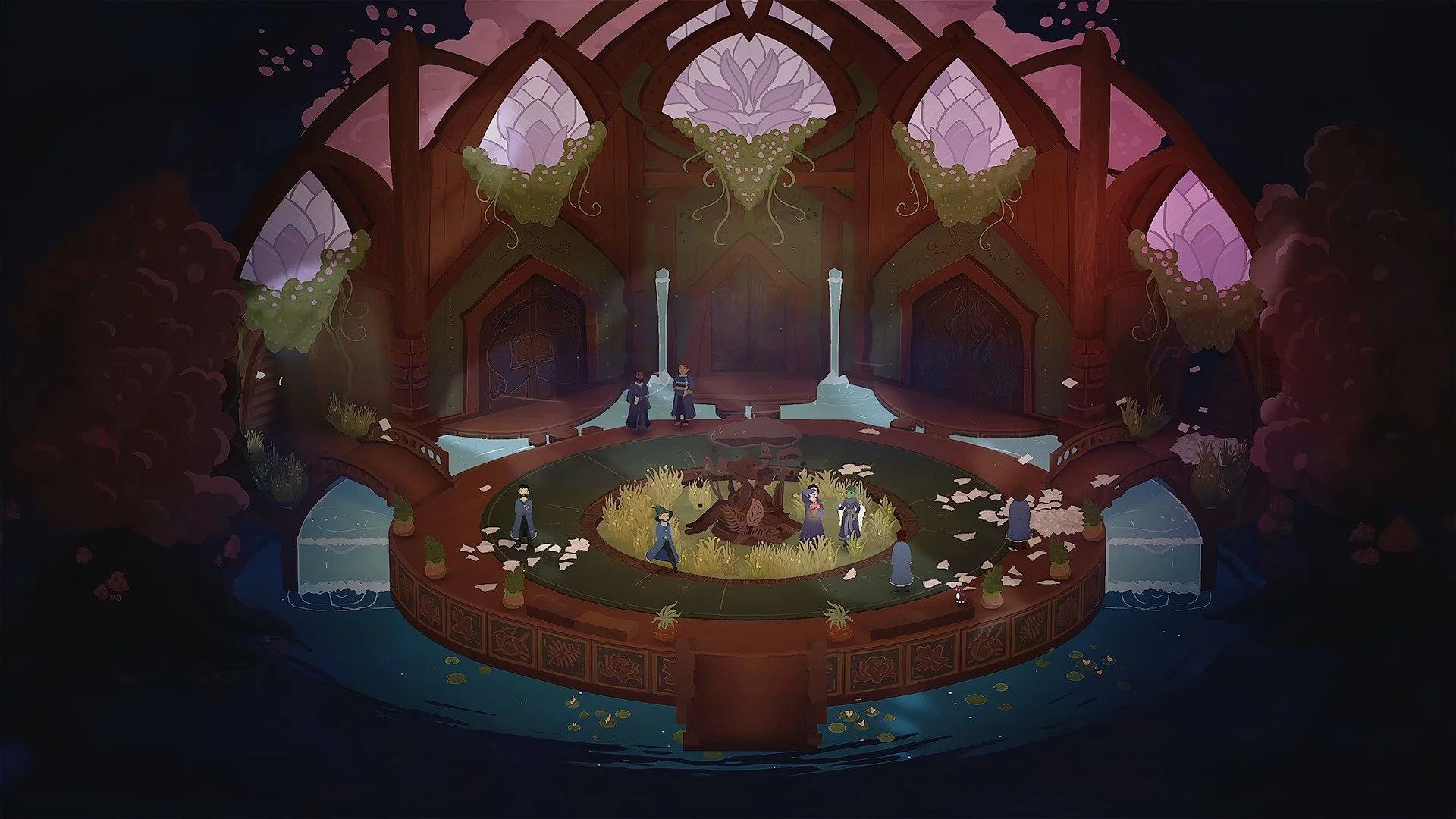
A strong example of this can be found in the game’s use of environmental storytelling in the Orchard. This playspace is extremely convoluted and unintuitive to navigate and memorise, and the map given to the player to reference is hand-drawn and childlike. With enigmatic landmarks such as dinosaur bones, graves, an obtuse glass box, and a horse statue, the space contributes to the sense of mystery experienced by the player at the beginning of the game. As the plot progresses, certain objects come to take on new meaning. Within the memories the player explores, the slight changes in Iris’ home before the end of the world imply a lot about the character and dynamics of her family; what Iris valued as important or trivial in her youth shapes how we understand or sympathise with her actions later on. Throughout both of my playthroughs, I found myself returning to shelves to check for decor, plants, or goldfish, and came to have a more intimate and profound understanding of 1000xRESIST because of how Sunset Visitor composed these environments.
Also vital to contributing to how the player more intimately understands 1000xRESIST is the voice acting, which is — like every other component of the game — unsurprisingly excellent. Most of the game’s characters, having been cloned from Iris, possess a similar range of mannerisms. This challenge makes every detail of the actors performances matter, as each character’s personality and history is largely conveyed through voice acting. A compounding bold choice in this regard is to have many text boxes filled with nothing, where you simply feel a character pause, breathe, mumble, or sigh. Of particular note are standout performances by Felicia Lau and Nhi Do, which were distinct and thorough enough to have me recognising the characters by the sound of their breath by the end of my first playthrough.

With a wealth of elements clearly defining the game’s portrayal of hierarchies, intimacy, history, and character, what unifying purpose is served? Not only do all of 1000xRESIST’s elements intersect and cement one another, but they also serve to make informative and direct comments on the game’s titular theme: resistance.
By starting its timeline with an immigrant family, and by starting Chapter One following a Chinese student in a Canadian school, 1000xRESIST centres diaspora politics and the conflict of process early into the experience. Hierarchies and tensions can be felt between Iris and her “friends” at school, and they can also be felt between her and her friend Jiao, stemming from Iris’s outbursts of internalised xenophobia. The cutscenes’ uses of colour contrast and camera positioning communicate these emotional distances between characters that often start with geographic conflicts. As someone who is mixed race — having experienced racism and benefited from white privilege — these challenges that the characters faced resonated with me and I felt I understood their feelings of isolation and confusion keenly. Less relatable to me but still compelling and powerful, these hierarchies and tensions can also be deeply felt between Iris and her mother.
The game includes various references that highlight real-world systems that bring about prejudice and oppression. Iris’ parents reference the “Five Demands, Not One Less” slogan of the Civil Human Rights Front that was used throughout the 2019-2020 Hong Kong protests. In an interview for Story Mode, game director Remy Siu highlighted how the symptoms of those suffering from the fictional apocalyptic event in 1000xRESIST are shared with protesters attacked with tear gas. The characters often refer to burning, and during a communion featuring memories of the Hong Kong protests the player can see depictions of umbrellas that were used by protestors both during the 2014 Umbrella Revolution and the 2019-2020 protests staged in the game. As also identified by Kastel for Mimidoshima, the allusions here seems to be to the difficulties that necessitated umbrellas and made them a symbol during peaceful protest — using umbrellas defensively against pepper spray — and self-immolation and threats of violence in more radical protests — “If we burn, you burn in us” being one of the popular slogans in Hong Kong protests and activist art. The game’s fictional Red Guard faction shares its name with the violent Chinese paramilitary group from the 1960s, a connection that ties in with the game’s portrayal of recurring systems that accommodate factionalist and conservative beliefs.
The interactive verbs that constitute most of the gameplay — engaging in dialogue and viewing memories — shape the game's narrative of what it means to resist, and how resistance occurs.
1000xRESIST asks us to consider what memories we will take with us, and how much dialogue is enough dialogue. It illustrates that there is an extreme finesse required to understand how to reconcile differences between people, as well as how much someone’s past and emotional experiences or trauma can explain, but not justify, the damage they may leave in their wake. “What will you take with you?” is a question that the game asks often, suggesting that the memories you indulge and the stories you tell shape the next generation. Will people see what you’ve seen and protest? Will they hear what you’ve said and feel outrage? Will the experiences that you’ve chosen to clasp onto perpetuate further damage? What will come of “the you that remains”?
In particular, 1000xRESIST’s final choices illustrate how you as the player have always carried a responsibility to how much of the game you engage with. I feel that Sunset Visitor’s most decisive choice was to make the game criticise my decision-making. Intent on carrying everything with me, I pursued a path that would be pacifistic toward all of the game’s characters. I was then shown the brutal and irreparable outcome for my choices, and sent back to try again without even getting to see the credits roll. I had been deemed culpable for a fraught future, as there was an irresolvable conflict inherent to my interest in being accommodating to unaccommodating groups and people. I didn’t just get what would amount to a “bad ending” — it felt as though I was told that I sought the “wrong ending” and had to change my way of thinking before earning the right one. In the game’s (debatably) best and final moment, it called me an asshole and demanded more radical action for a brighter future.
Piece by piece 1000xRESIST comes together to become far greater than the sum of its already excellent parts. We are all connected, “hair to hair”. We choose what to take with us, we are guided to moral and political action by our memories and the memories of others. We choose what goes in our backpack, and we trim things down from “circle to square”. After two playthroughs, I more fully understand the game’s thematic narrative and its intricate science fiction plot. I was pulled in by the way it studies culture, religion, protest, and diaspora. I cried quite a few times. 1000xRESIST feels like a watershed moment in gaming. It’s definitely a landmark moment in my life. It will forever sit in my arbitrary top 10 games and I’ll cram it into conversations wherever it fits.
We choose what to carry with us, we choose the us that remains, so that others can make the right choices and choose what remains with them. 1000xRESIST is a part of the me that remains and remains and remains.
1000xRESIST was played on Xbox Series X with a code provided by the publisher.