Review | Virtue and a Sledgehammer – As Subtle As A…
Earlier this year, a friend of my parents died. At some point after his funeral, his daughter used AI to recreate him so that her mum could speak to him one final time. Apparently, she found comfort in this. I could not share that sentiment because that was not her late husband that she spoke to. It was a glorified computer programme wearing his skin; a virtual replica that could only predict what he would say in the wake of his death. This is a practice that’s unfortunately not uncommon in this modern age of AI chatbots and one I personally find abhorrent. The dead are having their bodies metaphorically puppeteered, forced to say things they can’t say for themselves, all to placate the living. Any comfort they provide is ultimately false because it doesn’t matter whether they were your spouse, your parent, or your child; you can never know what they would tell you in any given situation… because they are dead.
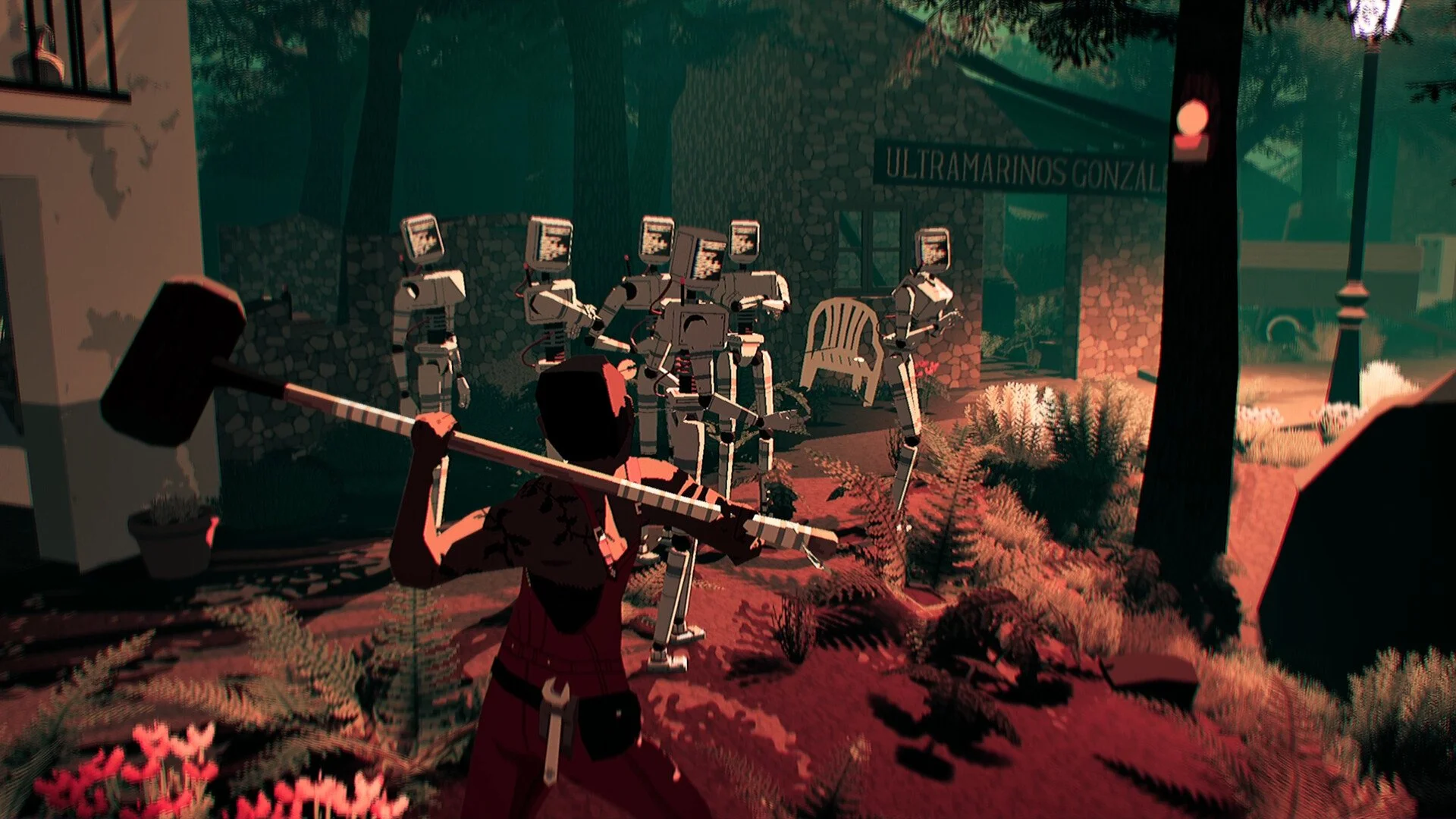
These thoughts rang through my mind during my three hours with Virtue and a Sledgehammer, which is populated by such bots; only these don’t even have the audacity to at least look human. When main character Pratelle returns to her hometown, its citizens are walking, talking CRT monitors; their screens only displaying strings of text and numbers rather than anything resembling a face. Pratelle’s sister, Nina, is responsible for this, having created a digitisation process that allows people to have their minds copied and emulated in mechanical bodies. They see it as a gift, an extension of life. Pratelle disagrees, and with nothing but a sledgehammer and a lot of pent-up rage, she intends to destroy the town and everything in it.
I’m almost hesitant to describe Virtue and a Sledgehammer as an action game because its combat is remarkably simple, with no Devil May Cry or Bayonetta-esque combos, though that’s appropriate given Pratelle’s choice of weapon. You only have three attacks, which are determined by how long you hold down the attack button – a light shove that’s perfect for creating some distance, a horizontal swing, and a slow but mighty vertical slam for finishing off a prone target.
These moves are all you have at your disposal as you trudge through Pratelle’s old home, laying waste to not only its mechanical inhabitants but their houses too. The simple combat means there’s no complexity to the enemies’ attacks either, but their biggest strength is their numbers. They can swarm you and attack from all sides, and with no block button, it’s easier than it sounds to be taken out by successive punches. Death is only a slap on the wrist if you let it, though. Choosing not to give up sees Pratelle instantly revive herself with a superpowered smash that wrecks surrounding enemies; a perfect representation of her indomitable spirit.
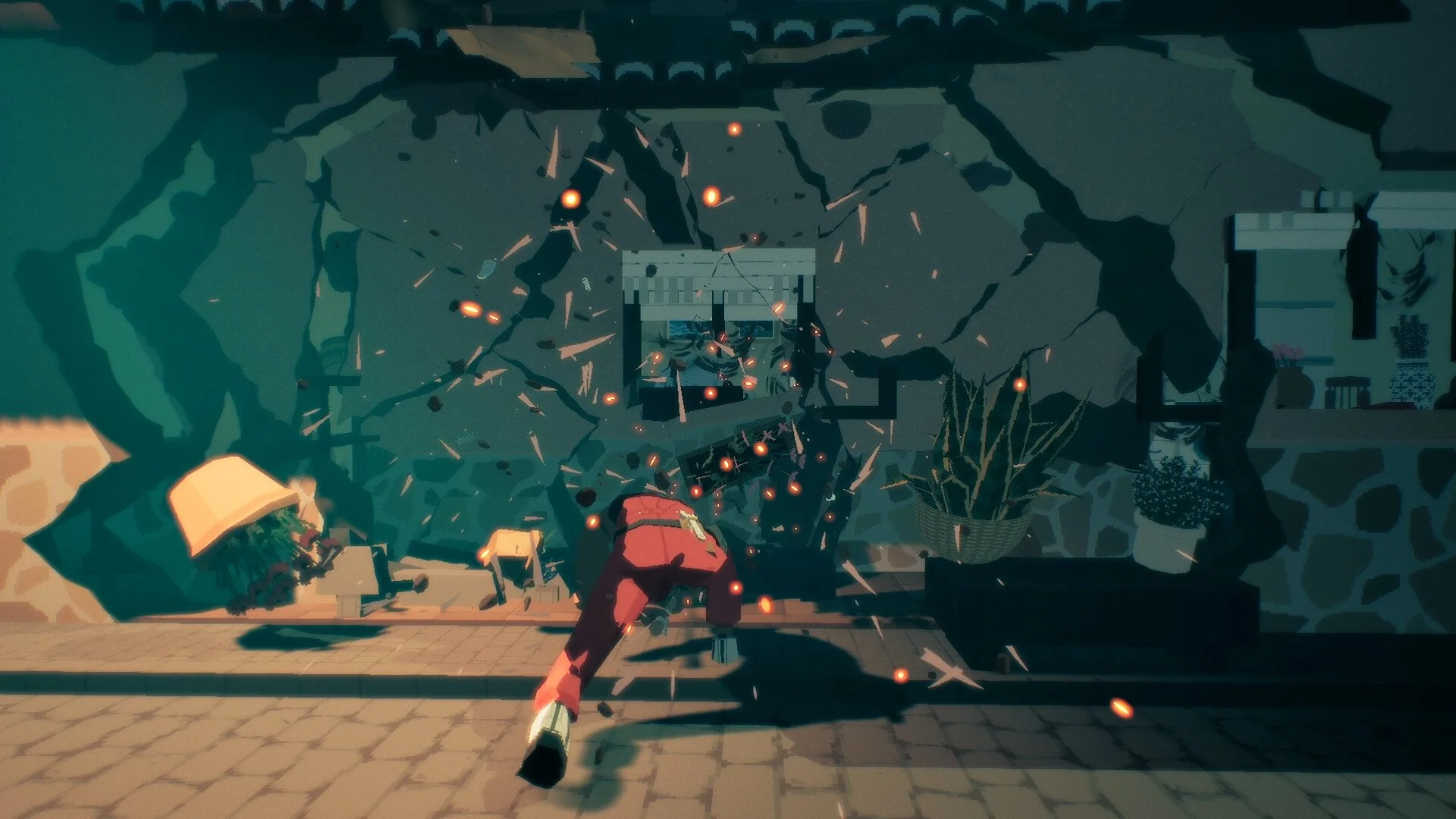
There’s a fantastic weightiness to Pratelle’s swings, making the very act of demolishing everything around you incredibly satisfying (well, almost everything; chain-link fences are somehow the strongest material around). This is enhanced by the destruction effects for buildings, which crumble around you depending on where you hit them. You can leave gaping holes in walls and, if they’re big enough, the lack of foundation causes the ceiling and anything above it to crash around you. Finishing off robots also sends them careening almost like a projectile, meaning they can take out other robots or crash through buildings.
All this ensures that, even if you’re apathetic to Pratelle’s moral crusade, you’ll want to go out of your way to trash the place just for the sheer catharsis of it all, but especially if you want to get the most out of the story. While you could probably make a beeline to the end and still understand what’s going on, you can find and break these large, blue, crystalline statues that offer glimpses of Pratelle’s past. There are also smaller red statues scattered around, and for every ten of these you break, you unlock further flashbacks fleshing out Pratelle’s relationships with her sister and late mother, which are shown to be incredibly messy yet no less loving. These are perhaps the game’s most human moments, touching upon the complexities of familial ties as you grow older, how generational trauma impacted how Pratelle’s mother came to treat her daughters, and how love and hate truly are two sides of the same coin.
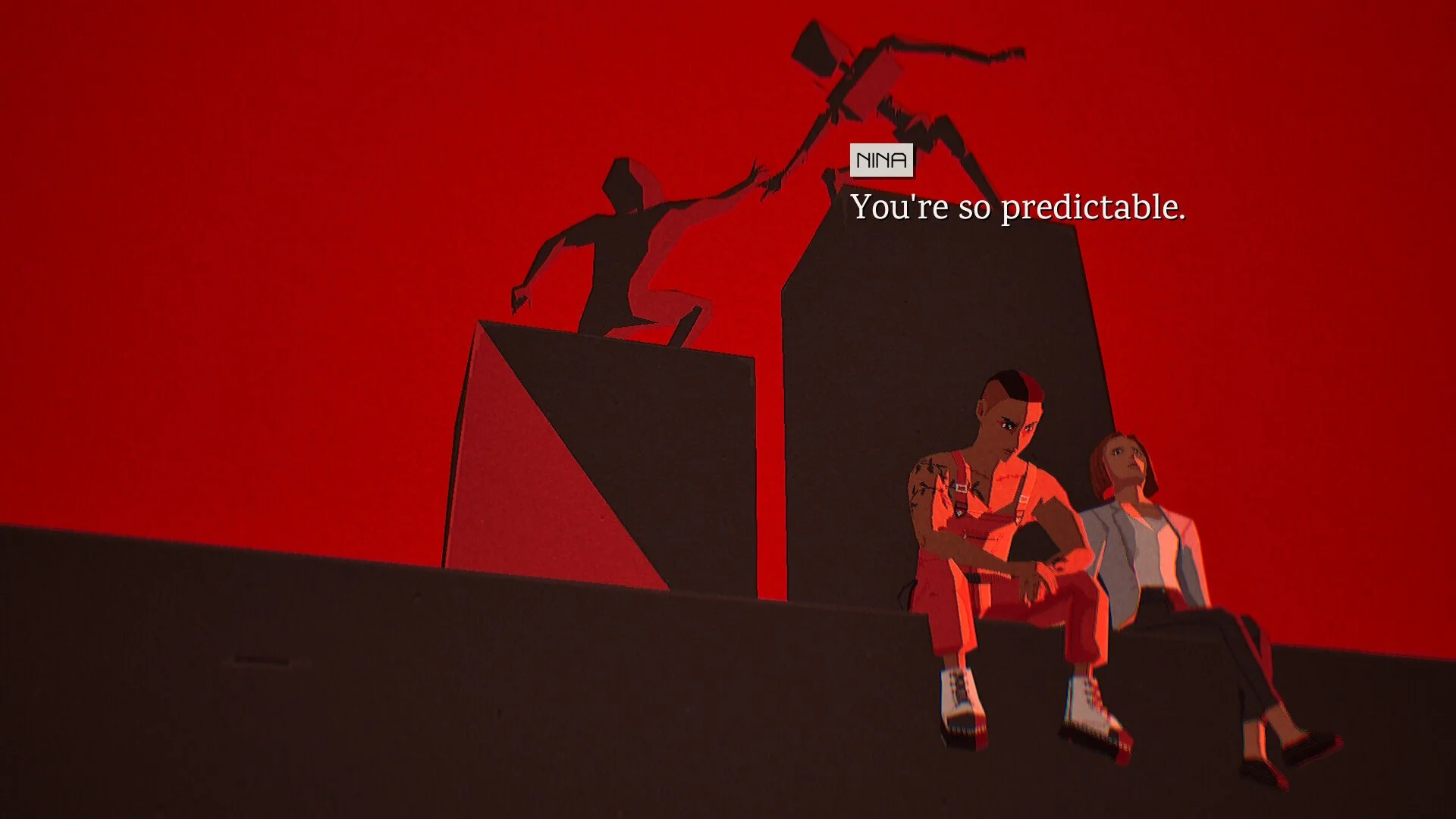
You can’t find these statues without smashing down a few walls, and some are more hidden than others. I think I managed to find most of them during my playthrough, but a part of me wishes the game had a map so I could more easily navigate my surroundings. I even got a little lost a couple of times since it’s not always obvious where you need to go to progress.
I must confess to some hypocrisy, though. Despite the game’s active encouragement and that opening paragraph I wrote, I spent a not insignificant amount of time trying to be a pacifist, completely going against Pratelle’s unwavering objective. The game is explicitly not designed to be played this way, as there are too many antagonistic robots looking to do Pratelle harm. Some are near gleeful about the prospect of murdering her despite being ordered otherwise, while others throw condescension or slurs at her, so it’s easy not to feel bad about caving their not-heads in.
Yet some robots are completely harmless. Plenty can be found standing around in idle conversation, joyful about the freedoms their mechanical bodies provide or pontificating about what it means to no longer be able to eat or masturbate. Some even run from Pratelle, begging not to be killed. One robot, who has come to regret his decision to be digitised and sees it as unholy, asks that I kill him where he stands and then do the same to his wife and children, who he’s locked inside a house. I granted his first request, but upon seeing his faceless family express confusion and fear through the window, I kept walking.
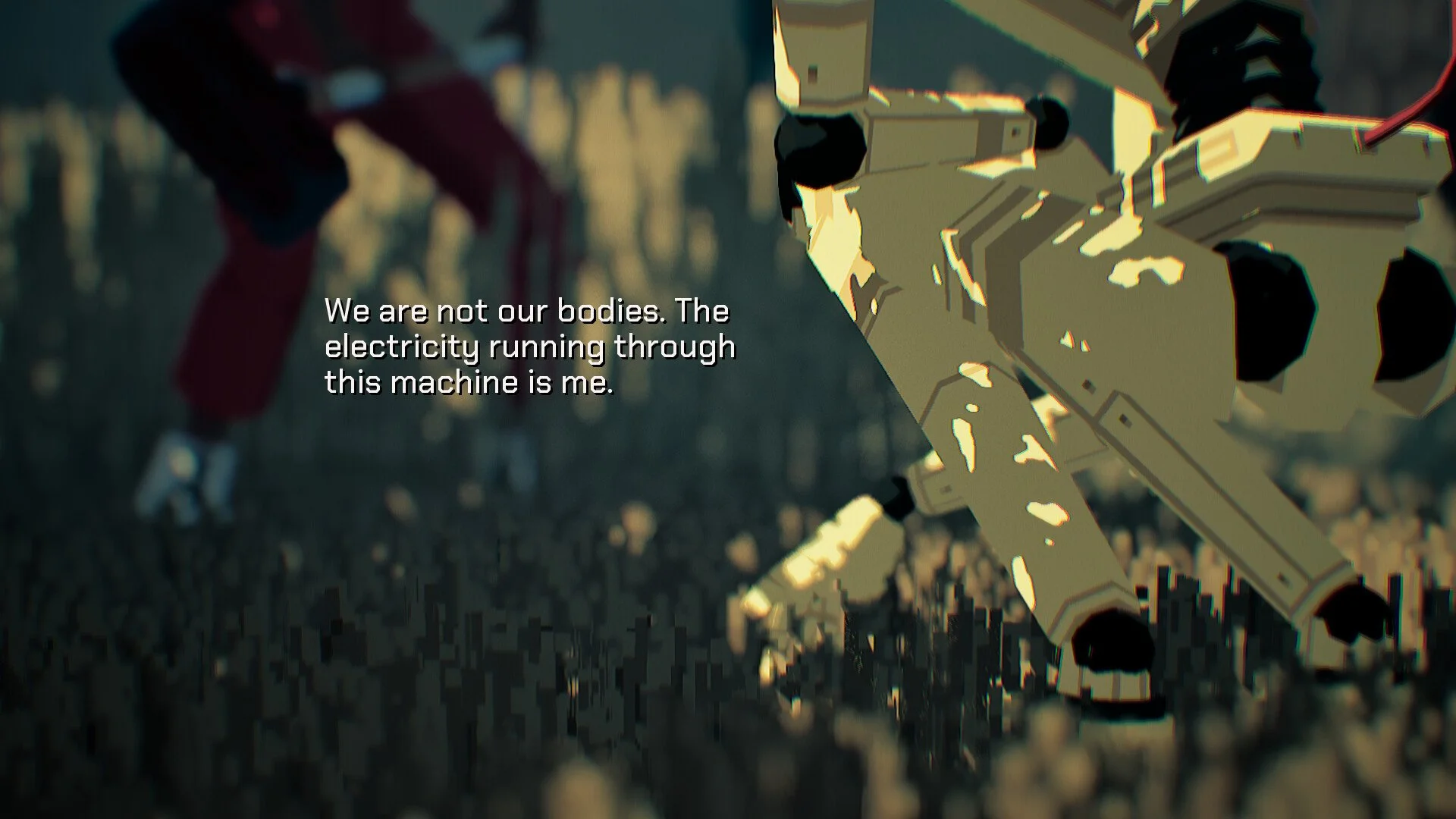
I’ve always been a fan of the “robot learns what it means to be human” trope. There’s something beautiful about an artificial construct overcoming its limitations and programming, opening the question of whether a machine can develop a soul. So, when I see these robots cower in fear as I walk past with my hammer, having already crushed some of their kin, I can’t help but question if what I’m doing is right, ethically or morally.
But that itself is the trap. Right now, we do not live in a world with sentient AI. AI as we know it cannot grow or develop a sense of self; it can only emulate. It can only plagiarise. When AI says it is alive, it’s because someone told it to say that. What’s more, the robots in Virtue and a Sledgehammer are not their own people. They are echoes of the dead. Everyone Pratelle knew is gone, and these robots are but duplicates, snapshots of who they were right before the end and incapable of being anything more. The game stresses this on its own pause menu: “Relax. They’re not real people. Everyone you knew is dead.”
Seeing that message ironically only strengthened my doubt, like I was being tricked. It’s very easy to perceive Pratelle as the villain thanks to her intimidating frame, unwillingness to converse with the robots, and the prominent use of a harsh, bright red throughout the game, emblematic of an eternal anger that cannot be sated. Yet the game, and by proxy the developers, call me out on my uncertainty. I don’t know if this would’ve happened regardless of my playstyle, but one of Pratelle’s inner monologues sees her arguing with herself, questioning why she’s actively avoiding destroying as many robots as possible and stressing that they’re not sentient.
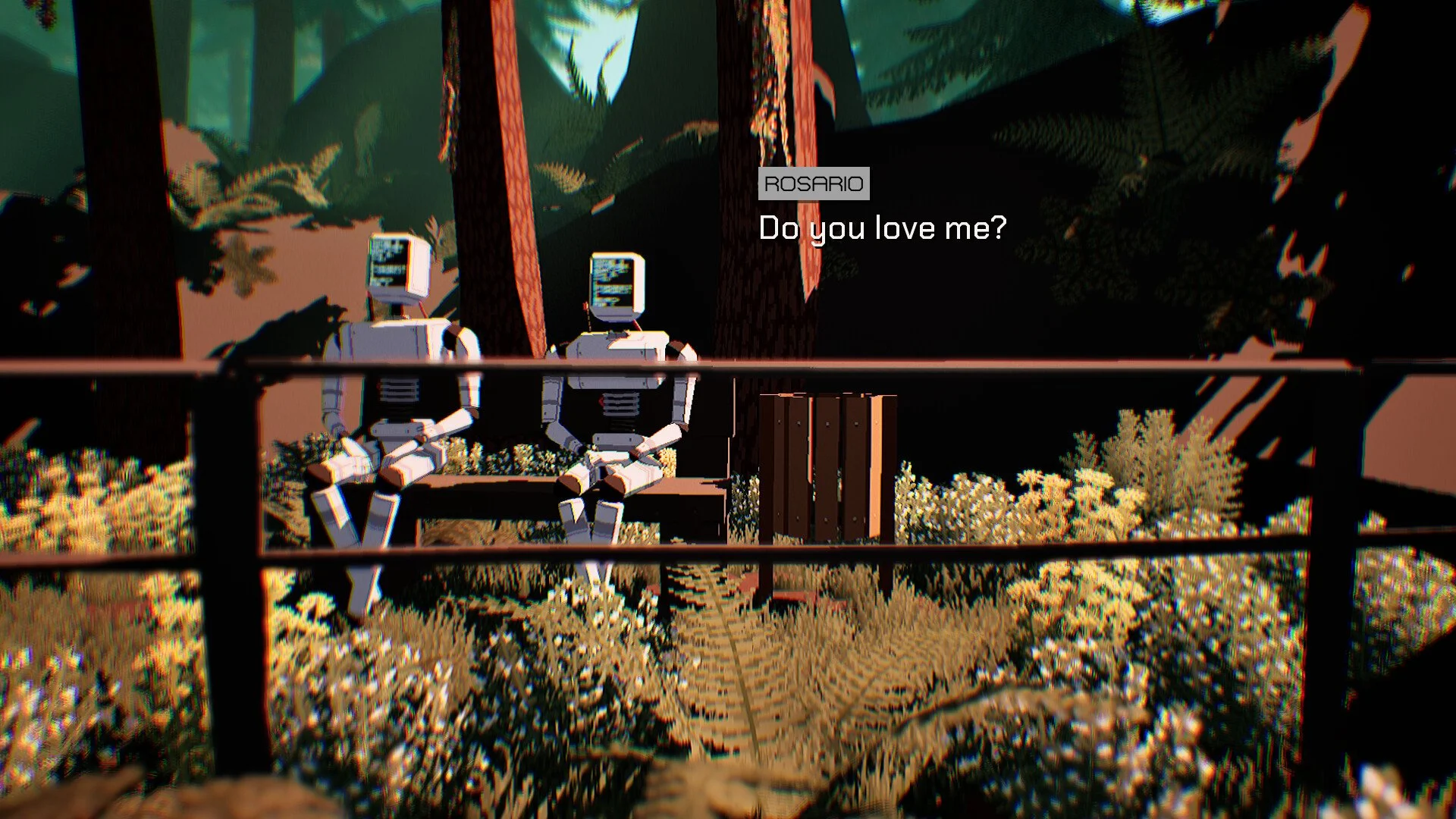
Virtue and a Sledgehammer is not here to debate the ethics of AI. It is unabashedly here to condemn the technology, to rage and scream at the very notion of replicating human life in a mechanical body and passing it off as a suitable substitute. Some may find this lack of nuance and subtlety childish (at one point, Pratelle even looks directly into the camera to basically say, “This is about AI”), but I respect it for its staunch commitment to its message. Even with it offering two endings, its core message remains the same, with it refusing to engage in whataboutism or play devil’s advocate.
There’s obviously a world of difference between real AI chatbots and Virtue and a Sledgehammer’s robots, and we should count our blessings that the latter don’t exist. The most significant difference is how Nina’s digitisation process actually works, which is a black mark against its perceived positives of saving the elderly, the disabled, and the terminally ill from their failing flesh. Yet the game’s message remains appropriate for real-world AI tech, which tries to convince us that the dead aren’t gone. That AI is keeping them alive when all it’s doing is crudely fabricating them. If they do contain the spirits of the dead, then they’re cruel cages denying those spirits any will of their own.
I have lost people in my life. I only have one grandparent left, and in recent years, I’ve become uncomfortably more aware of my parents’ mortality. Playing Virtue and a Sledgehammer made me question my own ethics regarding AI. I like to say that if someone showed me an AI duplicate of a dead loved one, I’d smash the thing or at least shut it down. Now, I’m not too sure. If it were my own mum or dad, would I succumb to the temptation to hear their voice again? To see them as they were in life, better even, and not as a cold corpse?
The fact that Virtue and a Sledgehammer is making me ponder this at all is a sign of how effective and powerful its storytelling is, and I hope that if that temptation ever manifests, I’ll remember Pratelle and channel her own resolve for myself.
Virtue and a Sledgehammer was played on PC (via Steam Deck) using a code provided by the publisher.