Review | Terra Invicta - E.T. Go Home
It’s 2028 and the world is in upheaval. Alien ships orbit the Earth, their intentions unclear but ominous. Canada and the United States have federated together as the United States of North America. Humanity has just begun space mining operations in Hellas Planitia on Mars, and launched its first fission-powered spacecraft.
After nine years in development and over three years in Early Access, Terra Invicta’s 1.0 version was released in January of this year. This is a huge accomplishment for Colorado-based developer Pavonis Interactive, not least because of the grand strategy game’s ambitious scope. It’s also quite the feather in the cap of publisher Hooded Horse, which took on Pavonis as its first client and has since grown into an indie publishing powerhouse in its own right, while also taking strong ethical stances on publishing contracts and generative AI.
In Terra Invicta, you assume leadership of one of seven organisations that has formed in response to an alien craft crash-landing on Earth. As the aliens’ intentions are quickly shown to be hostile, five of these organisations adopt a stance against the aliens, while two of them are pro-alien. What sets the factions apart are their differing philosophies on how to respond to the alien threat, and this shapes their victory conditions. One faction wants to destroy them, another wants to negotiate with them. In something akin to Don’t Look Up, one faction is just looking to extract as much profit from the situation as possible. Even the pro-alien factions have goals that are sometimes at cross purposes. The extremists want to be subsumed into the alien hierarchy, even if that means being enslaved, while the pragmatists want to establish humanity as some kind of vassal state in the hopes of maintaining a shred of autonomy.
In order to accomplish your faction’s goals, you’ll need to marshal the resources of Earth’s nations, but instead of wielding direct control you deploy agents to influence governments. These “Councilors” will sequentially bring the constituent parts of that nation’s society under their control, be it the Mass Media, Labor Unions or — in authoritarian governments — the Security Apparatus. Keep tasking your councilors to control a nation and you will eventually be able to influence its Executive branch, changing its foreign policy or even deploying its nuclear arsenal.
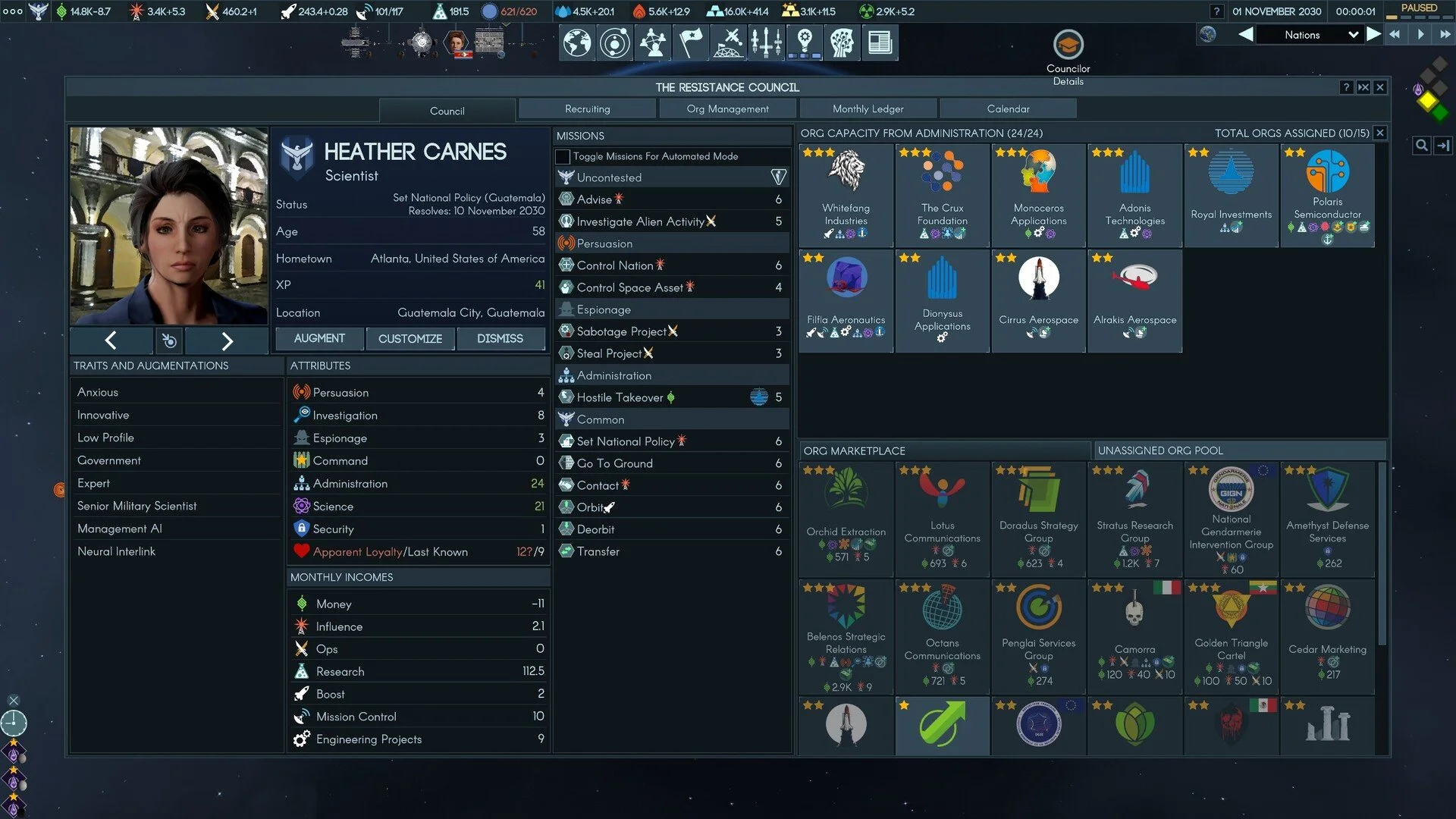
Dr. Heather Carnes, one of my original councilors, now runs a menagerie of science-focused organisations for the cause.
The experience of controlling a shadowy extra-governmental organisation (usually) opposing an alien threat is reminiscent of the XCOM games, and it comes as no surprise that Pavonis was founded by the team behind the expansive Long War mods for XCOM: Enemy Unknown and XCOM 2, which had Pavonis CEO Johnny Lumpkin at the helm. Your agents have a repertoire of available missions based on their archetype; a Scientist can investigate alien activity, while a Celebrity is skilled at rallying the public to your cause. Your rivals also have globetrotting agents pursuing their own aims. Investigating, detaining, and even assassinating them will prove crucial to your success — ideally before they do the same to you. However, no matter how badly you might cripple your rivals, you can never remove them from the board entirely, and they will continue to contest you. The same is also true of your faction — no matter how severe the setback, there is always a way to come back. And there will be setbacks, especially once the powerful aliens decide you are a threat that can no longer be ignored. The beauty of the comeback is a core philosophy that is shot through all of Terra Invicta’s systems. It strives to never let the player snowball out of control, and unlike many 4X and grand strategy games, it broadly succeeds in maintaining the tension of being perpetually on the ropes. Even when I think I’m ahead, I don’t feel secure. Just as it’s not possible to completely eliminate an enemy faction, it’s also not feasible to control all the nations of Earth, for going beyond your “control point” limit inflicts severe penalties. There are research paths and special buildings that increase this cap, and it’s essential to do so, but those come at the cost of neglecting equally essential pursuits. Therefore, instead of controlling the whole planet, you’ll more likely find yourself at the helm of a power bloc of nations, which hopefully includes some heavy hitters like the USA, China, or the European Union. Research paths for unifying the nations of the world into mega-nations tantalise veterans of grand strategy games like the original Victoria, which Lumpkin cites as a major influence.
Lumpkin studied game theory and international relations as a grad student, and prior to developing games was a journalist covering national security. His background shows in the attention paid to the profiles of the world’s nations. Every nation has figures for its GDP per capita, democratic index, domestic unrest, national cohesion, military readiness, and contributions to climate change. Though Terra Invicta has long felt feature-complete to me — I’ve been playing since 2022 — the largest addition with its 1.0 release is a 2026 start date to complement its original 2022 scenario, with nation values updated to better reflect the present day. Chief among these are the updated “boost” values for Russia, China, and the USA in particular, reflecting these nations’ ability to move mass to Earth’s orbit and beyond. When development began on Terra Invicta in 2017, the Russian-run Baikonur Cosmodrome in Kazakhstan was doing most of humanity’s heavy lifting (pun intended), but this has changed over the past decade as China and the US have ramped up their launch programs significantly. Because “boost” is a crucial early-game resource, this has made controlling Russia a less appealing strategy especially in the 2026 scenario, and only further increased the importance of China and the US in “optimal” strategies.
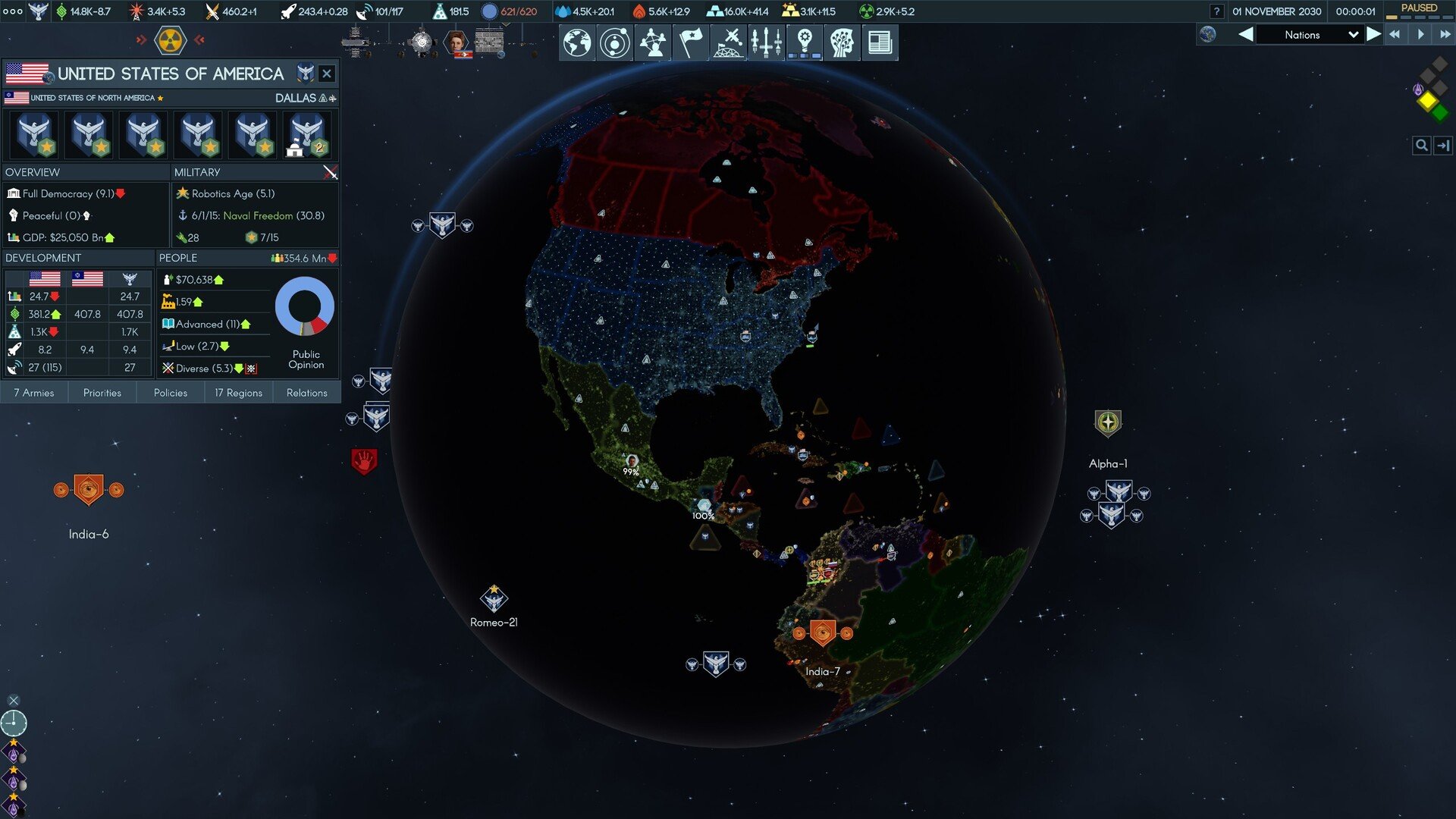
Under the influence of the Resistance, the USA looks very different than it does at the beginning of the game.
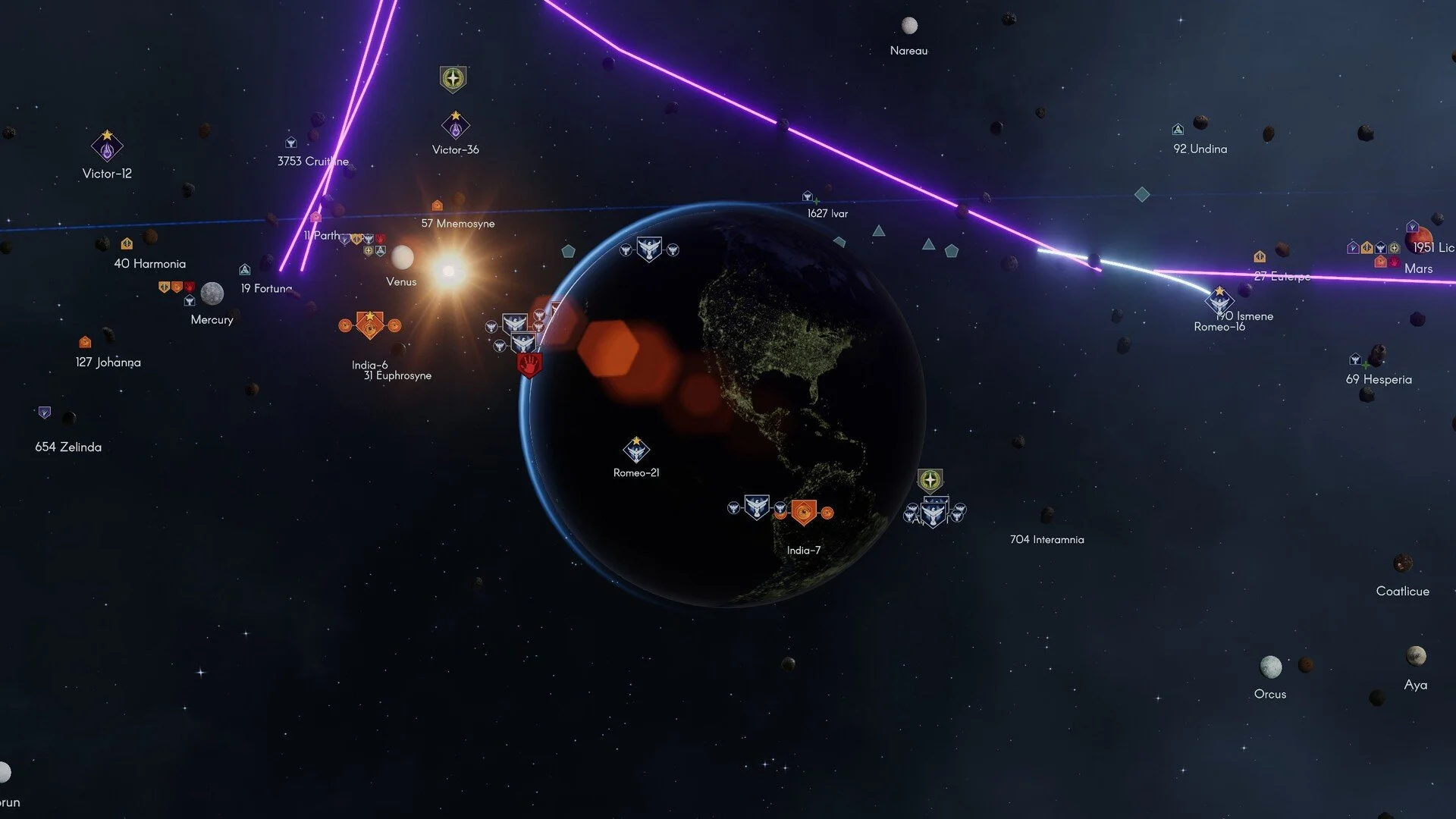
The experience of battling for influence over Earth’s nations would be a full game in its own right, but where the true scope of Terra Invicta’s ambition comes into focus is when you realise that you can seamlessly zoom out from Earth to view the entire Solar System all the way out to the Kuiper Belt, faithfully simulated with a Keplerian model. This isn’t just for show — you will need all the resources of the Solar System to succeed against the aliens, particularly to build spaceships armed with the weaponry necessary to combat the aliens’ own. Subsequently, you’ll enter a new space race with the same rival factions you must continue to battle on Earth, juggling your attention between your councilors’ terrestrial tasks and the construction of space stations and planetary habitats, first on the Moon and Mars, then outward throughout the Solar System. To win you must maintain the advantage in space, as your ultimate goal is to field a strong enough space navy to dislodge the aliens from the Solar System.
In space too, failure lurks at every turn, as does the promise of redemption. It is even possible to lose control of Earth entirely and have to wage a war from space to take it back. The expansive tech tree bristles with multitudinous options for spaceship drives, reactors, and weaponry to help you outmatch your enemies, but many players will learn the hard way that not every piece of tech is a worthwhile investment. The broad array of options has multiple sources of inspiration, such as Atomic Rocket, the boardgame Attack Vector: Tactical, and feedback from early access players who work in science and engineering. Some research paths are notorious “newbie traps” that consume valuable research time while providing subpar results compared to other parallel paths. This could either be a frustrating experience, especially when every choice feels critical, or immersive, since in the real world not every scientific pursuit is guaranteed to produce feasible results. I lean toward the latter — the many drive choices feel like set dressing to me, since I follow one of the many drive guides that dedicated players have assembled, effectively boiling down choices to one of a handful depending on the use case. Even then, there is no single “best” drive, because the ideal drives for long-distance travel suffer in orbital interception, and vice versa.
Spaceship drive selection is just one example of how Terra Invicta resists optimisation or, more specifically, resists the tipping point that comes from optimisation, where the AI can no longer meaningfully oppose the player. I have written about this moment in other grand strategy games, when the role playing aspect of these games drowns in the raw math of compounding gains, and every playthrough starts to feel like a world conquest run. Terra Invicta, on the other hand, has setbacks practically hardcoded in the form of the aliens’ “hate”. Efficient play requires that the aliens and their lackeys be resisted, but this builds their hate until they eventually attack. Opposing the aliens head on, then, must be managed strategically just like every other resource in the game, but you are guaranteed to suffer some losses. This is but one way in which Terra Invicta is constructed so as to foil the average optimiser who wants to run the perfect game and walk all over the AI.
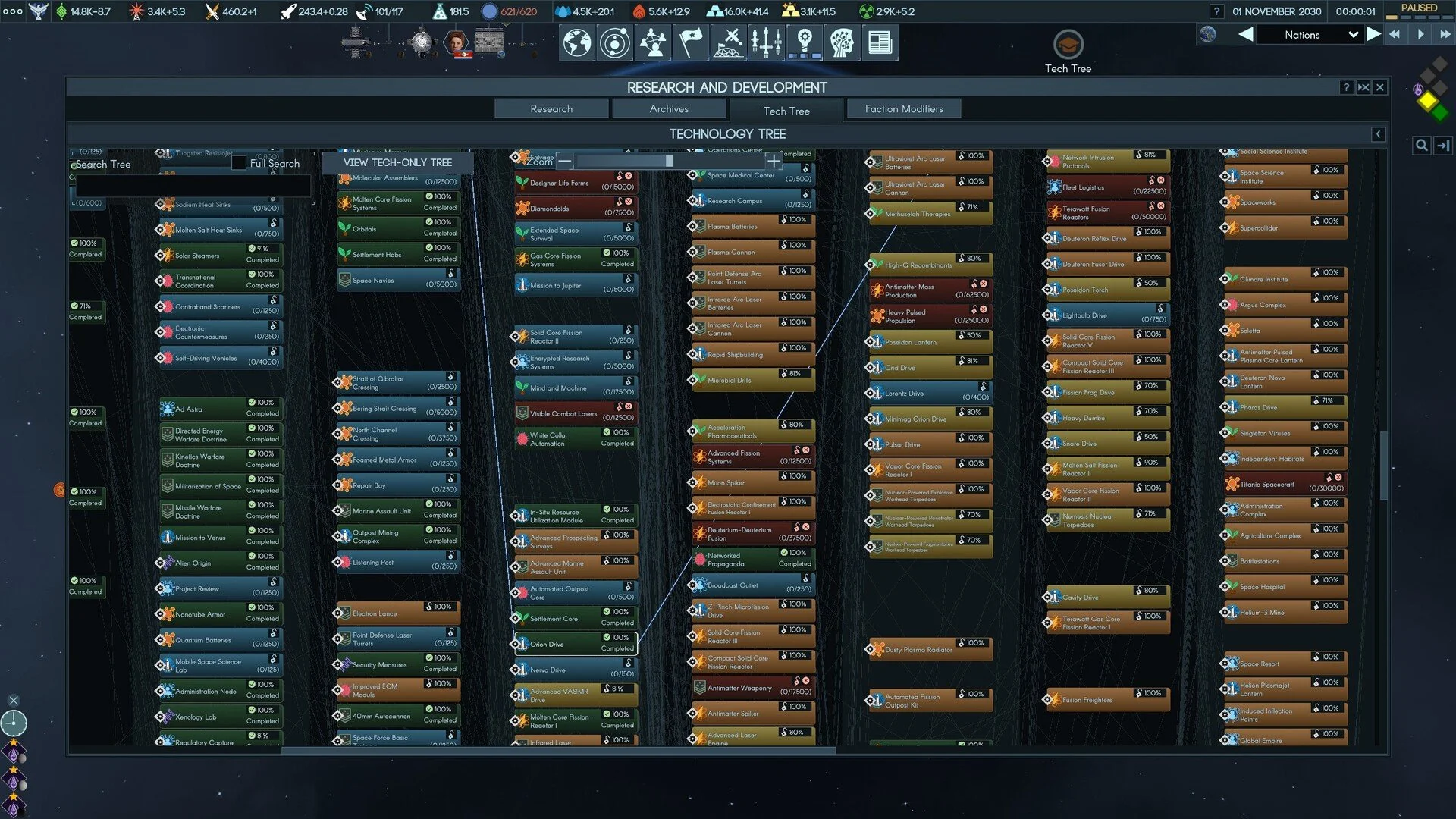
This is maybe a sixth of the tech tree.
The flip side is that Terra Invicta attracts a kind of super-optimiser, a real sicko, like an antibiotic-resistant superbug — for example, the player who published the GitHub repo they used to produce that drive guide I referenced earlier. Soon after the game entered early access, players discovered how to unify the entire Earth into one super-nation, obviating my earlier point about not being able to control the entire globe. This is no longer possible, but significant shenanigans are still achievable using national unifications that require a lot of work but make managing global control more viable. The effect on me as a player is that I feel the need to constantly check my decisions against others’ research to make sure that I’m making the “best” choice, like a lamprey on their hard-fought conclusions. This is just the kind of player I am, but it’s emphasised by how effectively Terra Invicta creates the tension of every decision mattering for humanity’s survival, since it does always feel like I’m surviving on the razor’s edge. As much as it sucks me into the game it also repels me, and I need to step away entirely for long breaks or risk burning out on decision fatigue. There are hours I’ve spent just analysing choices without progressing the game clock, and for this reason playing Terra Invicta is both enjoyable and torturous.
Reviews of Terra Invicta tend to use being wowed by the expansiveness of its ambitions as a hook. A lot of ink can be spilled just looking around in awe at this cathedral of game design. And yes, it is big, that is one of the Capital-T Things about it, but also it is not meaningfully more complex to play than the average Paradox grand strategy game for someone already initiated into the genre. Where it differs from one of Paradox’s modern iterations like Victoria 3 or Crusader Kings III is the balance of its systems. I find in a lot of grand strategy titles that one particular game mechanic can be exploited to trivialise the rest of the mechanics. For example, just generating a lot of money means you can buy whatever you need to win. Or, dramatically out-teching your opponents means you’ll always win a battle, regardless of your military’s size. In Terra Invicta this doesn’t really happen, because the systems are interlinked but not interdependent. Having the best councilors will help you win in space, but they can’t replace a competent space-industrialisation strategy. This makes every component of the game feel like it matters, which builds the tension underpinning every decision, and makes it feel huge in turn. I think this is sometimes what players and reviewers are reacting to when they describe how Terra Invicta feels overwhelming — it has been ascribed to to the game’s “enormity” — but it is actually that Lumpkin and the Pavonis team have flipped the traditional strategy formula, such that specialisation cannot be substituted for generalisation.
Therefore, more so than simply being ambitious, this is the kind of game that is going to develop a legacy for its successful execution of its ambitions. I spent a lot of time in my teens playing grand strategy games like Crusader Kings and Europa Universalis instead of doing my homework, and a lot of time in my early twenties reading after-action reports of those same games on forums instead of doing my job. The storytelling potential of these games is as engaging as the gameplay itself, and Terra Invicta has the same juice because of its compelling balance of disparate and asymmetrical components.
It’s 2029 and the aliens continue to orbit the Earth, their intentions incrementally more clear. North and South Korea have peacefully reunified under the United States of North America’s military umbrella. Humanity's first fission-powered spaceship is now a cloud of space debris clogging up low Earth orbit. I have been set back, but now I have something to persist through, to rebuild from, to make that ultimate victory all the sweeter.
Terra Invicta 1.0 was played on PC with a code provided by the publisher.