Not A Herd, An Ensemble: How Herdling’s Music Brought KM Nelson Closer To Her Calicorns
It’s time to run.
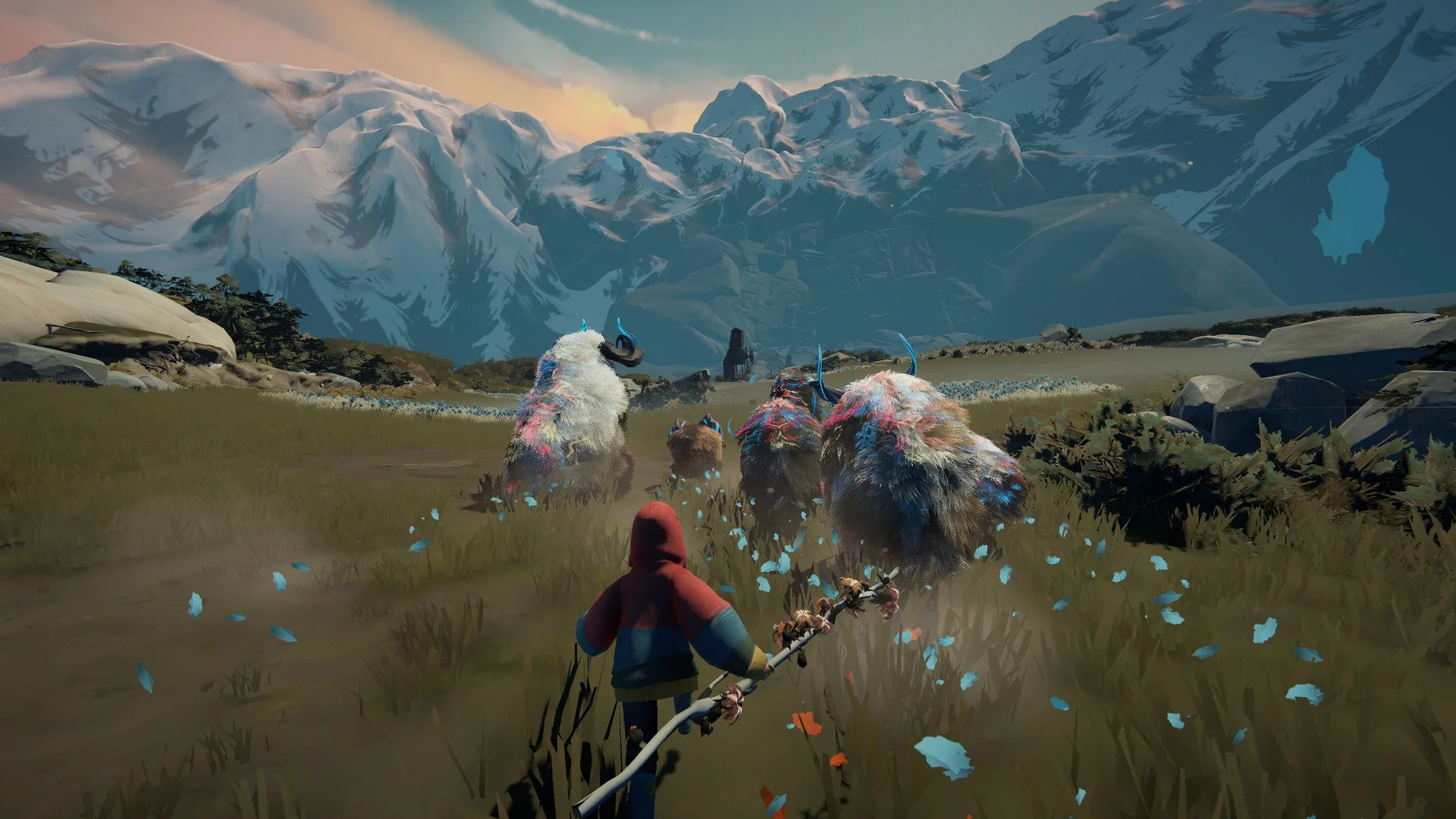
Your ragtag group of shaggy creatures shifts collectively into a gallop, with you sprinting at the rear. A polyrhythmic groove underpins your quickened steps, rollicking along much in the way of the loping strides of the horned beasts before you.
Joyously, you stampede across the countryside.
In Herdling, you navigate through various landscapes — a city, a forest, a mountain range, a glacier — guiding your growing group of animal companions, called Calicorns, with whistles and gestures. You, too, are guided: by the carefully placed fingers and controlled exhalations of an ensemble of musicians.
From its opening aubade — a woodwind chorus that heralds your dawn departure — the game’s soundtrack captivated me. There is a tangibility to the music, a tactile quality that belies the digital medium to which it is applied. The physicality of each instrument’s performance is enmeshed with the resulting melodies. As you amble behind your first Calicorn in the dingy alleyways of a city, your footsteps are echoed by the tapping of clarinet keys. The rhythm slid unnoticed among the overall ambience while I played, only becoming apparent to me when I listened to the music in isolation. However, whether or not you perceive it, that texture is there, taking pensive steps alongside you.
Herdling’s orchestration reinforces this sense of tangibility with instrument combinations that feel fresh to the ear while maintaining cohesion. Composer Joel Schoch eschews traditional symphonic instrumentation in favour of instruments sourced from a variety of musical traditions, whose timbres blend to create an impression of fullness and warmth. Featured instruments include the bassoon, clarinet, cello, duduk, hulusi, kamantsche, dulcitone, cabasa, qarqaba, and nail violin. Of particular note are the fujara, a large overtone flute used in Slovakian shepherd’s music, and the kantele, a Finnish box zither heard prominently in the game’s forest section. The score lacks a choral component: Herdling is not about human voices, but those of the animals.
On a video call with Schoch, I can see a variety of instruments hung on the wall. The kantele is too large to be mounted — this he retrieves to show me, demonstrating the various ways it can be played, inasmuch as the call’s automated noise-cancellation allows. He does the same with the hulusi and fujara. Schoch emphasises that his process is about taking action: he wants to “do the doing.” What this means in practice is that he gets his hands on as many instruments as possible in order to compose with them directly, rather than sitting at a piano or computer and conceptualizing the music. He performed many of the parts on Herdling’s soundtrack, but not all; collaborators including Philipp Hillebrand, Jo Flüeler, Federico Loy, and Sonja Ott are credited on Bandcamp.
This do-it-yourself attitude is not uncommon in the indie game sphere. By dint of low budgets and limited scope, game music composers often execute as much of the soundtracks as possible, whether that be via playing and recording the music themselves or relying on software tools. Yet, in contrast to the medium’s long history of electronic music — first by necessity, now for aesthetic — Schoch does not use any virtual instruments in Herdling.
His commitment to capturing real performances extends to the more otherworldly timbres on the soundtrack, though he does not avoid electronic audio processing entirely. In contrast to the expansive music of your herd, the game’s suspenseful sections are scored sparsely. As you attempt to avoid the ire of moon-faced predatory birds, tense scraping and discordant pizzicato are enough to set your teeth on edge. One subtle texture that does use electronic effects is heard as you reach the deep ice of the mountain peaks. In a method akin to prepared piano, Schoch lightly dampened the strings of his piano with UHU patafix deco, a putty designed for hanging décor on walls. He then routed the resulting audio recording through an Eowave Metallik Resonator, an amplifier that swaps out a speaker diaphragm for a gong, in a process called “re-amping”. The altered harmonics of the piano strings combined with the resonance of the metal gong result in a “deep rumbling” — the threat of impenetrable cold.
Herdling has one more surprise in store: a string orchestra. The ensemble was provided by Budapest Scoring, an organization that promotes accessibility of live recordings for smaller productions by offering “shared sessions” that can be booked in half-hour increments. Its inclusion pays dividends. In key moments, the music blooms with the fullness of the orchestra, enveloping you in its resonant embrace. You can feel that it was performed by human bodies working in tandem, the sounds of each individual instrument blending into a greater whole.
Much in the way that the musicians move collectively, your journey with the Calicorns is one of careful choreography. You direct the animals not with a conductor’s baton, but a shepherd’s staff, setting the pace and steering them away from danger. As you travel together, the soundtrack gives voice to your budding relationship.
The thing is, while you can pet your Calicorns with the flick of a button, you cannot feel their fur beneath your fingertips, nor their hot breath on your ear. Instead, you are touched by sound. The inhalations of the wind players, the friction of bows drawn across strings, the squeak of the piano damper: each adds a tactile element that contributes to the score’s overall texture, pulling you nearer even if you don’t notice the individual sounds. The music you hear helps cement your bond with these digital creatures, motivating you to protect your charges as you dodge bellicose carnivores and push through the howling winds of a blizzard.
Triumphant, you crest a final peak, snow giving way to meadow. You’re almost there. You can hear it now: your song. You and the woolly rapscallions you call your friends have not just formed a herd. You’re an ensemble.
You move with momentum, borne on the back of the melody. Bright sunlight sparkles on still water. There it is again, that buoyant theme. Do you sing along? Or are you out of breath as you gallop towards home?