Impressions | Demon Tides - The Horizon Calls Me
I’ve personally never quite fallen in love with Super Mario 64. Most of the time, I felt like I was fighting the camera and trying to adjust for the floaty feeling of controlling Mario. This put me off from 3D platformers for a while, believing they all would feel like I’m trying to run across a sheet of ice. It wasn’t until later — after playing more modern platformers — that I realised this genre isn’t quite as frustrating as I originally thought.
If you’re feeling nostalgic for a Nintendo 64–era 3D platformer but with modern quality-of-life features, you’re in luck! Demon Tides feels like the love letter of Super Mario 64’s traversal mechanics fused with Wind Waker to create a game filled with robust exploration, a charming crew, and rewarding challenges.
Demon Tides is the latest game developed by Fabraz, a studio that is known for platformers and currently making the upcoming Bubsy 4D. As a sequel to Fabraz’s Demon Turf, Demon Tides seeks to improve upon the platforming formula of its predecessor by adding a more expressive moveset and online speedrunning mechanics that allow you to race against players globally.
You play as Beebz, a young demon girl who used her transformations to become a platforming champion, defeating the demon king (in the previous game Demon Turf) and gaining an invite to the kingdom of Ragnar’s Rock. Signed at the end of the invitation is the name King Ragnar, who reveals himself (unbeknownst to her) to be Beebz's father. Determined to give her dad an earful for being absent from her life, Beebz and her crew make their way to the kingdom but find much of the land in disarray. The King has terrorised his citizens in his reign, and caused massive flooding that has submerged a majority of the cities in water. To distance himself from the people who wish to overthrow him, the King’s castle is built high above the ocean with no easy path to its front door. Beebz must now travel throughout the ocean, collecting Golden Gears that will aid in accessing the castle, and gain the attention of the King by defeating his Champions.
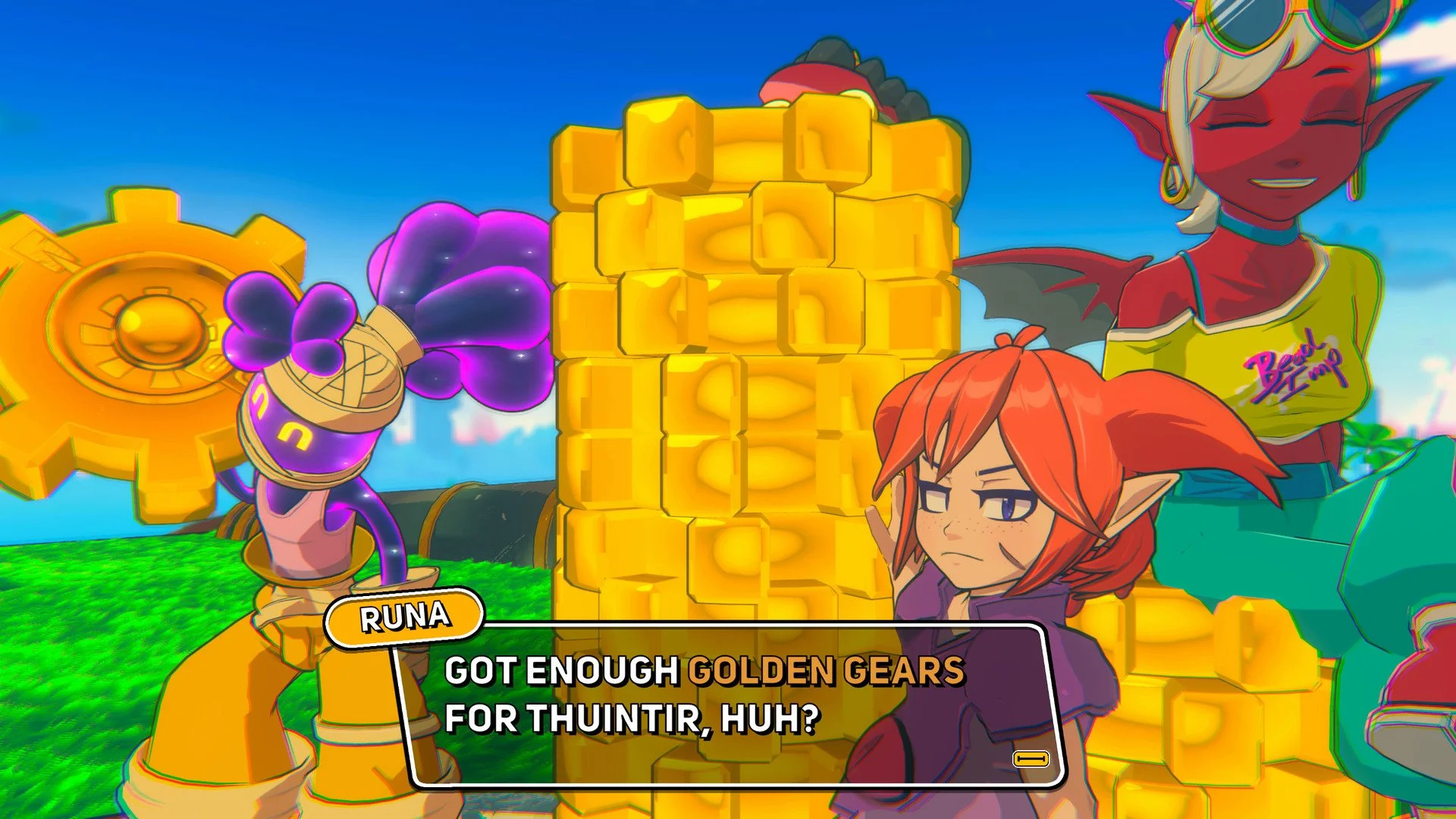
There is charm oozing from our main character, Beebz. The rest of the crew that join her travels are brimming with personality, too: Luci, an older sister-like figure who supports Beebz; Midgi, the engineer of the crew; DK, the hip one who can teleport anyone anywhere they need to go; and the Kappernian Captain, who is the pilot of the ship. Seeing the chemistry between everyone is refreshing in a game that knows how to balance the perfect amount of narrative before sending Beebz on her way to more adventures.
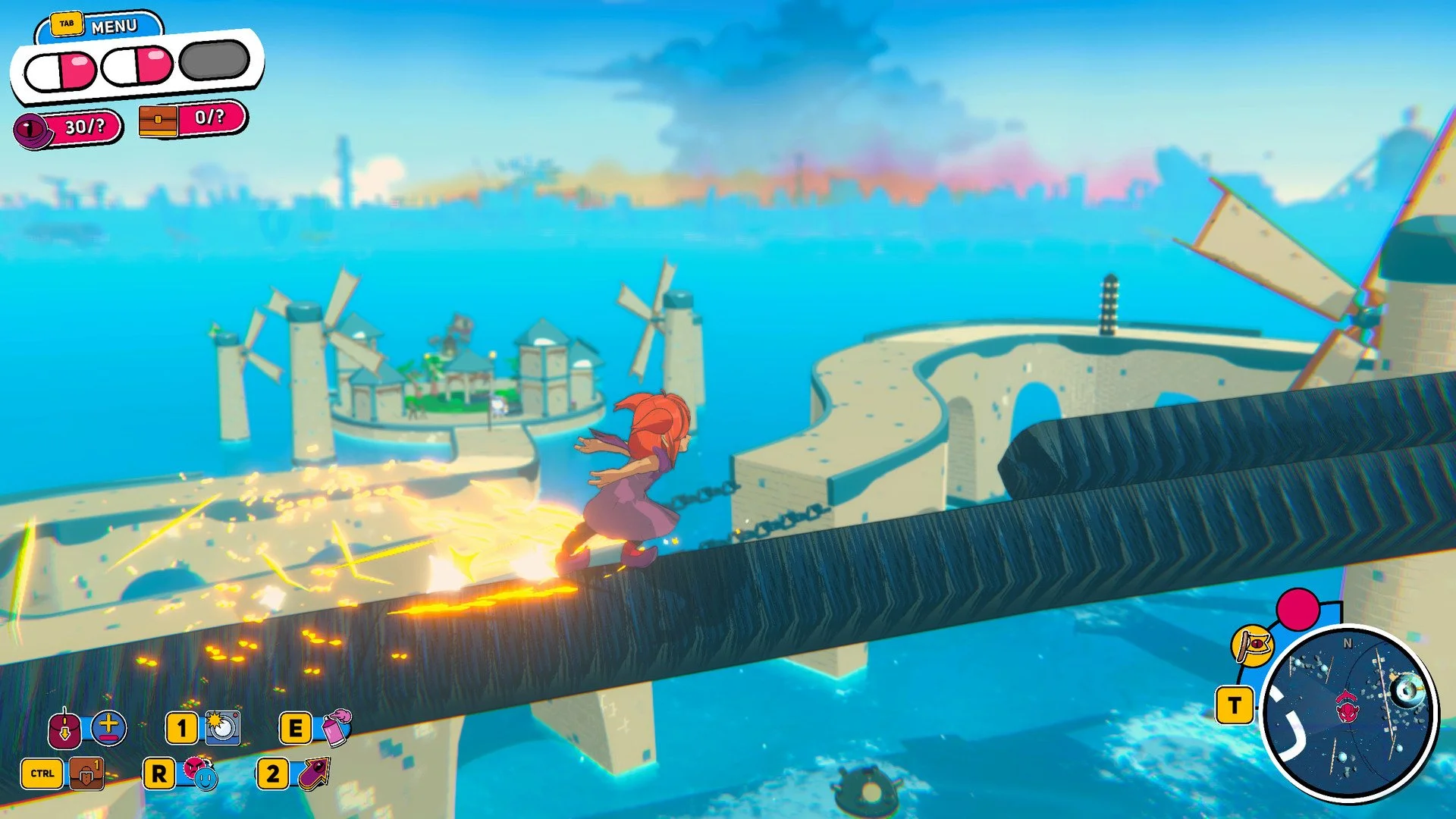
Demon Tides’ core gameplay loop consists of traveling to an island or small cluster of structures, finding all collectibles and opening treasure chests, and taking on the optional challenge race once everything else has been completed. The game also incorporates a large amount of vertical level design in its platforming challenges. Each island has platforms that circle large structures or simply float in the air, which are sprinkled with traps, lasers, spikes, or creatures that add some danger. If not avoided, these impediments will knock Beebz off course, sending her back down to the ground. Occasionally, the islands will look less like an off-shore drilling cluster and more like an actual island with sand, land, and towns. These islands feel a little more lively, hosting a variety of obstacles and platforms to jump through as opposed to the somewhat monotonous and dull pillar structures.
Each area also hosts dozens of eyetems, the game’s collectible currency. You can use eyetems to purchase talismans, which are equipment pieces that improve or slightly alter your moves. The first purchase I made allowed my spin drill — a move that carries my momentum and keeps me airborne for a few seconds — to raise me up, allowing me to gain some height before floating down.
Some talismans grant additional abilities that add to Beebz’s moveset. These talisman slots are limited, with two unlocked at the start and three more unlockable by beating the game’s bosses. For a talisman to alter a current ability — granting a speed boost or more horizontal movement of a jump — is acceptable to me, but I’m not the biggest fan of introducing a brand new ability and locking it behind an equipment slot. If I don’t equip the talisman that grants me a new ability, I feel like I’m missing out on a potentially useful move that will save me when I inevitably make another foolish button-pressing mistake. I often suffer from decision paralysis, so too many equipment or build options can mean I end up sticking with the same one throughout the whole game.
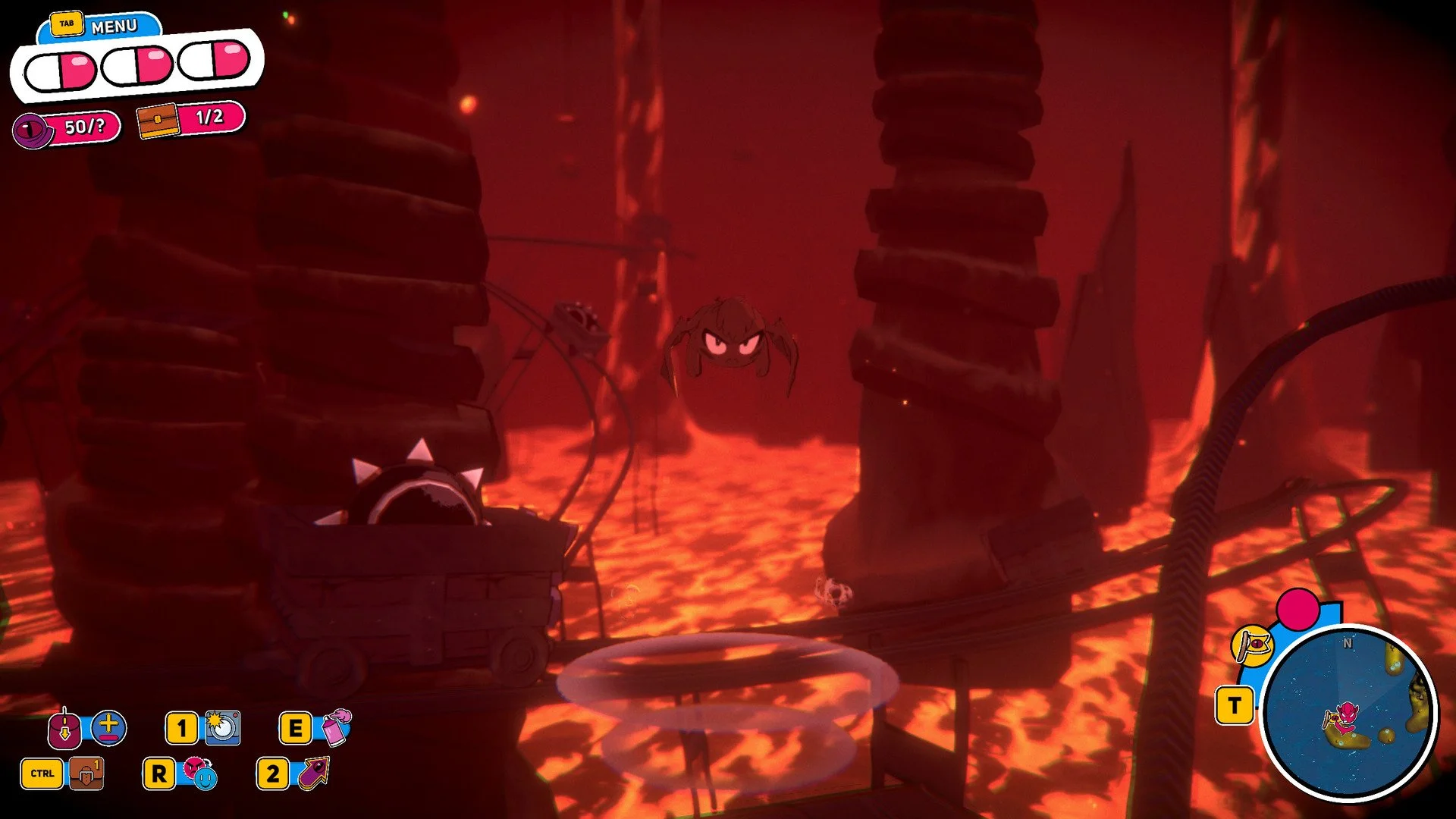
I was charmed by the different forms Beebz dons upon using any of her moves. The second you press a button to double jump, for example, Beebz temporarily transforms into an adorable cartoon bat-demon. Want to dash after your double jump? Congratulations, Beebz is now a white bat! How about gliding safely to another platform? Logically, Beebz turns into a drill-like creature that looks like a Pokémon. All of the forms are temporary, with most of them automatically transforming Beebz back into her normal human form upon landing. But not all moves, and forms, are built around jumping and dashing. There is also a traversal form that can be turned on and off via the left bumper (on controller). This transforms Beebz into an adorably stout snake, and grants her the ability to swim or run at a breakneck speed on both water and land.
The game’s expansive moveset allows Beebz to flow fluidly from platform to platform, chaining together the double jump, dash, glide, or combination of all of the above. Landing that perfect combo, nailing the button timing, and safely making it across a large gap provides me with a relief and satisfaction not found in many other games. But for every one time I pull off a particularly challenging jumping sequence, there are five additional moments of frustration.
Sometimes, it feels like there might be too many options between the combination moves. There is most certainly a learning curve in order to grow accustomed to the moveset. More often than not, I found myself panicking to recall where each move was mapped on my controller or the correct sequence in which to press the buttons. My most repeated mistake comes from trying to wall run up a structure that is slightly too tall. Beebz will run a few paces up the wall before stopping with her hand and sliding down. It’s in these moments in which I panic. Eager to reach the top, I press the wrong button and send Beebz leaping away from the wall, adding insult to injury by dashing the opposite direction.
While frustrating, Demon Tides has a mechanic to return you back to your highest point, as long as you remember to engage with it. If you hold down Y while on a stable surface, Beebz plants a flag to recall her back to that point. These flags can be planted pretty much anywhere as long as Beebz is on flat ground. Simply holding Up on the D-pad brings Beebz back to the flag, saving plenty of time and hassle from retreading your steps. Once I remembered this mechanic existed — which was after many accidental plunges — I found myself relying heavily on the checkpoint, planting a flag after every challenging jumping sequence. You are only allowed one checkpoint flag at a time, but I was more than okay with that tradeoff since I had little reason to return to a lower level.
Once Beebz has collected all eyetems and opened all treasure chests in the area, you can take on an optional challenge: Lokian Races! These are the timed challenge mode races with leaderboards that allow for competition and interactivity amongst all players of the game (who wish to engage with it).
The first challenge I attempted had another player on the leaderboard with a seemingly impossible completion time. Demon Tides allows you to see the “ghost” of the quickest runs, and watching that ghost soar through the water, spring up a pole, and jump from pillar to pillar told me all I needed to know in that moment: I have no hope of topping the leaderboards. I completed the challenge at my own pace (a modest six minutes to the top player’s thirty seconds), and decided to be on my way to the next island.
In addition to the timed-trial challenges, there are also Mr. Mint challenges. Dressed in a trench coat, fedora, and tape covering his mouth, he offers Beebz a new challenge for a “small” fee of one hundred eyetems. Upon handing over your hard-earned currency, you step through Mr. Mint’s teleporter and enter an alternate dimension that Mr. Mint presumably created solely for the purpose of providing Beebz with a trial.
These challenges, while not restricted by a timer, are far more unforgiving than their timed counterparts. In the Lokian Races, Beebz is still able to place checkpoint flags, effectively giving yourself a redo if you fall. With Mr. Mint’s challenges, any ill-timed jump that sends Beebz flying off the edge results in a failure state that returns you to the beginning of the trial.This resulted in many frustrating restarts as I absent-mindedly pressed the wrong button, hurling myself downwards towards the oceanic abyss instead of dashing safely to the next platform. After completing my first Mr. Mint challenge, I was rewarded with a treasure chest, thus checking off the final objective for my current island.
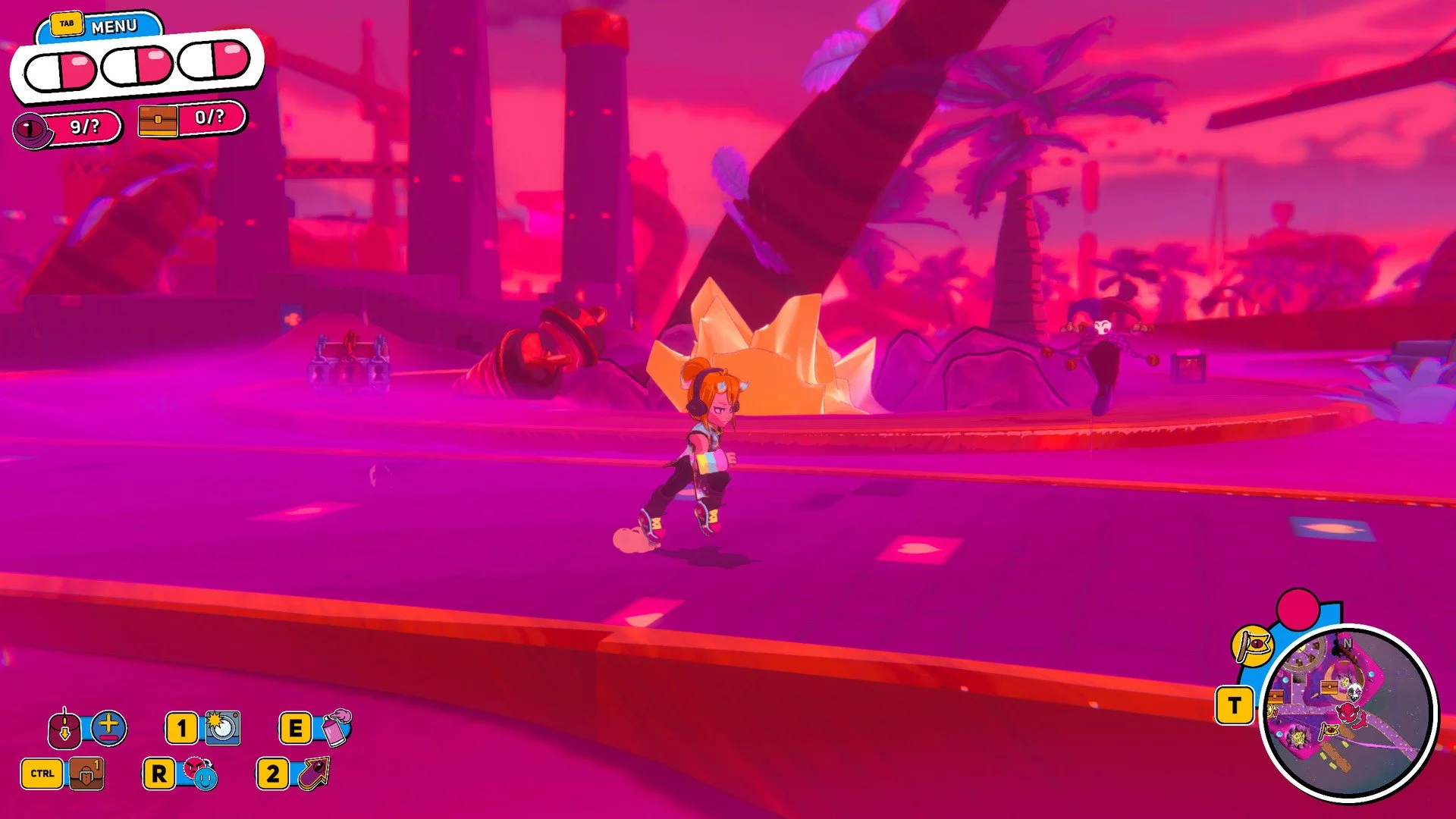
There is a certain allure to the atmosphere of Demon Tides. At first when I sailed from island to island, I found myself soaking in this world the team at Fabraz has developed. Maybe it’s something about the freedom of being out on the open ocean — seeing an outline in the distance and discovering a new area to explore. Or maybe it’s the tranquility of it all, where you find a bit of relaxation and excitement as you leave an island and embark towards your next destination. I really wanted this feeling and excitement to last because, despite how much I enjoyed this setting initially, I found the islands grating as I continued to play.
After the first couple of hours, I felt like I was no longer learning or experiencing anything novel. I hoped perhaps more abilities would be unlocked (other than through equipment), and that each island would have some unique factor that needed to be mastered to best all the challenges. Unfortunately, whenever I landed on a new island, it looked relatively similar to the rest of the areas I’ve previously explored but with a slightly different placement of the structures. My opinion quickly changed from enjoying obtaining that final checkmark and completing an island to feeling like a chore to grind for every last item. I would sail around until I found a new island, see more of the same in the design, then feel disinterested in landing. I tried circumventing this feeling by ignoring some islands, occasionally finding one that would hold my interest long enough to feel invested in completing it. It probably did not help that I started feeling eye strain and motion sickness after playing for longer than thirty minutes, something I rarely — if ever — feel while playing a video game. Thankfully, there are FOV sliders to help with the viewing angle, but it did not do much for the dizziness I felt while playing.
Demon Tides made a great first impression, one that still has me giving it multiple chances even though I’ve mostly set it down at this point. I acknowledge that die-hard fans of collectathon 3D platformers might love all of the slightly iterative level design offered in each island, but as someone who has only recently gained a newfound appreciation for the genre, I felt like I was a bit lost at sea.
Demon Tides was played on PC with a code provided by the publisher.
![[PATREON UNLOCK] Update Patch - February 2026](https://images.squarespace-cdn.com/content/v1/5caf2dea93a63238c9069ba4/1772562881770-ZXZN65X2NZXJBKI3HAZF/Update_Patch_0.jpg)