
Review | Horripilant - Chasing Riskless Reward
Horripilant is the debut game from Pas Game Studio’s Alexandre Declos, and it’s published by Black Lantern Collective — which has had a knack for scouting eclectic and quality indie horror games since early 2025. The game is dedicated to the project of reconciling two disparate experiences into one enticing and miraculously cohesive whole: the endless journey of an idler, where numbers will always go up and players are always (or never) satisfied, and a point-and-click horror game, where players are met with constant rewards and new goals to progress towards a definitive ending.
I identify with the group of players who pursue the latter game far more than the former, especially since swearing to never fall into the trappings of another idler after Adventure Capitalist, Tap Titans, and Universal Paperclips all consumed me in my teenage years. The experience I had with Horripilant did eventually satisfy my wants for it, once my expectations had been properly adjusted to what it was offering.
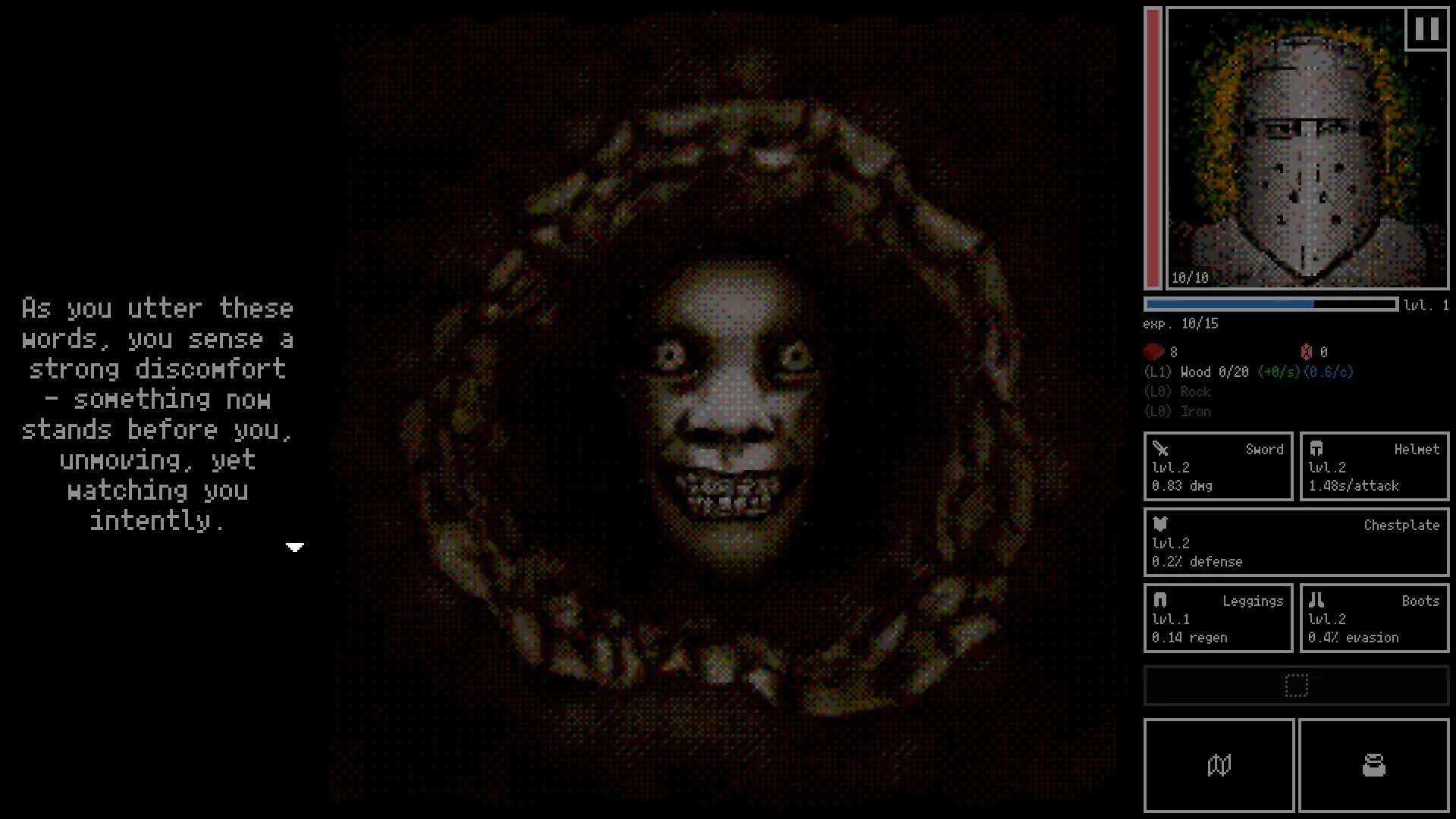
The game opens by dropping you, the player, into a dingy and creepy hole after a short and cryptic monologue from some kind of omnipotent being. The art style is alluring and, intentionally, barely legible, lending itself to an aesthetic that is decisively both engrossingly scary to look at and easy to ignore when doing other things with Horripilant playing itself idly in the background. Before entering combat or resource collecting, the tone is set and an end goal is given to the player: make sense of the world in order to escape your damp and dark corner of it.
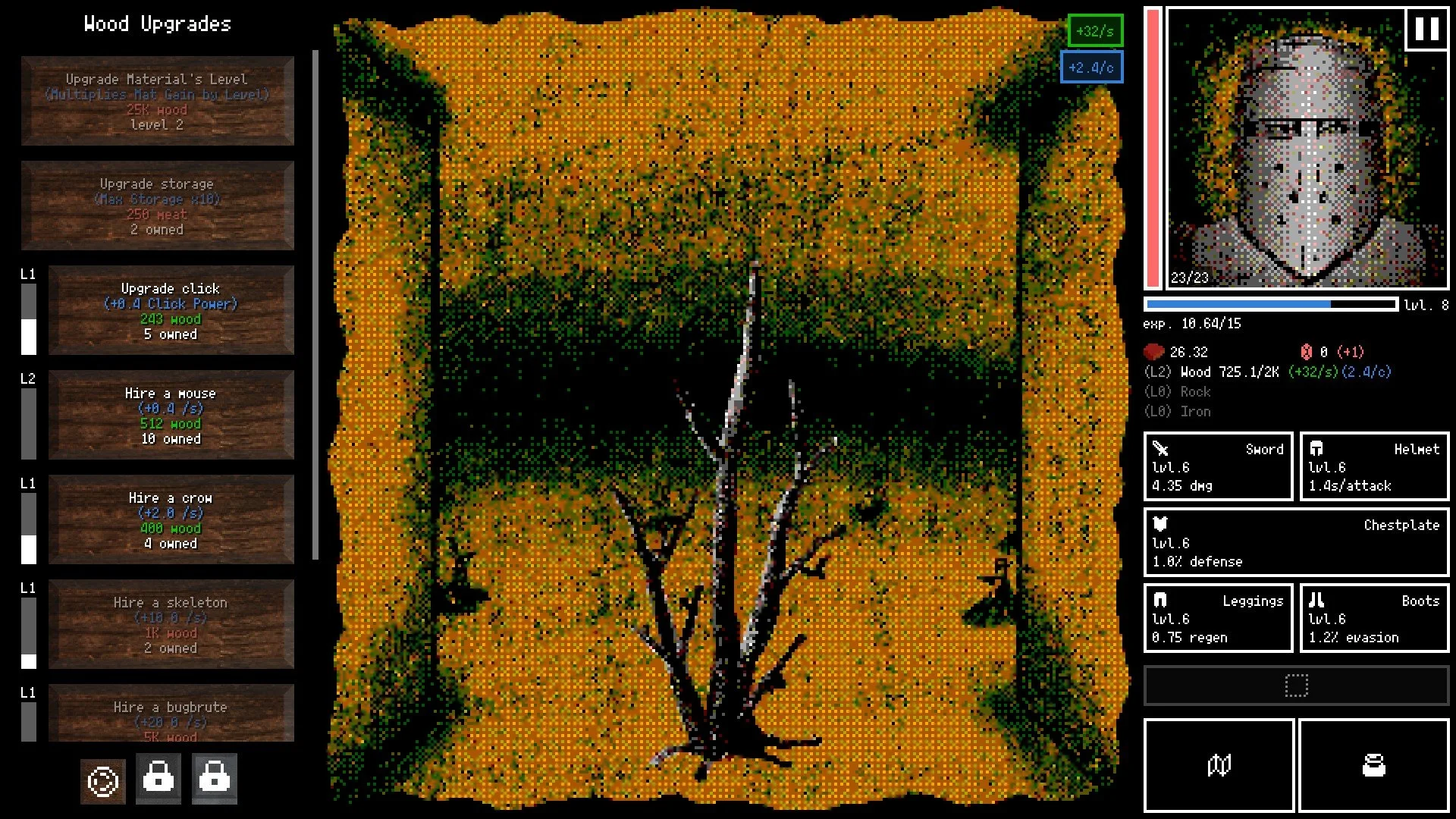
Three main gameplay components constitute your journey: almost completely idle resource collecting, mildly involved dungeon combat, and hands-on exploration through puzzle solving. Coming from someone who is predisposed against truly idle gameplay, the resource collection was the weakest part of the game for me, by a significant margin. Wood, stone, and iron are the key resources required to acquire near-permanent upgrades (health regen, defense, critical hit chance, etc…) that last until your character is ascended via reset. They are gathered by clicking on the corresponding resource nodes, or by spending these gathered resources on means of automatic, idle collection. When trying to beat Horripilant in a number of short, dedicated sessions, this creates an unwelcome barrier to progression, whereas leaving the game to itself after getting stuck and coming back hours or days later to a higher-level player character can be satisfying as an indirect way of increasing your mileage with the game that also spreads out a single playthrough. Whilst points do appear on screen that provide extra resources when clicked on, the process of waiting for numbers to go up on their own or mindlessly clicking the screen to obtain a competent character was the game’s most boring and least-involved aspect.
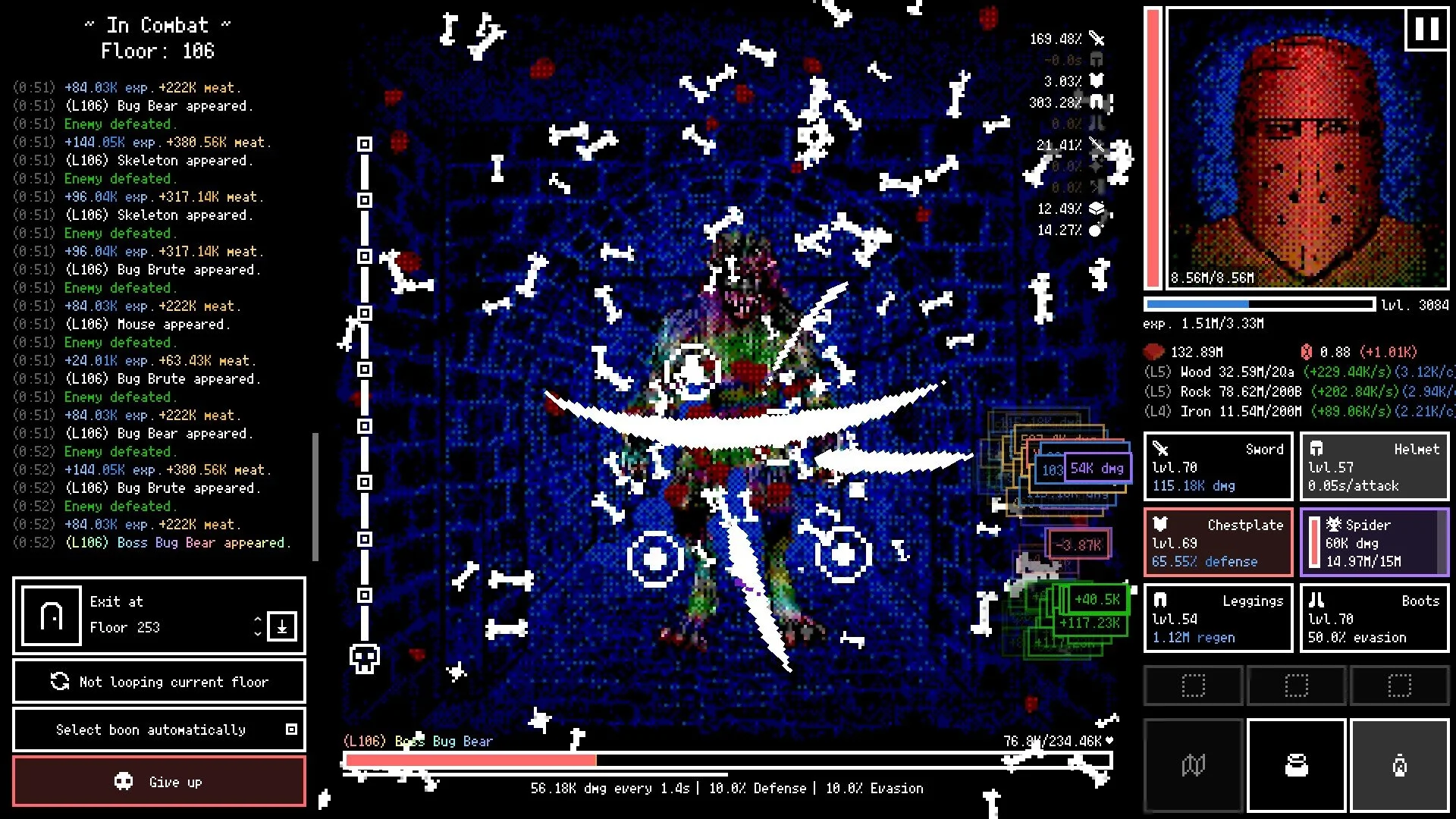
The dungeon combat is when the idly obtained upgrades are put to the test, and it’s where most of your time with the game open will be spent. The player character will attack a constant stream of single enemies on their own at an interval determined by your upgraded stats, and weak points will occasionally appear on the screen for you to click that deal extra damage. Every ten enemies, a boss will appear — who is just a normal enemy with more health, damage, and sometimes a faster attack rate — and beating said boss grants you a temporary stat upgrade that will last until you leave the dungeon or die down there. Each group of ten enemies corresponds with a single floor of the dungeon, and there are a thousand to clear before the game’s ending. Although Horripilant’s mood and near-monochrome aesthetic continue to look striking throughout, the selection of fantasy creatures felt generic (rats, skeletons, spiders, golems, etc…) and the combat did little to entice me throughout my time with the game.
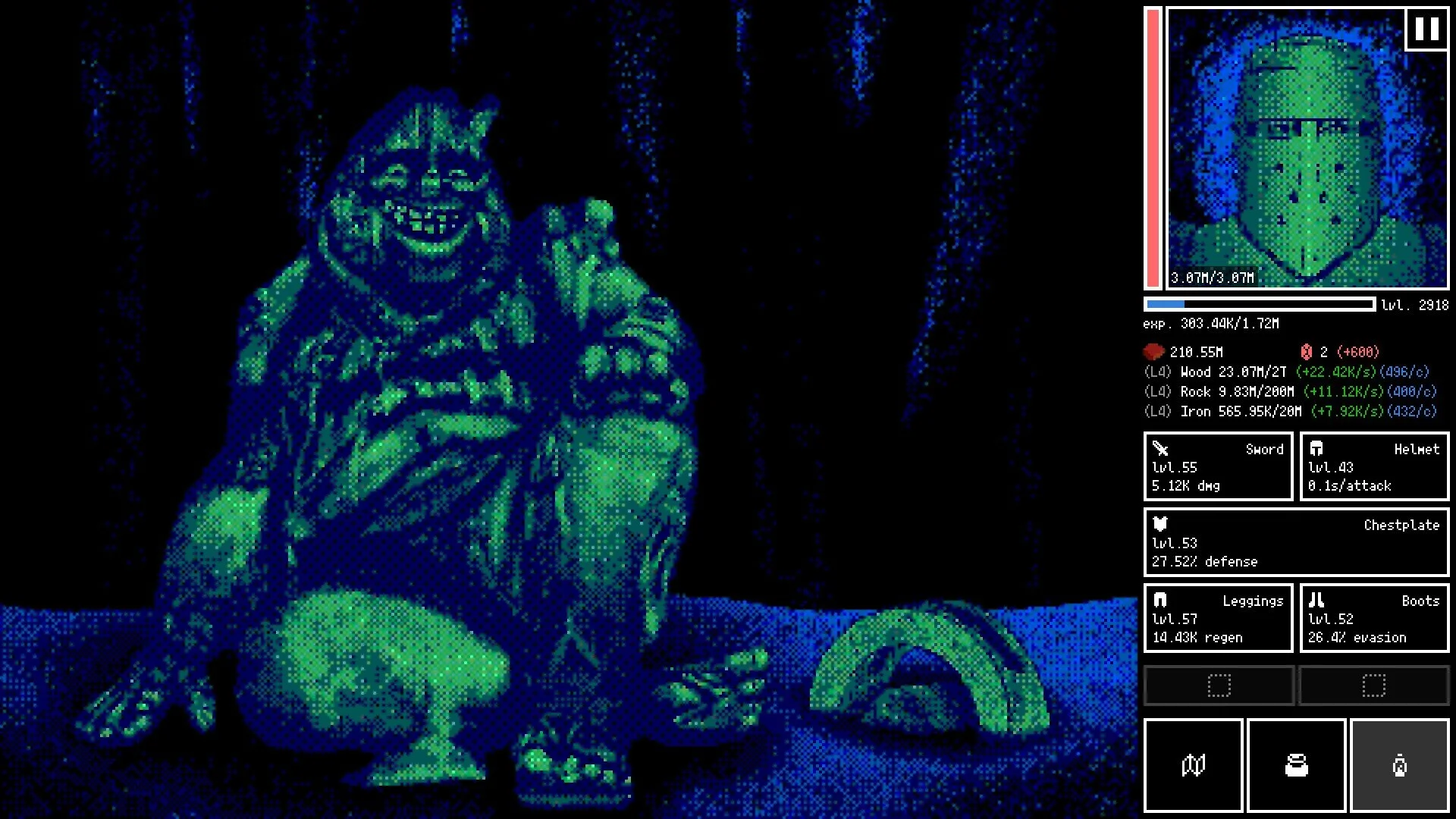
Returning from the dungeon with new items or hints in my in-game notebook left a different impression on me, and this part of Horripilant is why I remember it fondly despite most parts of the game feeling mind-numbing and repetitive. Instead of material rewards, most items and hints obtained lead you to new areas around the starting one. These locations often uncover more secrets and puzzles that either require more thought to solve or can only be approached later, and in each new area, an assortment of fascinating little freaks and cosmically terrifying entities lie — many of which pull somewhat obvious inspiration from Kentaro Miura’s Berserk. Horripilant hides its creativity here: behind hours of a traditional idle game, there's an engaging point and click adventure game with an original universe to uncover and intuitive puzzles to solve.
These moments are the ones through which the game became satisfying for me, as I’m not one to just enjoy numbers going up anymore. The times where the aesthetic justifies itself and is utilised in bizarre and horrifying ways, and, without spoiling too much, where the puzzle solving became abstract — almost reaching the highs of games like Void Stranger — are what make Horripilant worth recommending.
Some would argue that idle games can’t truly be games due their non-interactivity. The game beneath the not-game of Horripilant provided me with the reward I wanted as someone who doesn’t care much for the anticipation or the numbers. Whilst it would be an easy endorsement for someone who typically enjoys idle games, everyone else should know that for its low price of entry, Horripilant hides a few hours of an excellent puzzler and dungeon crawler beneath many more hours of not looking at the screen and simply getting on with your day.
Horripilant was played on PC with a code provided by the publisher.
![Review | Darkest Dungeon 2 - Smoother and Slicker, But With Less [Grim] Pizzazz](https://images.squarespace-cdn.com/content/v1/5caf2dea93a63238c9069ba4/1683728851782-N3TQF2SVZBNNHJ5T3EVK/Darkest+Dungeon+2+00.jpg)

