SGF Preview | Star Wars: Galactic Racer Is A Thrilling Racer That Under Promised And Over Delivered
You hear the loud roar of your landspeeder as you accelerate towards the crevice just barely large enough to fit your vehicle. Preparing to enter the narrow fissure, you lay off the acceleration, but just as you do, the hum of a speeder bike grows louder as your opponent closes the distance. Not wanting to give up the lead, you wait, patiently, for the bike to catch up. As soon as they pull alongside, you ram your landspeeder into their bike. The weight of your speeder overpowers the tiny frame of the bike, sending it directly into the mountain wall, causing a violent explosion paired with a slow-mo action-cam shot as you secure your lead in this race. Now this is podracing.
Well, okay, not quite yet, but we’ll get there.
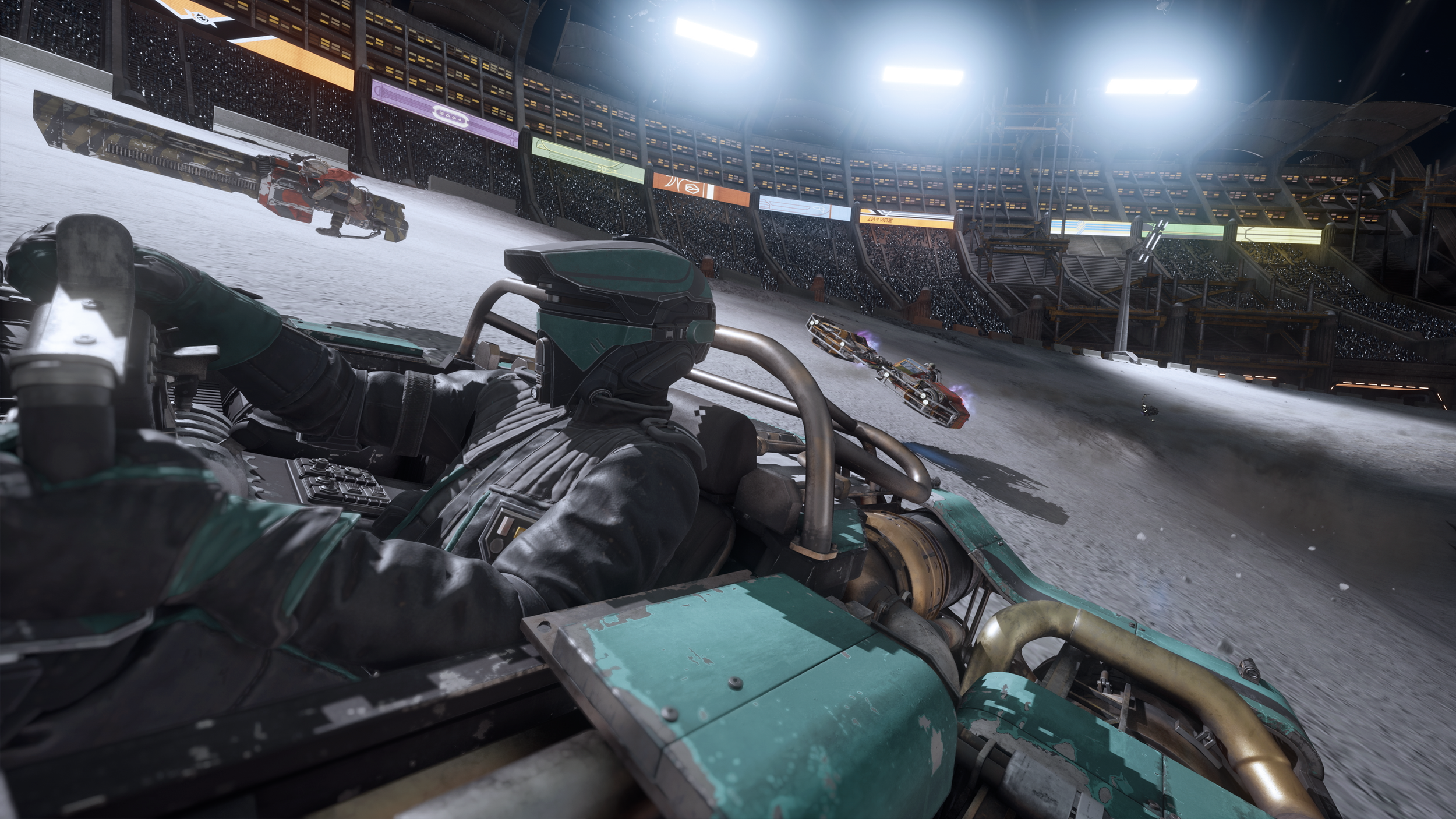
Star Wars: Galactic Racer, developed by Fuse Games and published by Secret Mode, was one of the best things I played at Summer Game Fest. I wanted it to feel fast, but I was not prepared for the exhilaration I felt during every race. The intensity of the speed barely allowed me time to think. The opponent racer’s behavior was perfectly tuned, often overtaking my lead and trying to shove me into an upcoming obstacle. The races felt deadly and exciting, as they should. But what I was not prepared for was for the game to have so much more than just racing.
What surprised me the most about this game is the in-depth narrative and run-based structure of the campaign mode. I was fully prepared to accept that Star Wars: Galactic Racer was simply an arcade-style racer with custom races and maybe a tournament mode. Instead, what I saw was the start of a fully fleshed-out story that pits our main character, Shade, against the galaxy’s most ruthless racers. The start of Shade’s story begins after the fall of the Empire on Jakku, a sandy planet filled with the remnants of the Empire’s final battle. Shade has entered the Galactic League, a racing tour that consists of an escalating series of events. He will stop at nothing to claim his destiny as champion.
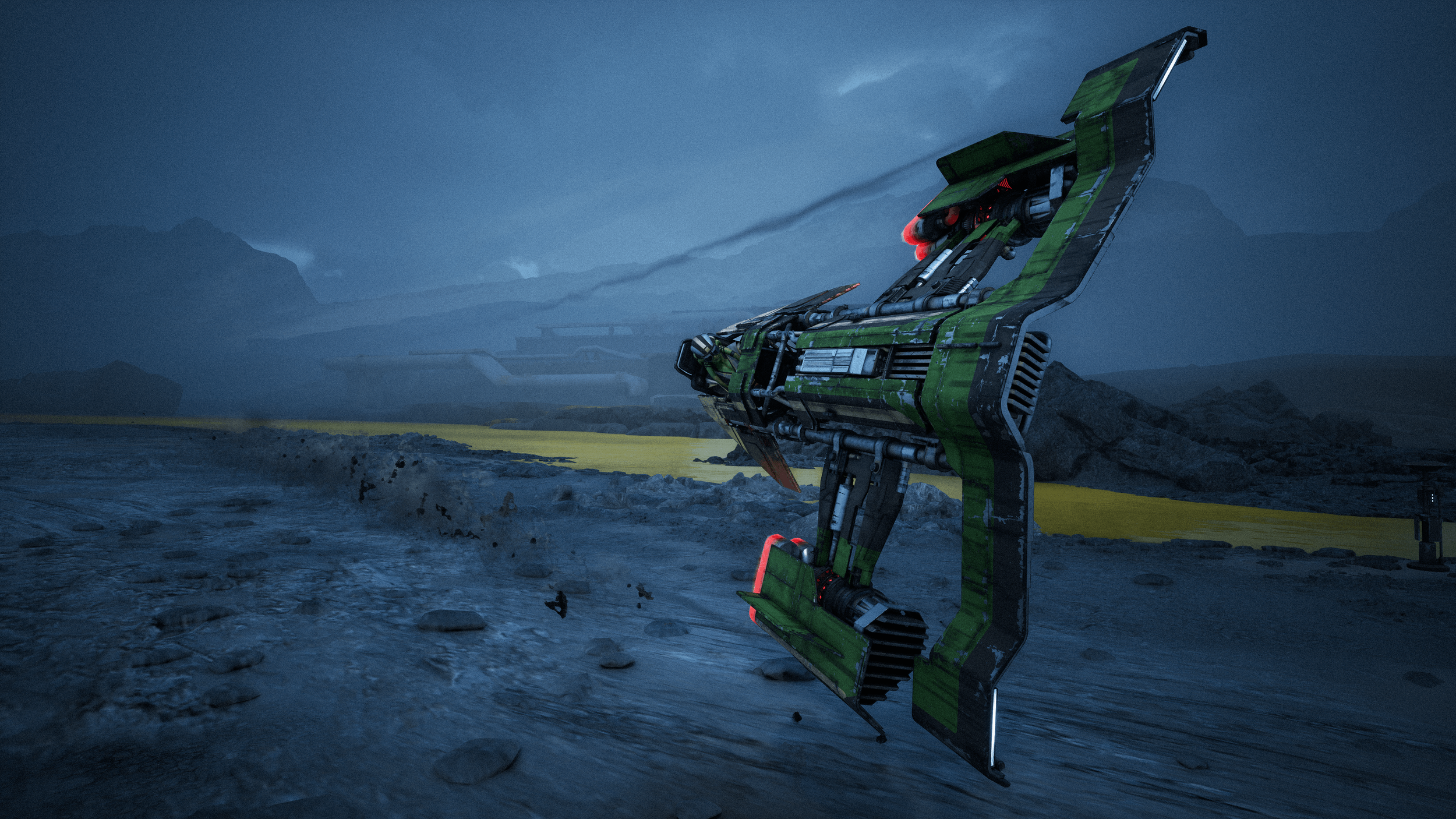
The preview started me off with a little taste of every vehicle type. First, I was given a classic land speeder, the perfect decent-at-everything vehicle to get the feel for racing mechanics and the structure of the races. I was plopped into the middle of a race, at the part of a course that showcased all the different turns, ramps, and paths that are featured in most tracks. Maybe a minute into this race, I was whisked away to a new track, this time riding a speeder bike.
The bike had a faster acceleration and handled the turns a bit more smoothly, but seemed to have a slower top speed. Once again, I was only given a moment with the bike before being placed into a new race with the third and final vehicle that’s in the preview campaign: the skim speeder. This new vehicle had more control during the turns, allowing you to drift on a knife-edge to maneuver around those sharper corners.
Once this montage of vehicles was over, I entered the paddock of Jakku, a temporary hub where you can chat with other racers, upgrade your vehicle, or purchase parts from travelling vendors. I immediately walked to my objective and was introduced to Darius Pax, the founder of the Galactic League and Shade’s sponsor for entry into the league. Darius seems to be a somewhat sleazy but good-intentioned mechanic and lover of racing, one who you don’t quite trust but has placed his faith (and coin) in Shade.
A racer needs a “League Entry Token” to compete in the Galactic League, and Darius has graciously given you his token — which can only be handed out by sponsors. If you don’t place within the top three of certain events or crash too many times, you will lose your token and must start the tour over.
The entire tour is broken down into three Acts, with each act consisting of events spread across a fixed order of different planets. The layout and types of events are randomised and change at the start of each new tour.
The tour is made up of various events: races, eliminators, field tests, and mystery encounters. Races are pretty self-explanatory. You race against seven other opponents in a closed circuit track, often consisting of three laps, and try to beat everyone else to the finish line. Eliminators reminded me of Mario Kart World’s knockout tour mode, in which you must stay ahead of a specific position once the timer reaches zero, otherwise you’re eliminated from the race. Field tests have specific goals you need to achieve during the course, such as “run two laps in under two and a half minutes”. I was unable to find a mystery encounter event on my path, but I am okay with leaving some more to discover when I play the game.
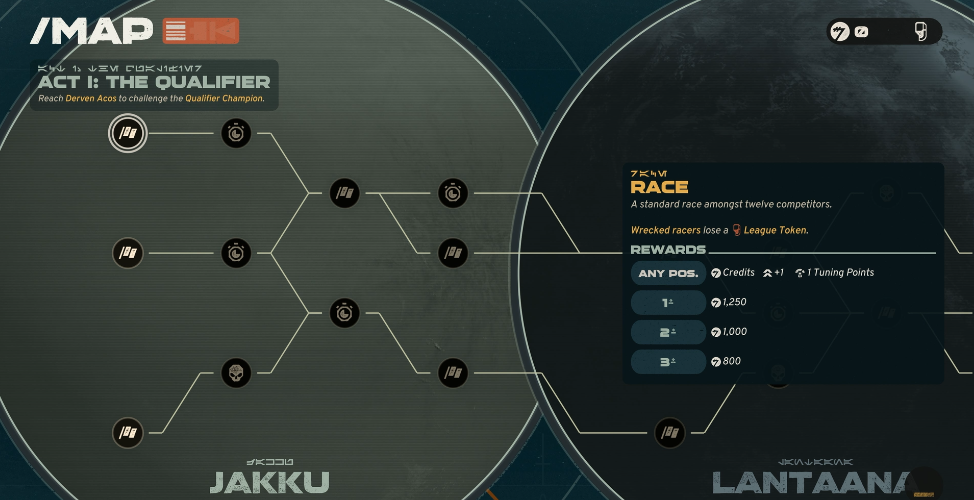
At the start of the tour, you choose an event on the branching path. If you win, you choose your next event, and are rewarded with resources and have the opportunity to modify your repulsorcraft — the general term used for the different types of speeders — with new parts, abilities, or visual customisations. If you lose, as mentioned above, you lose your Token, which is akin to a “life” in run-based roguelikes. Once that token is gone, you will have to start the tour over.
Fortunately, there is a form of meta progression via currencies that carry over between runs. These include: credits, tuning points (used to unlock new vehicles or upgrade base stats of vehicles), kit points (used to customise your vehicle’s appearance), racer styles (similar to RPG “classes”, these are traits and abilities that change your racing style), and favors (powerful effects that can be used during races).
I was not able to make it too far into the Galactic League (as I only had time for a single run), but I did earn quite a bit of resources and spent some time upgrading my speeder, knowing I would not be able to take it out for another tour. As I sunk the majority of my one-hour time slot into the campaign mode, with fifteen minutes left, I was suggested to exit the campaign and try the scenario mode. Now, it was time for podracing.
In the scenario game mode, you play through challenges or races that are suited for a specific character. I was told to select this mode if I wanted to try out the podracing (which was notably absent from the campaign section I saw, as apparently podracing is saved for the higher levels of the league). And what better way to try out podracing than by piloting as the legend himself: Sebulba.
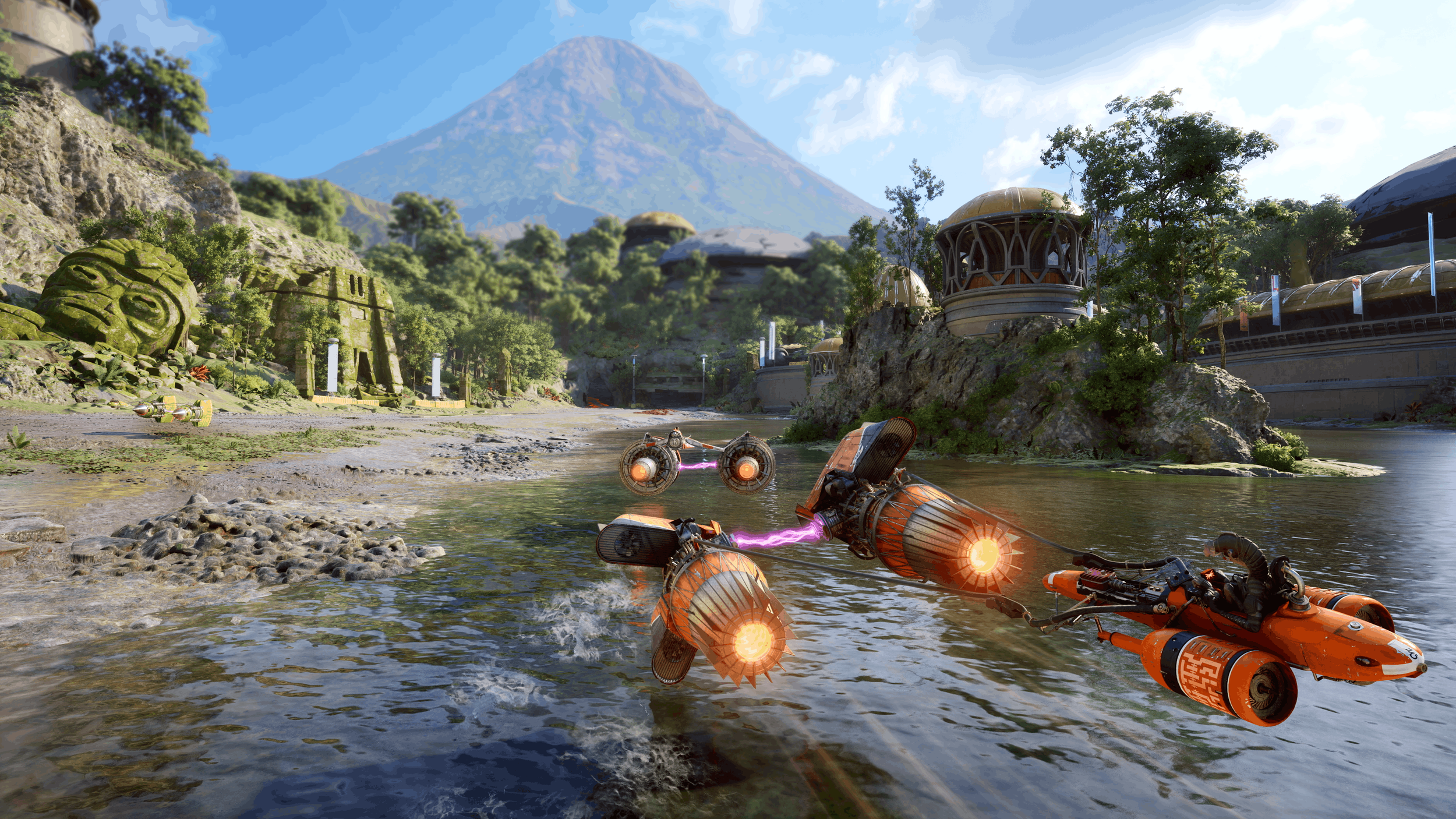
I was utterly unprepared for what I experienced while podracing. I thought the speed and impact of the previous repulsorcraft was already frenetic, but this felt like I was driving at warp speed. I was worried about controlling the craft if I dared go full-throttle, and my concerns were justified as I crashed at nearly every tight corner. And yet, I could not get enough of this breakneck pace. The thrill of accelerating and causing everything around you to become a blur. The rush of narrowly dodging a pillar that seemingly appeared out of nowhere. I was becoming addicted to the chaos. The short cinematic that plays every time you (or your opponent) crash was a beautiful touch that was reminiscent of the action-shot cinematics commonly found in Burnout. I kept pushing on, listening to the podracer’s engine chug as I used my boosters during the straight-aways.
I finished that race in sixth place, but I truly could not care less at that point. I was ecstatic to be podracing. I’ve been a Star Wars fan for a long time, and I did not realise how much I needed this experience. Star Wars: Galactic Racer is the game I cannot stop thinking about from SGF.
Star Wars: Galactic Racer releases on October 6, 2026, on Steam, PlayStation 5, and Xbox Series X and S.