Review | Perfect Tides: Station to Station - Just Enjoy the Ride
What is the value of a sunset? Is it more than just the collection of colours that denotes the end of the day? Some might say they just like the look of it, but I can’t help but feel there’s more to it. For me, its worth is derived from our shared experiences — the way the world shifts before our eyes, changing the familiar and mundane into something new. In this sense, Perfect Tides: Station to Station serves a similar purpose to both the first game Perfect Tides, and to my own experiences; it’s a magnificent display that amplifies and alters the ways in which we see what came before.
While the first game was a punchy coming-of-age story, Perfect Tides: Station to Station is a game about coming to terms with the realities of adulthood. It showcases the transition from the adolescent yearning for more to the adult realization that "more" is often messy, exhausting, and complicated. It tells us that it’s okay to not be okay.
As a point-and-click adventure game, Perfect Tides: Station to Station offers ample opportunity for examination and exploration of the small spaces it takes place in. Essentially everything you see on screen can be inspected in some fashion. Though most objects and people don’t confer any benefit upon examination, it is both worthwhile and interesting to do so as they offer a glimpse into the player character Mara Whitefish’s psyche. Unfortunately, there’s no way to quickly skip text you’ve already read, so being thorough sometimes sees you re-reading the same descriptive text if you accidentally click the same object twice or happen upon an item that shares a description with another element onscreen.
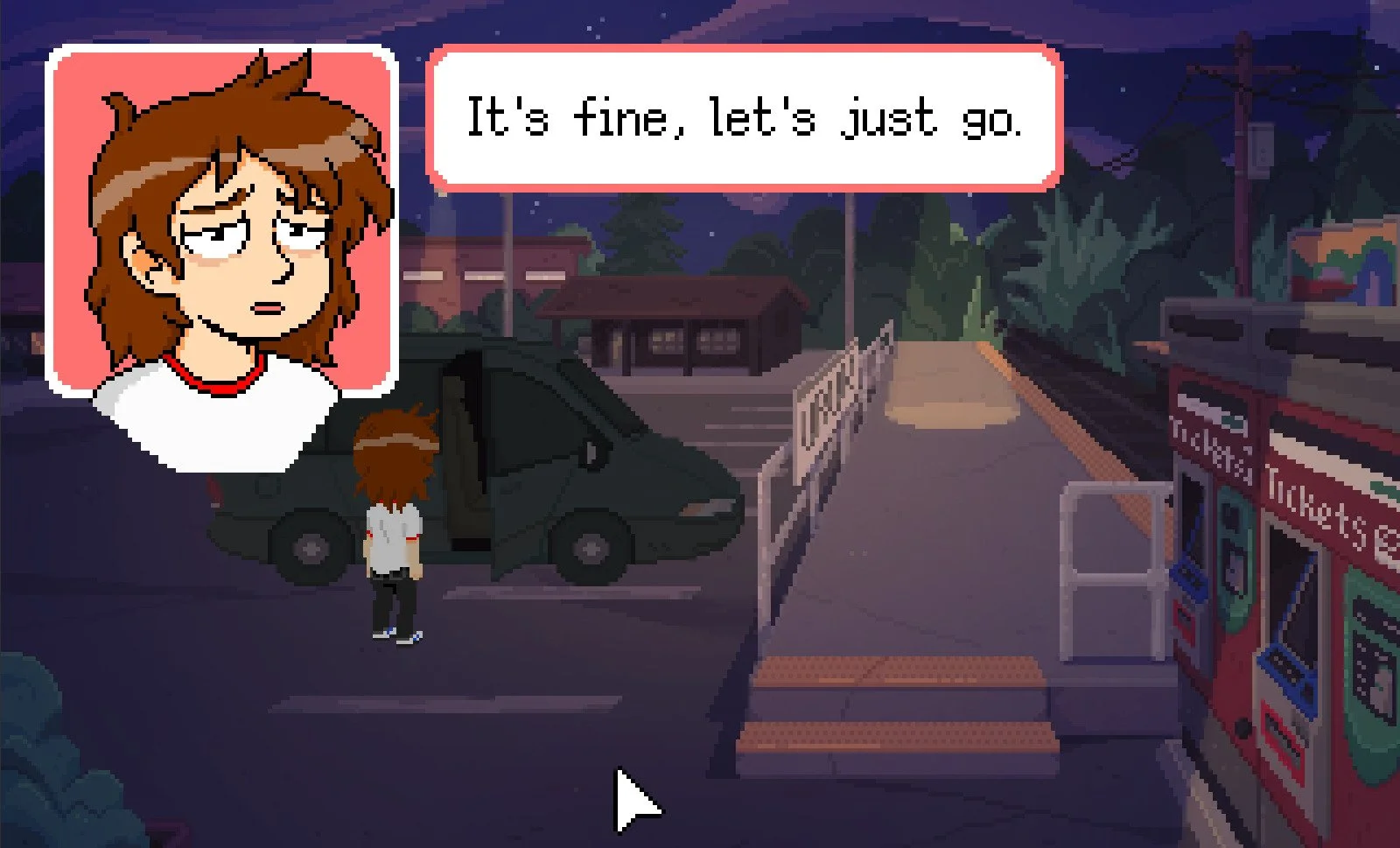
The game maintains the beautiful pixel art aesthetic of its predecessor, though it notably lacks resolution and display settings, preventing players from fitting the window to their monitor’s specifications, or even putting the game into fullscreen. It also lacks accessibility options; even something like object highlighting or colourblind settings would go a long way for visibility, though this is understandably a big ask for a small game.
That being said, the animation work is evocative, full of intimate details that give the people and places of the city personality, and uses shifting perspectives to communicate feeling, tone, and messaging in any given scene. The music and sound design are also used to great effect in similar ways, such as the noise of a printer having a specific cadence that anyone above a certain age will recognise, or exciting moments being punctuated with high-energy, garage rock-esque tunes.
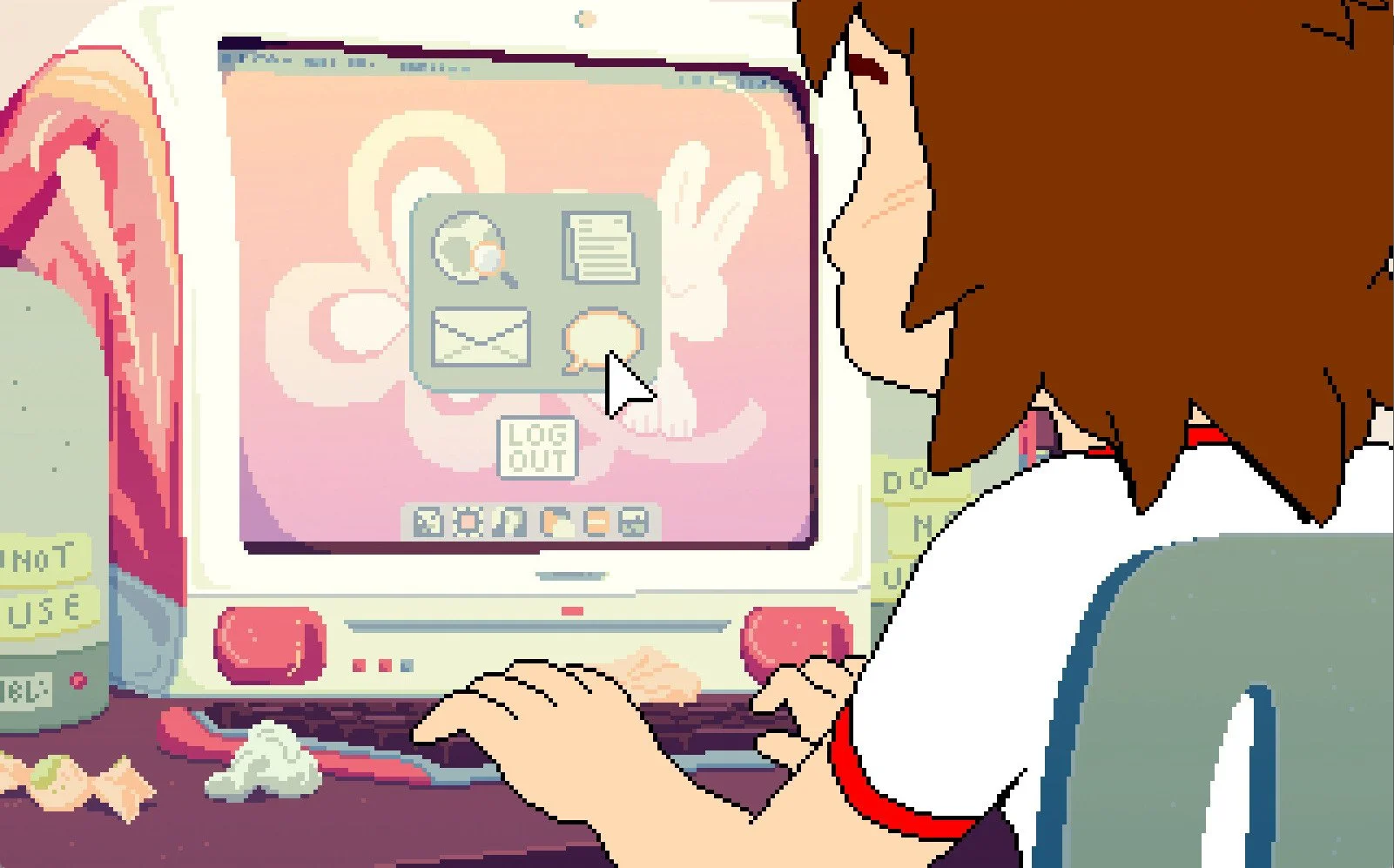
Among the more charming aspects of Station to Station is how it forces you to inhabit Mara’s space. Simple tasks like sitting at a computer require the player to click individual icons, and navigate the desktop themselves. This approach to point-and-click mechanics makes the moment-to-moment gameplay much more interesting and engaging than it would have been had there simply been a list of choices to make upon clicking the PC.
Allowing the player to interface directly with the objects in the world leaves room for player agency. Even when your actions aren't consequential, something as simple as being able to do web searches for “drugs” and “sex” and seeing Mara’s reactions to them is endearing.
As the game starts in the first few weeks of April 2003, Perfect Tides: Station to Station works as a peek into a specific moment in time for “The City” (New York) and America itself. Signage for Phone Booth and Anger Management shows up on the marquee of the theatre, people make note of the release of the iTunes MP3 marketplace, and the spectre of the September 11th terrorist attack looms large over the city and its people. Mara herself is a student at State University of Creative Studies (SUCS for short), striving to navigate her daily life as a student and a writer as she tries to make headway in finding and cultivating love.
That said, Mara is a mess. Her room looks like the aftermath of a storm, with trash and clothes strewn about, and boxes littering the floor. She is unkempt and disorganised, trying to keep her head above water in a creative environment that demands a self-assuredness she simply doesn’t possess.
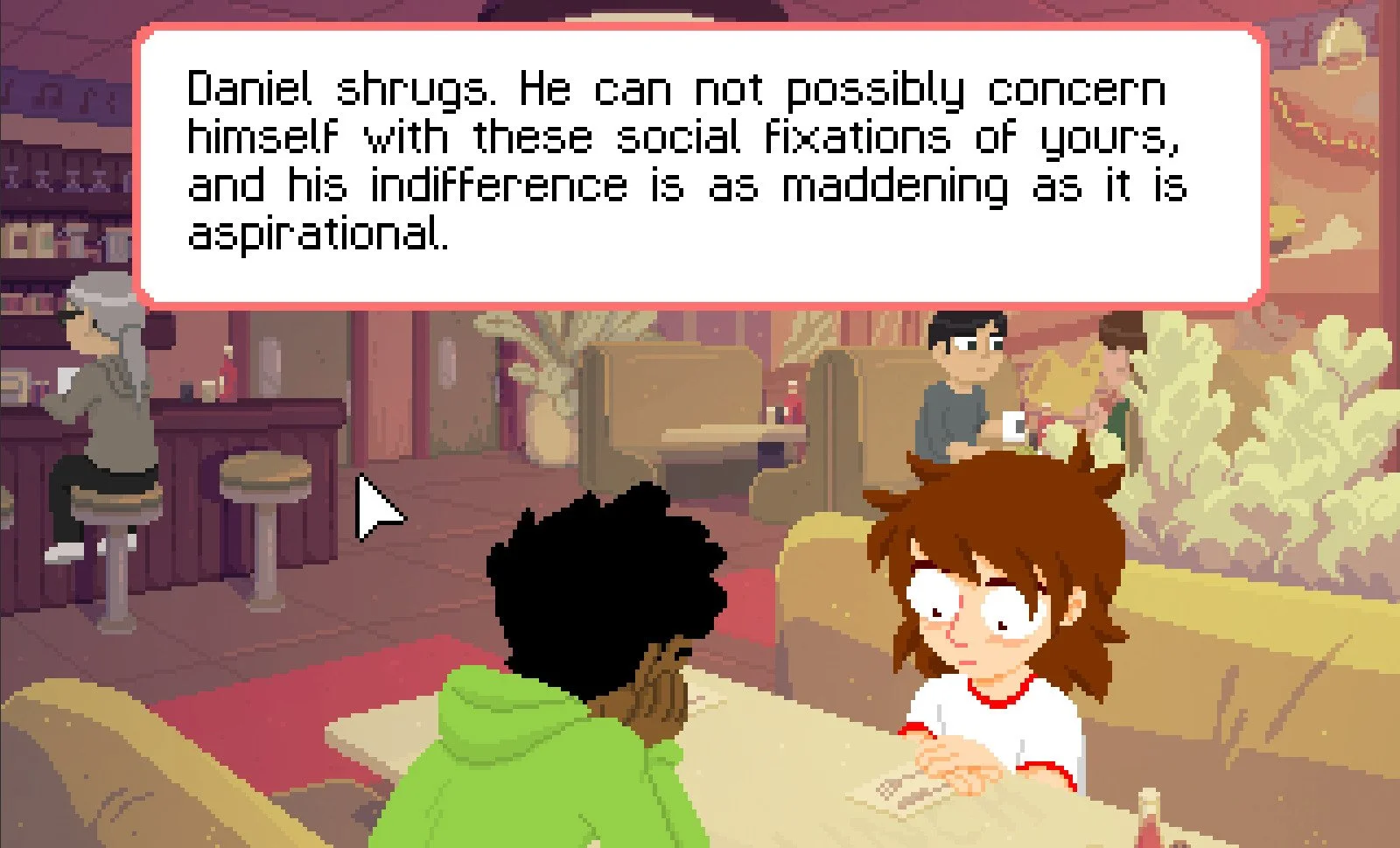
While the entirety of Station to Station is exceptionally well-written, Mara’s persistent self-doubt is particularly painful to witness. When contrasted with the confidence of characters like Daniel, her insecurity becomes a black hole, sucking the air — and joy — out of the room. Station to Station captures the specific agony of the creative struggle, and examines the fear that putting yourself on the line will only result in failure or, perhaps worse, marginal success that no one notices.
Nothing illustrates Mara’s fragile state more than her relationship with Adam. From the jump, Adam is particularly off-putting. For anyone who has ever been in a long-distance relationship, his attitude and particular method of communicating may be familiar, as he frequently notes how different things would be if he and Mara were in close proximity. He is consistently controlling and manipulative, giving off a palpable sense of toxicity, using coercive language to force Mara to abide by his schedule and needs at all times despite never seeing her in-person.
Early on, Mara contemplates dropping out of school to live with Adam, imagining a life where she writes from home while he works — at his behest, of course. This is a textbook setup for financial abuse, and he is exactly the kind of person who would hold that power over her indefinitely. Watching her bend over backwards to cater to him is painful.
Though I wish I could say that I have made no such mistakes, I too was like Mara. Eager to please, so willing to jump headlong into a relationship hoping that the other person would give me everything I needed so that I may feel whole. But it never comes. It’s not possible for someone else to complete you in this way, especially when you aren’t certain what is missing.
Station to Station’s treatment of grief is also devastatingly accurate. Mara lost her father several years prior to the events of the game, but the way grief comes in spurts is captured well. Most of the time, you don’t think about the loss at all, but then a small reminder tears open the wound:
“But sometimes living feels like leaving you behind.”
This line from Mara captures the guilt of moving on — the fear that by continuing to exist, you are somehow forgetting the people you’ve lost, as though they never mattered at all. A beautiful piano scene featuring Mara’s mother and grandmother playing a song and singing along, respectively, serves as the anchor for this theme, reminding the player that while the pain of loss is hard to comprehend, it is also a testament to the love that preceded it.
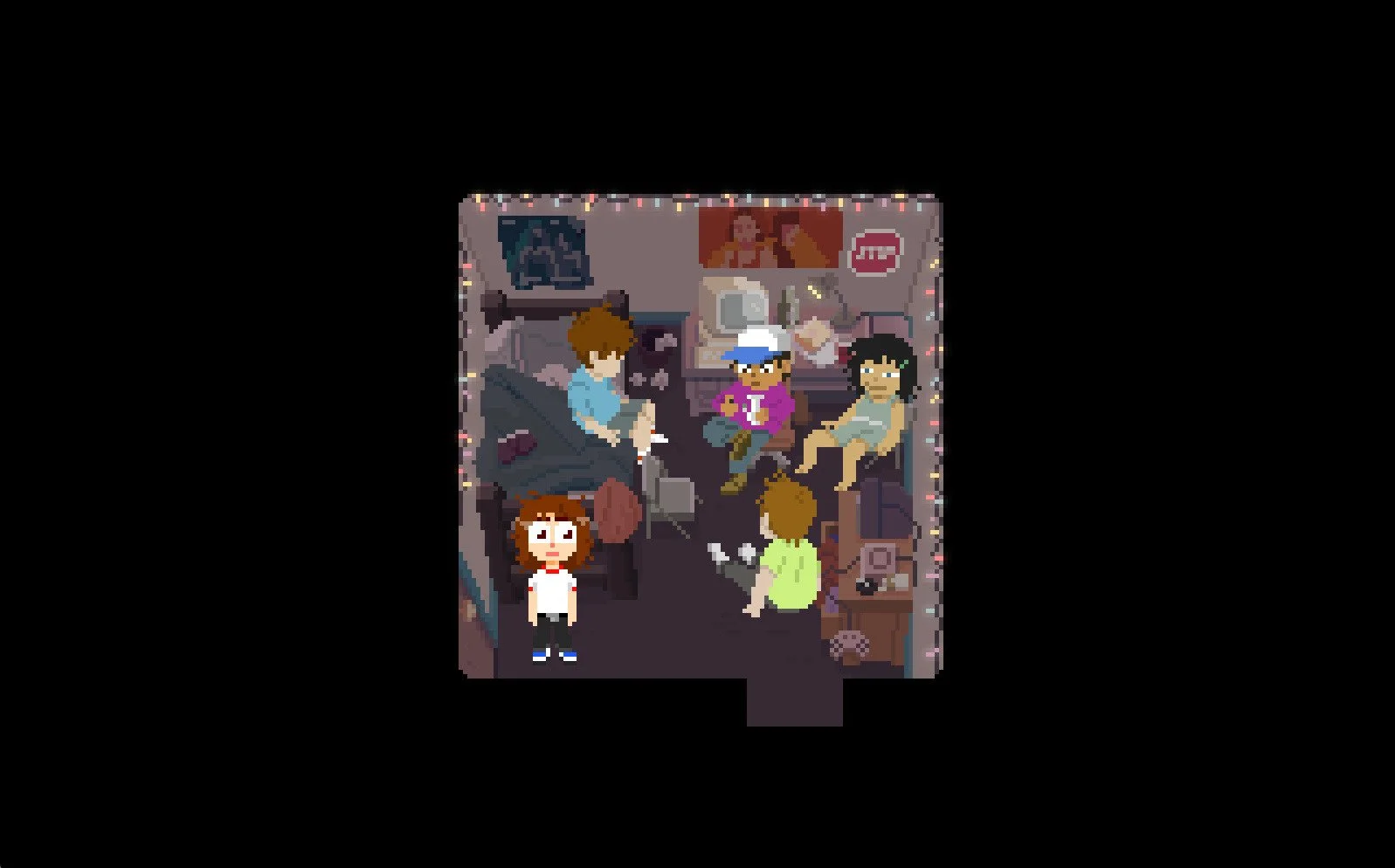
Even events like a bad breakup leading to missed classes, depressive episodes crippling Mara’s motivation, etc. are reminiscent of my own labours in college. There’s such a painful familiarity with Mara’s trials that I find myself recounting some of my own failures and inadequacies, as well as the ways in which I’ve ultimately moved past them. It’s admirable just how much can be said and shown in just the dozen or so hours it took to finish playing.
Perfect Tides: Station to Station is a brilliant example of character-driven storytelling. It is a lovingly crafted, often uncomfortable look at the transition into adulthood. I don’t think you have to have played the first Perfect Tides to understand its sequel, as long as you have a lived experience that helps you understand the struggle. It doesn’t even have to be about writing — if you have felt the sting of loss both personal and professional, this is a game that might remind you that life sometimes feels like it has it out for you. It’s for the people who suspect they might be dealing with something deeper internally. It reminds us that while living is often challenging, there is value in the struggle of coming to terms with who we are and what we want out of life. It tells us that despite those struggles, if you live to stick around for the sunset, you may just see something beautiful.
Perfect Tides: Station to Station was played on PC with a code provided by the publisher.