SGF Preview | Tomb Raider: Legacy of Atlantis Demo Is A Promising Slice Of Gameplay Muddied By Unclear AI Usage
You find yourself in The Lost Valley, a temple hidden deep within a jungle. You have been tasked with solving a puzzle requiring you to retrieve three giant cogs scattered throughout the temple grounds. These cogs are not marked by any objective on a map, so it is up to you to explore and hunt down these puzzle pieces. Yep, Tomb Raider is back.
The Lost Valley is an early level in Tomb Raider: Legacy of Atlantis, which I got hands-on with at Summer Game Fest. It is designed to teach you not only the core mechanics of the titular activity but the logic behind solving these environmental puzzles.
As the game loaded me into this first environment, I was stunned by the beauty. A luscious jungle filled with waterfalls that collect into a deep pool, leading to underwater tunnels that connect to secret caves. This felt like one of the seemingly endless video game worlds I remembered playing in as a child: fascinated by the environment and wanting to explore every nook and cranny. Only now, the game contained probably hundreds of thousands more polygons on screen than the shimmering and warping environments of the original PlayStation game.
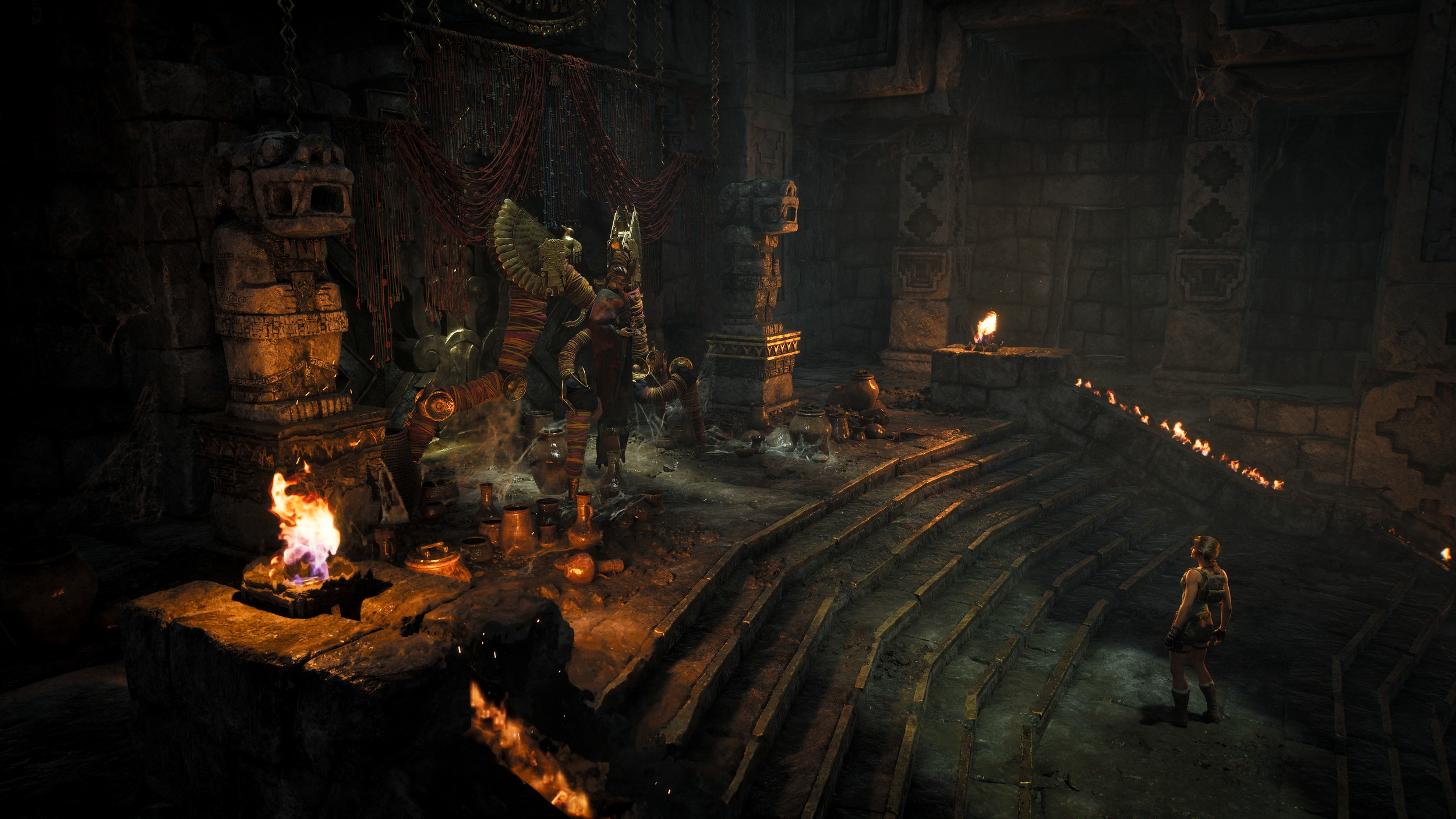
The scale of the temple felt just right for the first area of an action-adventure game. I was in awe of the size of the structure, looming behind the trees, covered in vines and branches that hid the walls behind the rest of the greenery. The platforms and handles were integrated into the design of the structure without it feeling too obvious. The introduction said to look for any sort of white dust — as opposed to the infamous yellow paint — to indicate a scalable surface. I was so used to seeing off-coloured and apparent interactables that I had to force myself to look for the structures that I could climb. This blend of natural “gamer paint” with the environment made the whole level feel exciting and mysterious. What other secrets could I find if I just looked hard enough?
The environmental puzzle itself was not too complex. It was a simple mechanism that involved collecting three cogs to rotate a pillar and stop a waterfall from running, revealing a hidden door. As long as I kept climbing up the temple, I would eventually find another cog to pull down into the stream, returning it to the mechanism at the beginning of the zone. The most challenging aspect was finding out which direction to climb.
In most adventure games, I feel like I can identify the critical path designed to progress the story compared to any side-path that might be host to collectibles or secrets. In this demo, I often felt unsure of which way to go, but this was a good thing. There was a natural linearity to the game’s design that never felt like it was holding my hand. The paths never strayed too far from each other, and it was relatively easy to just turn around and go the other direction. This encouraged exploration as it never took too much time to venture around a new corner.
Most of the traversal mechanics felt great, too. Lara’s running, swimming, and climbing all felt snappy and accurate. Never did it feel like I was lumbering around or mistakenly jumping in the wrong direction. In fact, it felt a lot quicker than what I remembered in previous Tomb Raider games. Even in the 2013 reboot series, Lara’s movement has always felt very deliberate, whereas here her speed leaned more towards the “action” side of the action-adventure genre. Though the feel of her jumping could be a bit more fine-tuned, as it was finicky at times in a near traditional homage to tank-controlled originals. I never got a good sense of just how far I was able to jump. This had me question some gaps that were meant for Lara to leap over, but looked to be too far during an initial approach. As it stands, the jump felt quite floaty, almost like you are gliding in the air and then snapping towards a cliff’s edge at the very last second. The feeling of jumping often felt like it was interrupting the exploration rather than adding to it.
While running around, I was able to collect resources from the ground or ingredients from a bush. This was for a crafting system that was not yet in the demo, but I wanted to make note of the feature because it's an additional layer of resource management not present in the original game, which feels much more in line with the series reboot.
Now it wouldn’t be a classic Tomb Raider game without everyone’s favorite anachronistic enemy: the dinosaur! After solving the temple’s puzzle, a cutscene played out, and Lara found herself face-to-face with one of the prehistoric period’s most intelligent hunters, a velociraptor. The design of the raptor matches a more modern understanding of these beasts, tufted with feathers and vibrant colors.
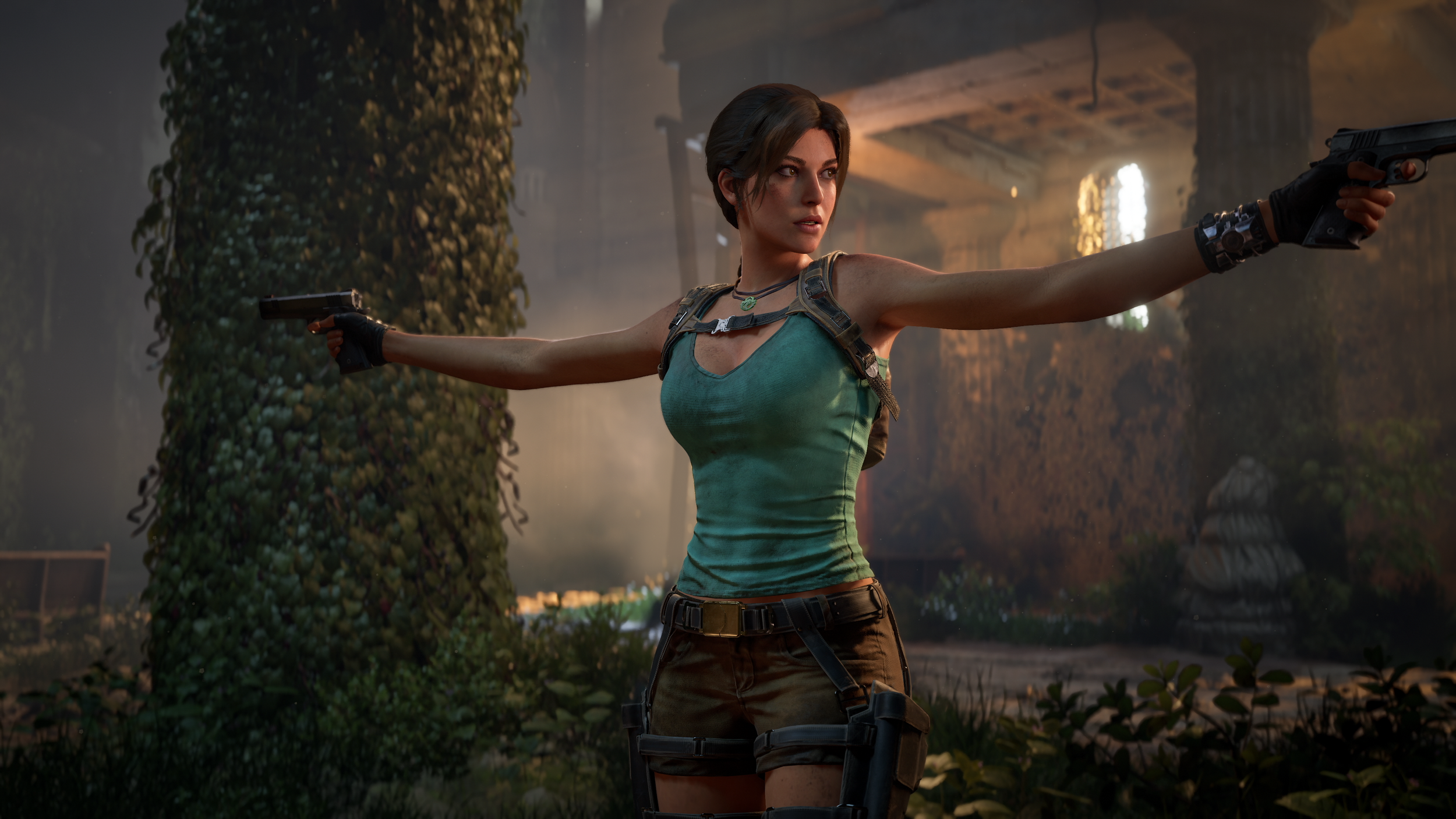
The gunfights are where the action really starts to shine. I had to constantly be on my toes and evade attacks as the raptors strategically attacked me from all angles. I ran and climbed up various ridges to get a better angle of the raptors, only to find them right behind me as they kept up with my every move. Lara’s dodge was quite forgiving as I spam-rolled away every time the raptors lunged. There is also a limited-use bullet-time that sends Lara rolling in the air, firing as many bullets as possible before touching the ground. The weight and impact of each shot felt a bit lackluster, but that could be due to the weaker nature of the unlimited-ammo pistols. There didn’t seem to be much depth to the combat, but taking down dinosaurs felt nostalgic and satisfying (but I did feel bad for killing these poor creatures just minding their own business).
Another cutscene played, and now Lara is joined by the raptors as everyone tries to escape from the iconic Tyrannosaurus Rex. While simply a set piece and probably not something that will occur too often in the game, this chase sequence felt thrilling. Much like the Raptors, the T. rex was right on Lara’s tail, leaving no room for error as she escaped the giant beast. I ran across a bridge, almost making it across before the T. rex snapped the ropes and caused both Lara and the dinosaur to plummet into the stream below. The preview ended with another cutscene, highlighting the adventures the player has to look forward to in the full release.
Tomb Raider was one of the first video games I played as a child. Hearing that Crystal Dynamics and Flying Wild Hog were remaking this 1996 classic had me elated. My expectations for Tomb Raider: Legacy of Atlantis are high. So, if the quality of this demo is representative of the final game, Tomb Raider: Legacy of Atlantis could be a day-one purchase for me. Well, it might have been a day one purchase, but this game is plagued by a disease that seems to be invading so many Triple-A studios these days: Gen AI assets. The studio confirmed that Gen AI was used for ideas, but claims that all final assets will be crafted by hand. However, the fact that that very specific media-trained answer was parroted to dozens of reporters and outlets with a refusal to elaborate further, only really raises more questions about the extent of the technology's use. Whether or not the game’s experience director, Jeff Adams, is telling the truth about replacing the AI assets, my excitement for the game was turned down a couple of notches after hearing those words.
Tomb Raider: Legacy of Atlantis is set to release on February 12, 2027, for Steam, PlayStation 5, Xbox Series X|S, and Nintendo Switch 2.