Review | Titanium Court - A Midspring Day’s Reverie
I have had a most rare vision, past the wit of man to say what dream it was. I dreamt of pixelated landscapes, unstable in their composition, prone to dissolving upon a great Tide. I was the monarch of the Fae folk, who were clothed in three-piece suits, spoke in riddles, and cheered with toothy grins. I envisioned an endless war — hundreds of combatants cleaved by the sword, burned alive, assailed by an array of arrows, trampled by centaurs, and gored by harpies. But worry not: they all rose again in the morn, and the court convened for war once more (after we’ve had our breakfast). My eye hath heard, this ear of mine hath seen, this hand able to taste, my tongue to conceive, it’s in my heart to report what my dream was: not a hallucination brought on by slumber, but a real video game.
Titanium Court is the latest game by AP Thomson, known for magical-capitalism simulator Fortune 499 and as Jenny Jiao Hsia’s co-director for 2025’s Consume Me. It’s a hybrid of a game — a real chimera — blending match-three, deck-builder, auto-battler, tower defence and roguelike mechanics together, seasoning them beautifully with an idiosyncratic style, a heaping serving of dry wit and naturalistic humor, and some existential reflections on what it means to change as a person in a world in constant flux.
Cards on the table: Titanium Court is one of the best games I’ve played all year. It briefly ruined my life. It led to sleepless nights; an intensive read of Shakespeare’s A Midsummer Night’s Dream; nightmares about moving land-blocks and unattainable victories; and has temporarily afflicted me with a madness that I could only ascribe to the presence of magic. When I finally stepped outside of my fugue state brought on by the satisfying gamefeel of snapping tiles and little pixel-fae gathering food and destroying fortresses, I did come away from the experience with a couple of nitpicks and complaints. But It speaks to the quality of the game that I can only find minor imperfections in the gem that is Titanium Court.
I play as a human woman, or the actress cast for this role in a meta-play, magically transported to the world of the Faeries as it is experiencing a cataclysmic event. Every day, the Titanium Court materialises in a twilit void, navigates the changing landscape of the Tides, and goes to war against an enigmatic enemy. Either win or lose, the Court evaporates into nothingness at the end of the night, and the day restarts, ad nauseam infinitum.
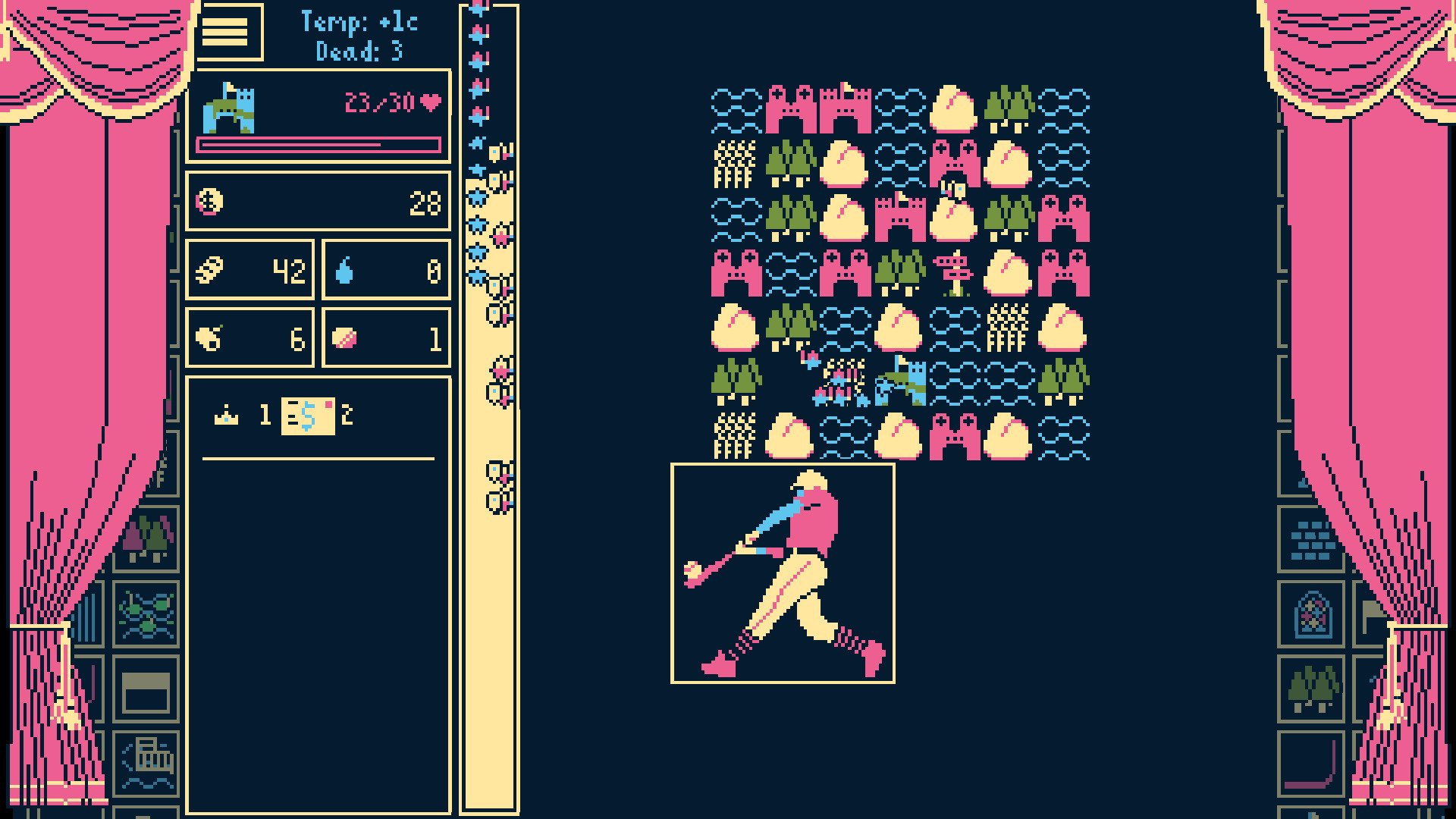
Each day is the same. After a quick shower and a meal, I retire to my office and make preparations for battle. I chat with my courtiers, double-check my to-do list, fiddle with the thermostat, then it’s off to traverse the void. Pick your path, and sail the High Tide with your mobile castle. The ground materialises, segments itself into squares, each one containing either fields of grain, deep rivers, gigantic hills, vast forests, or enemy keeps. Combine three of the same squares, and you get either one of its corresponding resources — food, water, rock, wood — or reduce your foes’ presence.
Then the Tide recedes, the tiles compress into a battlefield, and I expend my resources fueling the heart of my cards. I summon a soldier to lay the enemy forts asunder, a farmer to harvest my crops, a miner to gather precious rock from the steep hills. Mayhaps I’ll spend some buckets of rocks and chunks of water and cast a spell: annihilate the tile above me, get medevacked to safety by a tiny helicopter, scatter a love frequency over a radio antenna to enamour an enemy battalion. When you “play” a card, time is still, the troop you summon or the spell you cast takes its place in queue, backstage, before you press play like a tape deck and watch your little faeries scatter around like ants, colliding against the enemy forces or greedily gathering their logs and minerals.
Egads! What folly! What cruel nature! The whims of labour and income incentives follow me into the game! What do you mean I have to pick a job before I spill blood?! Indeed, while I start with the basic Monarch “job”, which grants me the standard deck and gameplay experience, I am able to unlock other jobs by buying tickets from a gift shop (among other methods). I could go all-in on becoming a capitalist warlord, trading resources in the holy M.A.R.K.E.T. that shrouds my steps, following me as if it was the Holy Spirit itself; or topple the hills as landscaper; other times I light up a cigarette and watch it all burn, draped in reckless youth. Jobs not only affect my starting cards and money-making method, but also fundamentally alter how I play the game: whether jockeying defensively, letting myself be battered by the enemy line while steeled by my cohort of knights, or if I unleashed a horde of scamps and birds upon my enemies and picked the map clean of their pink fortresses.
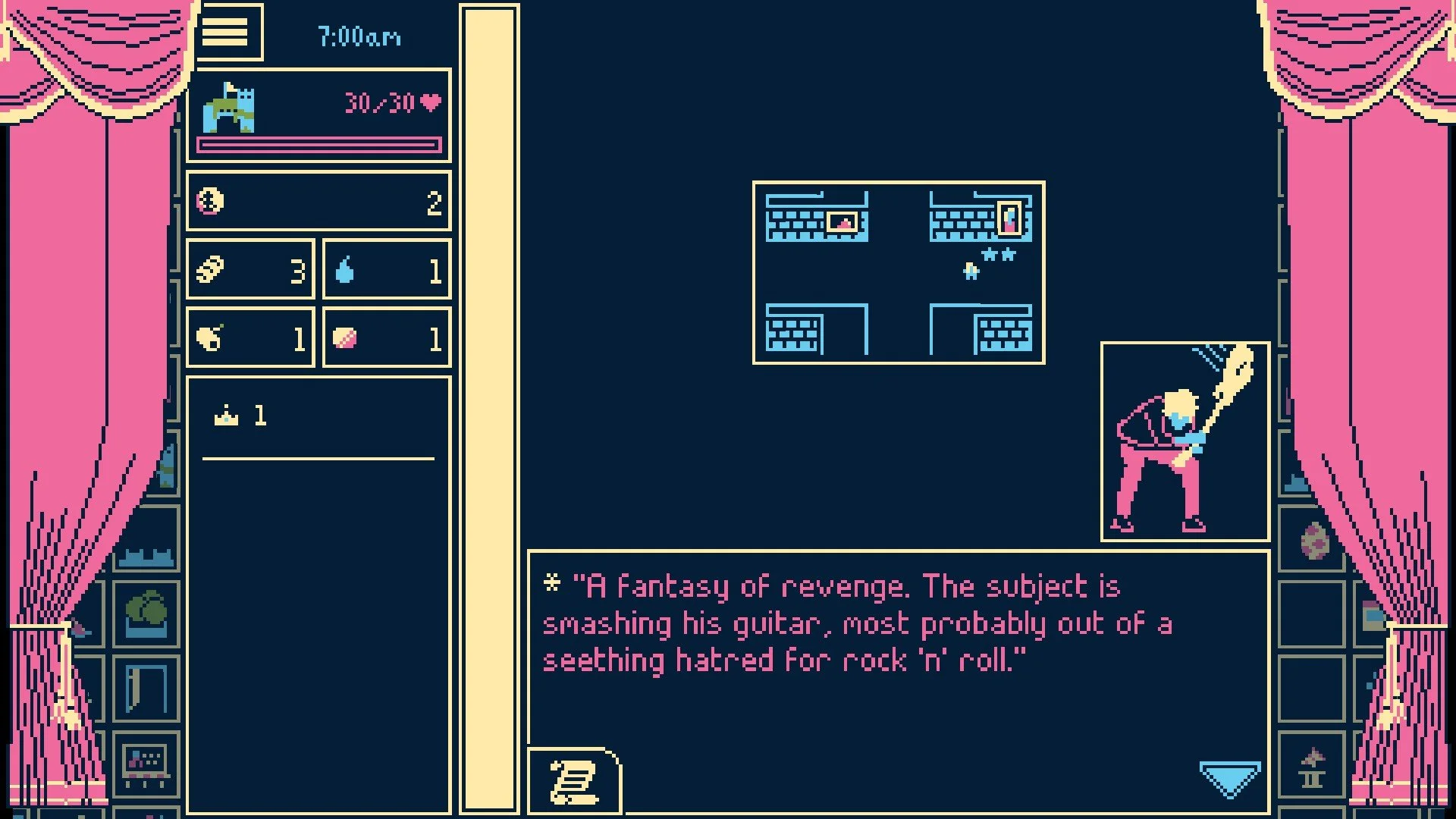
Titanium Court complements all these little bits and bobs with an indelible sense of style that exudes anachronism: despite the fact I am teleported to a quasi-fantastical medieval society, many modern trappings can be found within. Road signs litter the battlefields, which your faeries humourously think of as totems of great power. When a catapult launches a rock in my direction, a brief animation of a pitcher launching a baseball plays. Look outside your window in the castle and you will see dogs gleefully catching frisbees and cats mischievously batting glass cups off balconies.
There’s a lot of bravery in the aesthetic choices of Titanium Court. Presented in contrasting pastels of blues and pinks, the small vignettes and character portraits that depict the blue-skinned faeries often use negative space — which the faeries reference when viewing certain paintings in the gallery. And, while the little pixel-fae of the battle portion of the game were charming at first, it was a shame that in the latter half of the game abandons a lot of the humour and funny little vignettes. So much of your cone of vision is focused on the same tiles you’ve been staring at for hours, concentrated on a small array of pixels that form nondescript faeries. Regardless, the game is able to communicate different unit and building types well with its chosen aesthetic, and nothing was confusing or ill-defined.
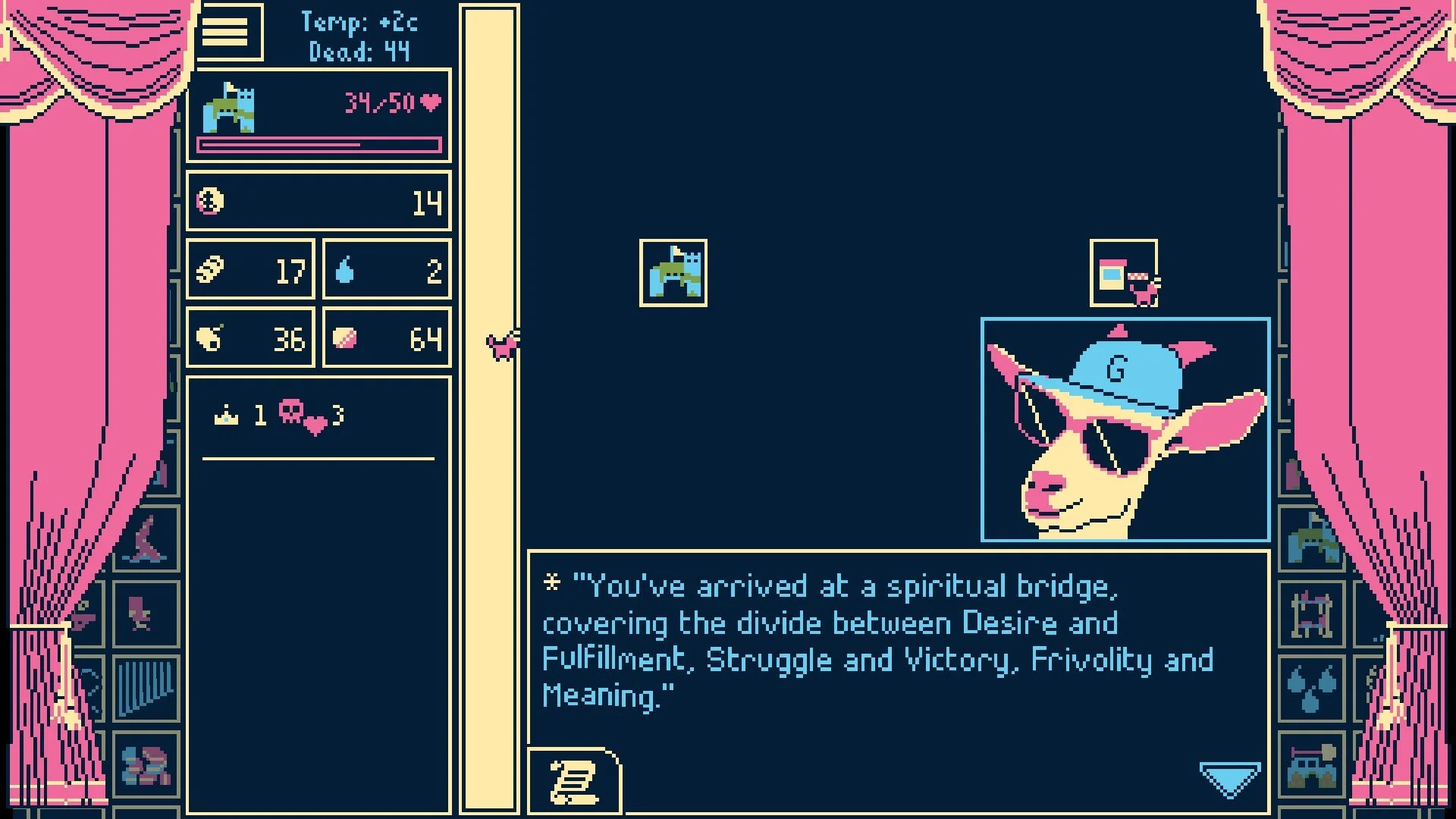
Titanium Court’s gameplay loop is charming, especially in the first few hours. It clicks certain parts of my brain together, dissipates them into a miasma of whimsy and satisfaction. When the clink of three aligning fields led to a chain-reaction of even more conjoined lands, I felt like I had started a Rube Goldberg machine of elation, regardless of whether the result was born from merit or luck. Seeing my tiny warriors and labourers executing their strict functions while accompanied by the jangliest guitar you could conjure almost never failed to inject a smile on my face. It helps that this simplistic gameplay is complicated by bits of humour, metanarratives, and various unexpected wildcards tossed into your direction.
You really never know what the game is going to throw at you. Aside from the astronomic amount of reading you will do in this game (complimentary), the comedic aspects serve both to spice up the simple experience and to add depth and layers to the narrative.
Unfortunately, despite an array of welcome experiences to partake in, including wildly different one-shot campaigns that see you playing as a moving clockwork monastery, the adopted child of a Leviathan, or a magical mirror that must reflect enemy castles in order to reproduce its units, the game and narrative start exhausting themselves a few hours in. This is pretty normal for a game of its ilk — there’s only so much a game with roguelike mechanics (which invite you to replay the same levels, fight the same bosses, and die, over and over again) can do to hold my attention and devotion.
The rocking guitar soon turns into a sped-up track as I fast-forward through the same battles, the jokes stop coming, the characters recede into the background. What’s interesting is, the game is aware of it, it understands it is becoming stale, and starts pushing out more of its metanarrative, stares directly at the player and asks: why are you still playing? What are you hoping to achieve?
While you may think this is where the game starts losing steam, it is actually when it starts focusing on and exploring its themes.
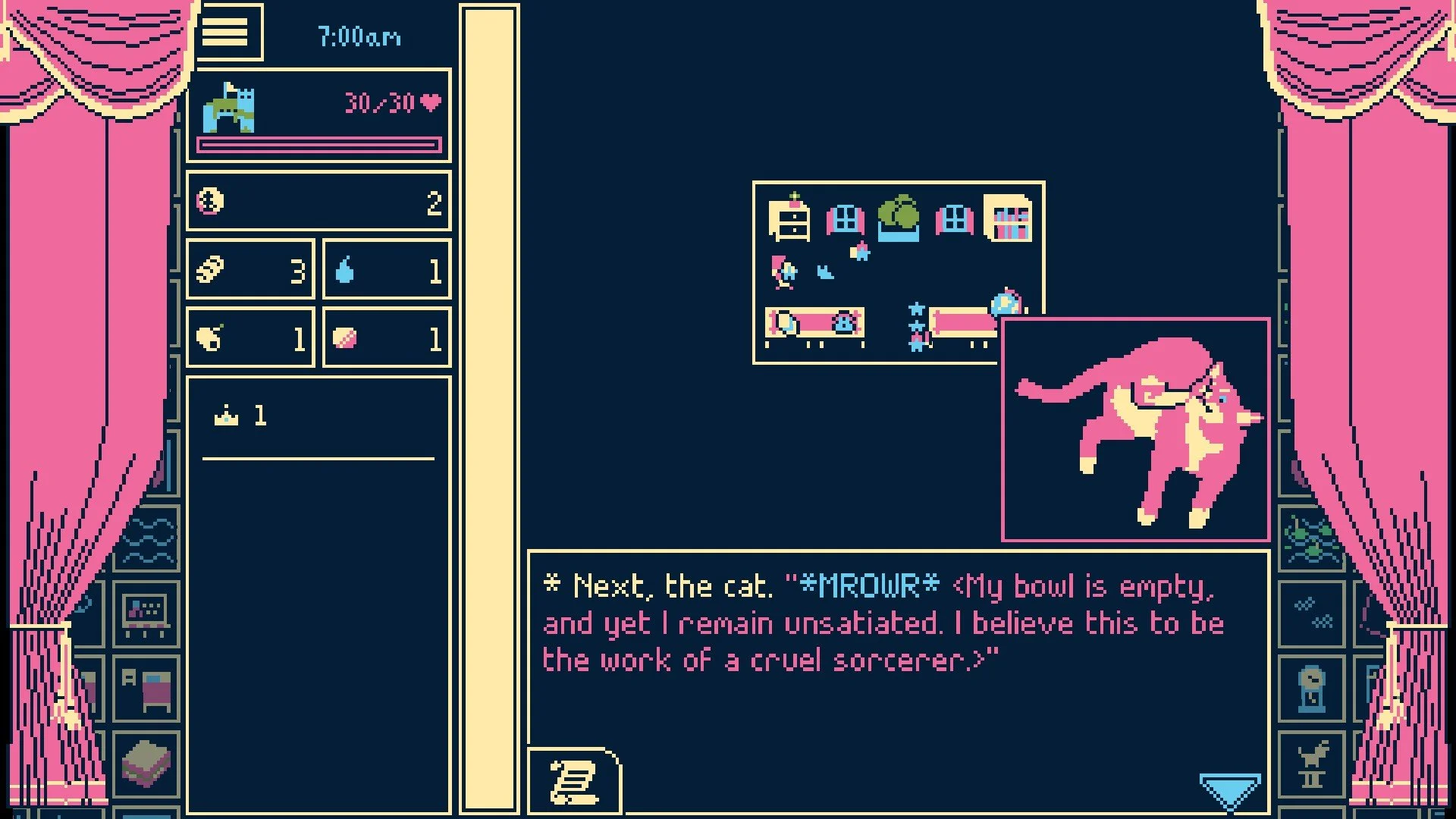
If you achieve victory in the war, you get the privilege of exploring the Court at night. Here, you can visit the gift shop, overhear some water-cooler gossip, stack leftover resources to assist a talking cat, and you get to speak with your steward, Puck, and ask him one question before the court disintegrates — despite the fact he promises honest answers, all of them are purposely vague and open up more queries rather than resolve anything. To sprinkle in a little nitpick, navigating the castle in the evening was a pain. In the bottom of the UI are a set of navigation buttons that you click to go to the various locales of the court, which means getting anywhere involves clicking a button, waiting for your little sprite to move across the pixelated space, then repeating the process until you get to your desired destination. This clunky navigation system soon grated on me. After a few victories, visiting the court at night felt like a chore rather than a reward, regardless of the fact I was able to speed up my character’s animation with the fast-forward mechanic.
Titanium Court is a meta-textual game, always forcing me to interrogate the reasons as to why I was continuing to play, even after I was bored and done with the game. The longer I play, the more faeries become stale and disappear while blaring their repeated dialogue, never to be seen again. It becomes an anti-roguelike in its later stages, refuting long-held conventions that games of its kind should carry infinite playtimes, endless content, and reasons to continue playing long after credits roll. Once I reached the game’s end, I was satisfied: I had gone through the ordeals of war and came out of the experience a changed person.
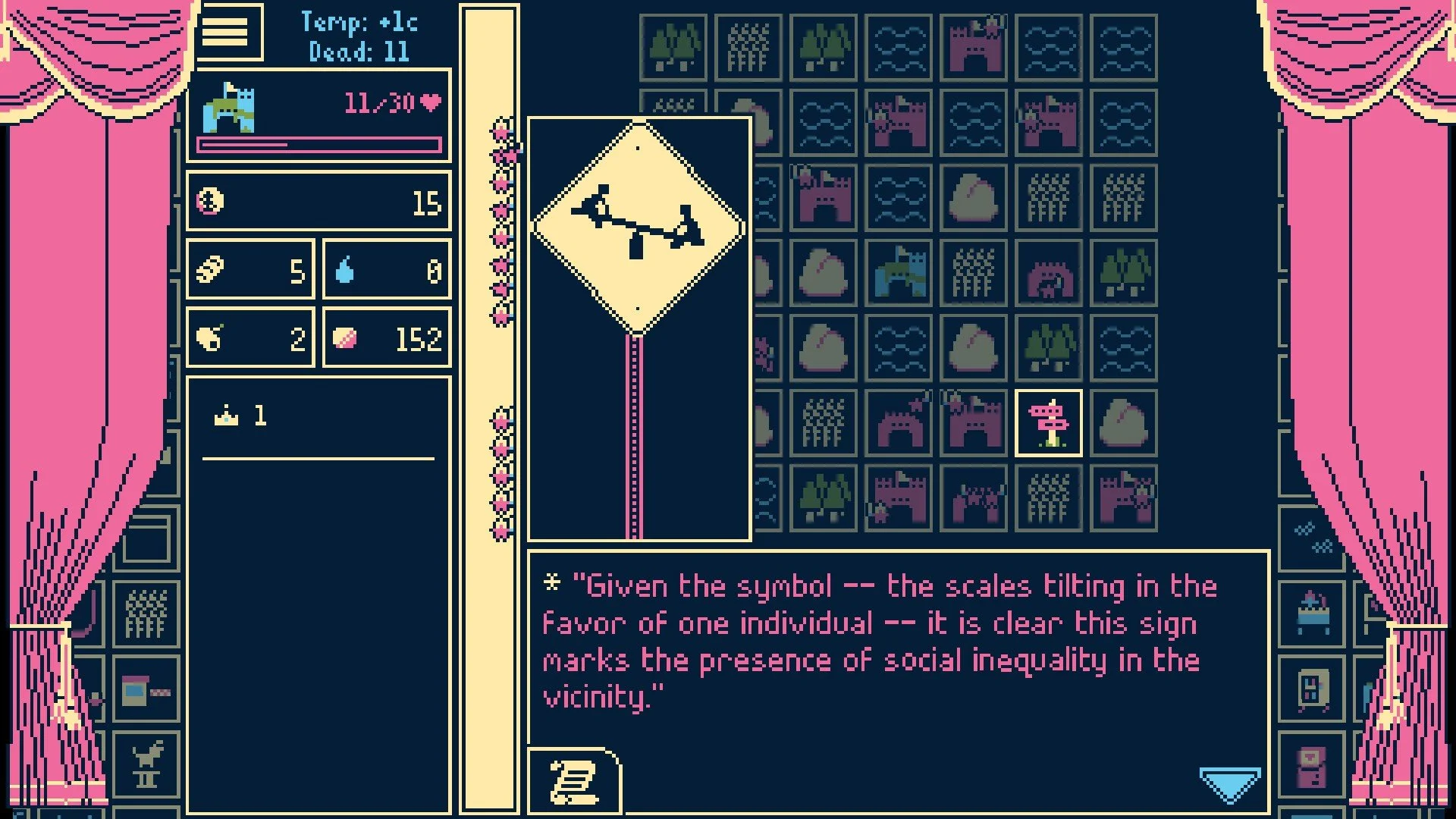
It’s obvious the developer poured so much of himself into this project. This sometimes made the game feel like a masturbatory experience — I actively cringed at the unskippable musical performances, performed by AP Thomson himself, that are offered as substitutes for boss fights. But there’s multiple layers to this game that give it a universal edge. Who among us can say they have not changed, or tried to improve for the better, at one point or another in their life? In addition to the references to dorm life and nights out with friends, the game hints strongly at class struggles, how capitalist machinations grind us down, and how important it is to mature yet retain a heart full of whimsy.
The game borrows heavily from Shakespeare’s A Midsummer Night’s Dream, in which mortal men and women enter into the magical woods of the Faeries and are changed via trickery, magic, and love. They become infatuated with different people, forgetting their original lovers. Some even transform literally: one of the lower class artisans, Nick Bottom, has his head turned into a donkey’s. To love, or be loved, is to be changed. After a surreal and dreamy night in the woods, all love potion effects dissipate, and the Athenian youngsters are blessed to marry their true loves.
In Titanium Court, the theme of change is constant. There’s a clear demarcation in the game between the bundle of pixels you control and the player. The playable character has already been changed: the game implies the returning monarch is none other than Titania herself, Queen of the Faeries in the comedy, having returned to the land of magic after many years living among mortals and engaging in human activities like going to college, living with housemates, paying bills, and smoking late-night cigarettes with friends.
It is the player that must change, that must think of the reasons why they insist on wanting games to last forever, to offer replay value rather than to have defined conclusions. The game often shirks all comedy in favour of introspective reflection, almost as if it is pleading to the player to mature, to not just become a consumer but a critical thinker. The large amount of reading helps, as there is no substitute for the written word to precipitate such reflections.
As my final word on the subject, let me simply state:
If my review hath offended,
Think but this, and all is mended,
That you have but slumbered here
While Titanium Court did appear.
Titanium Court was played on PC with a code provided by the publisher.