Deniz Amasya Reflects On Social Vs. Anti-Social Writing: Visual Novels And Adventure Games | Winter Spectacular 2025
“I don’t understand anything you’re saying to me right now.”
“Okay, okay, let’s take a break and just return to Wittgenstein for a moment. The basic idea is that language is the limits of our world, right? The idea that we can’t transcend our words, and in order to expand our world, we have to expand our vocabulary. The game is challenging this.”
I still don’t really know what he’s talking about. I have a roundabout understanding of Wittgenstein as informed by my second-year philosophy lecture. I understand the game he’s talking about is some kind of 100+ hour epic about Japanese high schoolers killing themselves or others. The connection ultimately means nothing to me, and I am more concerned for him than I am about his fleeting discovery of God as it is presented in the hundreds of thousands of words in this video game.
It could be any of those visual novels he’s talking about--the kind where two character sprites stand across from each other on one corner of the screen, poised in a bizarre ideological debate that occasionally breaks out into inexplicable explicit sex. Just trust me, bro, everyone says.
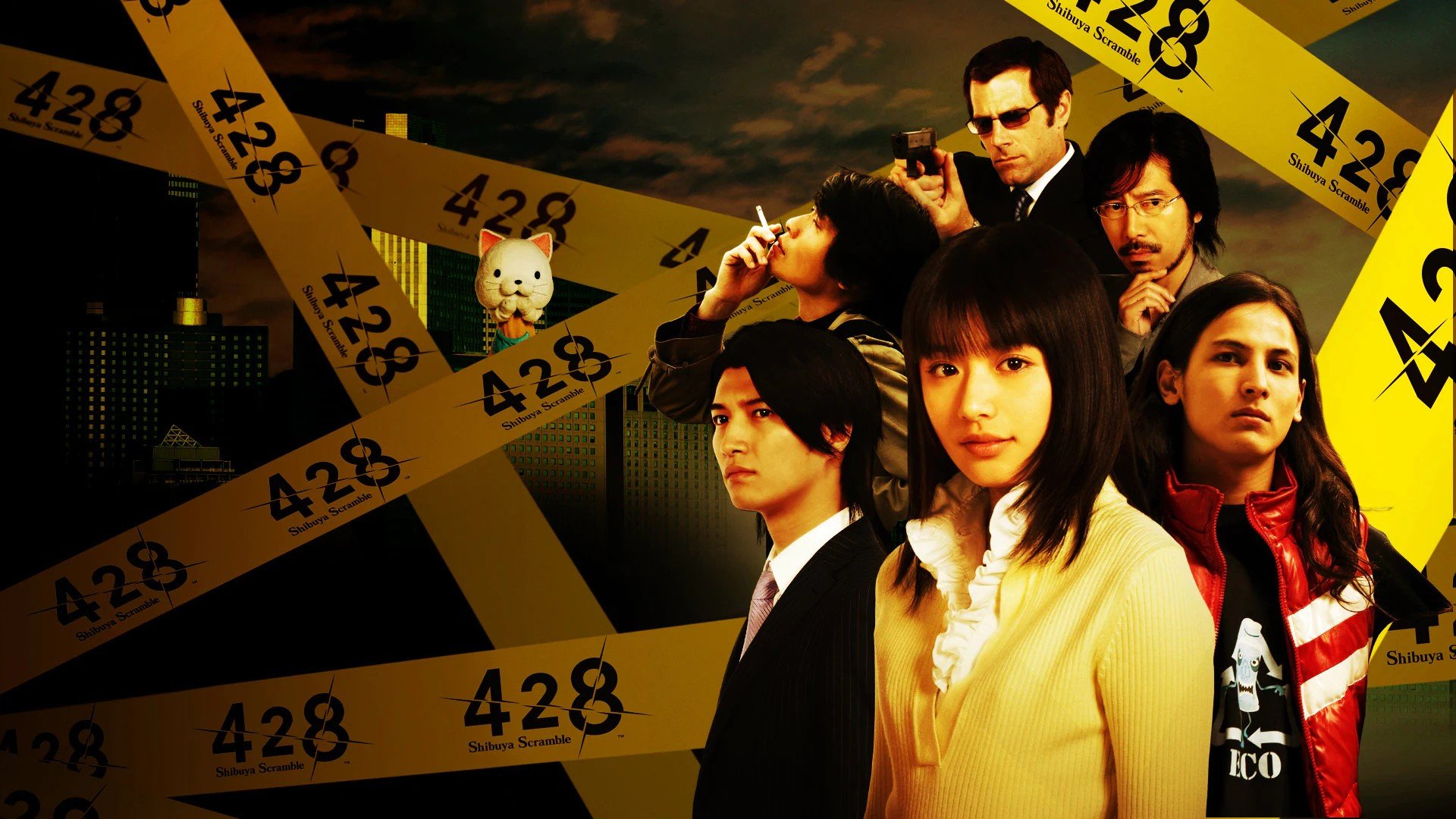
I have never played a Saya no Uta, a Sayonara wo Oshiete, a Subahibi, or a game made by a company called “Leaf.” I have played 428, Otogirisou, The Silver Case, Portopia, and most recently: Sound Novel Machi.
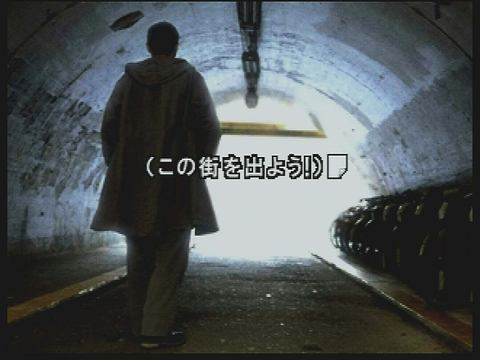
It’s a Saturn live action adventure game with eight(!!!) protagonists whose stories intersect and crossover in fun and interesting ways over the course of five days in Shibuya. Some stories range from the mundane (a young woman tries to lose an unreasonable amount of weight to impress her boyfriend) to the absurd (a university student is blackmailed by a cult whose members are named after the days of the week to blackmail others to join the club so he can get the phone number of one of the cult members he falls in love with). They don’t all coalesce and do the crazy climax that spiritual successor 428 manages to pull off, but they necessarily intertwine in ways that are as amusing as they are impressive. The Zapping system--wherein you can jump from one protagonist to another in real time if they come up in the prose--creates a sense of depth to a game that is ultimately about advancing text. It feels like space and time are created here in a way that can at times be more immersive than a 3D action game.

I said this game was for the Sega Saturn, but I played the PS1 port on my PS Vita, in hotel rooms and flights as I crossed the world to go to Gamescom over the summer. Each time, I would play a day in the life of one of the protagonists, and it would make for something to talk over breakfast with the others. On a brisk morning in Cologne, I sip an espresso with a producer at my workplace and tell him what silly thing happened in the game the night before. We both laugh and eat our croissants and head to work, enjoying the pedestrian whimsy of being in Europe and doing as Europeans do.
But I wouldn’t be able to do this if I had been playing one of The VNs. Not Safe For Work, as they say. Not Safe For Life, they sometimes say.
In any case, it isn’t quite something to discuss over breakfast.
---
Back in my university days, he tells me: I want to make a video game. It will be a visual novel like the others, but this time it will have my own personal brand of philosophy and interpretation of Wittgenstein built in, he says. I simply raise my eyebrows at him and sip my coffee. The cafe is near the university, and we come here because the espressos are cheap and it has enough of a vibe that we imagine we are scholars in the year 18-something, but instead of relating German philosophy to Marx, we are relating it to Japanese games made by freaks.

I only take his comment in stride because of course I do. But when I put myself back in this moment, where does my dismissal come from? It can’t all be personal, but I truly cannot excite myself for The VNs the way adventure games like Machi naturally draw me in.
I have only had negative experiences with the people who played the former games, and I have never been able to really mix with those kinds of titles myself. They seem ostensibly like the type of thing I should like: long, pondering, alternative, full to the brim with allusions to books and movies I’ve read and seen, and a philosophical backbone that makes the electives I took in my undergrad worth the cash. And yet they fill me with so much dread; not because they take a long time to read but because they feel deeply anti-social.
Why is it that these games always start as one-man jobs at doujin event sales? The most alternative methods of releasing your game could be? Why doesn’t Spike Chunsoft or whoever attempt to make a game like this? Is it because the authors are simply too crazy, too bizarre? Is there something about their work that necessarily means they can’t work with others, for they would dilute their artistic vision? There are plenty of people who hail Sca-di or whatever as being this generation’s Nietzsche or Tolstoy or Dostoevsky, but I have read Nietzsche and Tolstoy and Dostoevsky, and I’m not sure that’s the case.
The first time I read Dostoevsky was Crime and Punishment when I was 22. It was not for a class or an essay, but for myself, and, embarrassingly: that book saved me. It made me feel better about facing other people and also myself in spite of my deeply human flaws.

Likewise when I play Machi, 428, Kamaitachi no Yoru, or whatever--while these are still functionally the same kinds of games as Visual Novels (denoted with capitals for easier organization) in that you read a bunch of text and advance through a variety of images, they feel like they serve the same purpose: to make my life better, to guide me through the maze of being human.
But then there are The VNs, these deeply self-interested long spans of text that gaze into depths of the human soul perhaps we were not meant to gaze at too long.. Is this too much to say about video games where you watch JPEGs of anime characters talk back and forth for 100 hours? Maybe so, but again--my own personal experience talking to the kind of people who take these sorts of games as seriously as I might something like D2 is what I’m taking problem with here.
Imagine a person who reads Crime and Punishment because their favourite VN protagonist mentioned it in their fifth monologue that hour. Can they truly be considered to be reading it ‘for themselves,’ would not the specter of The VN hang over their reading of the novel, even at an unconscious level, an everlasting link between the two? Am I thinking about this too hard?

Whether or not my personal experiences colour my opinions of games I (largely) have not played is kind of irrelevant to the fact that The VNs are undeniably looked at a certain way by Gamers At Large, their titles always said in tones reserved for that acquaintance you’re not fond of for no real reason, and your insistence that they are “actually good” met with a polite nod. Then there is Sound Novel Machi, which probably holds the same kind of reverence overseas among fans of 428 who can’t read Japanese as “a cool game I wish I could play,” and domestically as a fun cultural artifact of the past that was enjoyed by people at large (and by this I mean Machi enjoyed as much cultural relevance a live action Saturn game could have in the 90s).
Forgive me as I try to conjure a point out of thin air, but what I want to say is this: that all video games should have a positive social aspect. This doesn’t mean that you should be making feel-good “wholesome” games that grovel in their inoffensiveness, but that, because it is an inevitable fact that I will eventually turn off the console and return to my regular life, I want to be a better person for it. The immediate example is having a laugh with my coworker as we pretend the four euros we coughed up for an espresso was worth it. The opposite example is driving yourself insane over Wittgenstein as his ideas are portrayed by an anime girl.
--

I haven’t said anything to him for at least an hour, but his complex designs toward a treatise on Kant and some VN I can’t remember the title of show no signs of stopping. His food is getting cold, and I’m a little bored. Is this what I sound like when I talk about a game I like?
I haven’t played any of the games he talks about because I am frankly not interested. The way he talks about it, too, is uninteresting yet impassioned, like someone who can’t scratch some kind of intellectual itch, trying to solve an unsolvable puzzle. The unresolved thing in myself then and probably still now is if I am any better for it; if my own obsession with bizarre video games is any healthier than his attachment to The VNs. The only thing I know for certain is that what’s happening between us here does not qualify as a conversation, and barely qualifies as a lecture--it is more like very intellectual rambling.
But the thought remains: am I any better for it, or am I just another type of this kind of person? The self-interested with a self-righteousness that comes from a misplaced confidence in something as flimsy as their taste in video games. At the time, the answer is not so obvious to me, but it comes easier many years down the line.

I am on the way home from my video game job in Tokyo, Japan, as I think about what exactly it is I am trying to say with this article. Am I any more sociable a person just because I managed to “legitimise” my interest in video games by making it a living? Maybe this is something deeper than simply thinking about “good video game writing,” but for the time being, the following example will bring this article to a close:
A secret protagonist unlocks at the end of Machi, and my otaku brain tells me this is gonna be the one that ties it all together, the one that pulls the 428 trick. I’m so excited to see how my tens of hours of reading text will pay off. There is still one final mystery that pervades all eight protagonists’ stories that has yet to be explained, and logically, it must come together here.
He stands off to the corner of the character select screen; I hover over him and hit the circle button.
It is five days in the life of a man who is tangentially related to the story, whom I haven’t thought about since I was on the train from Frankfurt to Cologne. Right, I guess there was somebody like that. His brief (I’m talking five minutes worth of screen time) in the main plot is quietly presented in a fuller context. He is a father who has been estranged from his son--one of the eight protagonists--and I’ve completely forgotten about him as I navigated the son through his five days in Shibuya. This afterthought of a person, shockingly, is connected to that “final mystery,” but not through anything silly like weekday cults or a yakuza with a mistaken identity and so on--it’s simply fatherly love that guides Machi through to its ending, and it has no interest in showing you some grand final trick.

The game shuts off, and I think of my own father one gajillion miles away in Toronto, Canada. No amount of German philosophy will bring my dad into my mind’s eye with the same warmth Machi’s extra ending did; I could read 1000 hours of a VN about wanting to die, and this simple pleasure would not be with me. The next time I see my dad, I will probably be a little kinder--not even on purpose--because of what was imparted to me in the Sega Saturn live-action adventure game. Isn’t it amazing that a video game could do that for me?
Or maybe I’m just talking out my ass, and Subahibi is really that good. I wouldn’t know.