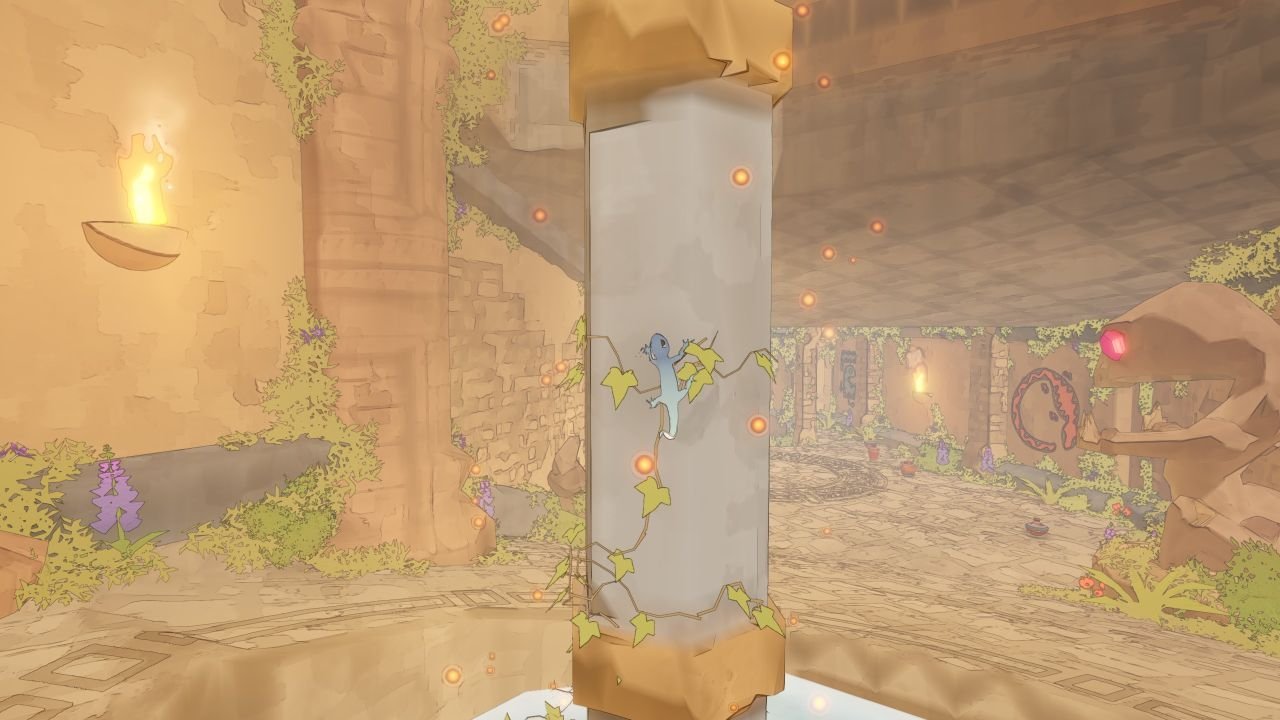
Review | Gecko Gods - Cold-Blooded and Warm-Hearted
If you were to tell me that a new game had come out where you play as a lizard and it scratches the itch that The Legend of Zelda: Breath of the Wild (BotW from here on) and Ico left me with, I’d probably be unsurprised and simply give it a go. A lot of indie games come out now. I’m sure that there’s at least two games that release a day that fly under my radar and are worth my time. So, on today’s episode of “I recommend not missing this if you have similar tastes to me”: I present Gecko Gods to you from independent developer Inresin and publisher Super Rare Originals, a great game despite the prominent technical issues in its latter half (on Nintendo Switch, at least).
The game opens with a short, hand-drawn cutscene portraying the player character — a customisable gecko — being separated from its community in an accident and washing up on a strange new land. From here, you are free to take up control of the lonely lizard and explore the island as you wish. This opening does well to set the tone, however it fails to communicate what the game will be about. The bright colours, gentle music, and cute fauna established in the introduction can be seen throughout the rest of the experience. However, finding and reconnecting with the gecko’s lost community is not a goal that the player can pursue, and no character ever mentions the possibility.
Your goal, from start to finish, is to uncover the mysteries of the land and connect with its history and deities via exploration and puzzle solving. Gecko Gods is extremely quick to present its inspirations proudly and make another option of itself to those experiences. The immediate freedom the game gives you, the coziness of the natural environment juxtaposed with oppressive sunlight and megastructures, and even the musical jingles that play when you solve puzzles all elicit memories of playing BotW and Ico from me. Unlike the aforementioned games, though, playing as a gecko means that you have the freedom to climb almost any surface, vertically or upside-down. Whilst this did inevitably cause some friction with the camera and even the analogue sticks when moving, it was definitely the biggest factor in making Gecko Gods a liberating game to play.
Puzzles can be found anywhere throughout the world, which comprises a variety of islands. Some structures present themselves as obvious and layered gauntlets of interconnected puzzles, and others can be discerned by looking for small out-of-place aspects within the environments. There are a variety of ways in which puzzles ask to be solved, but most require you to look for unique routes through the environment, which are signalled by subtle or overt context clues, and use the grab button to engage with switches and levers. If you’ve played similar games before, then the puzzles here likely won’t feel particularly difficult. Whilst I can see this being a problem for some players, I enjoyed the mostly low-stakes puzzles as they got me to engage with more of Gecko Gods’ beautiful world and exhaust my brain on the lore and mythology instead.
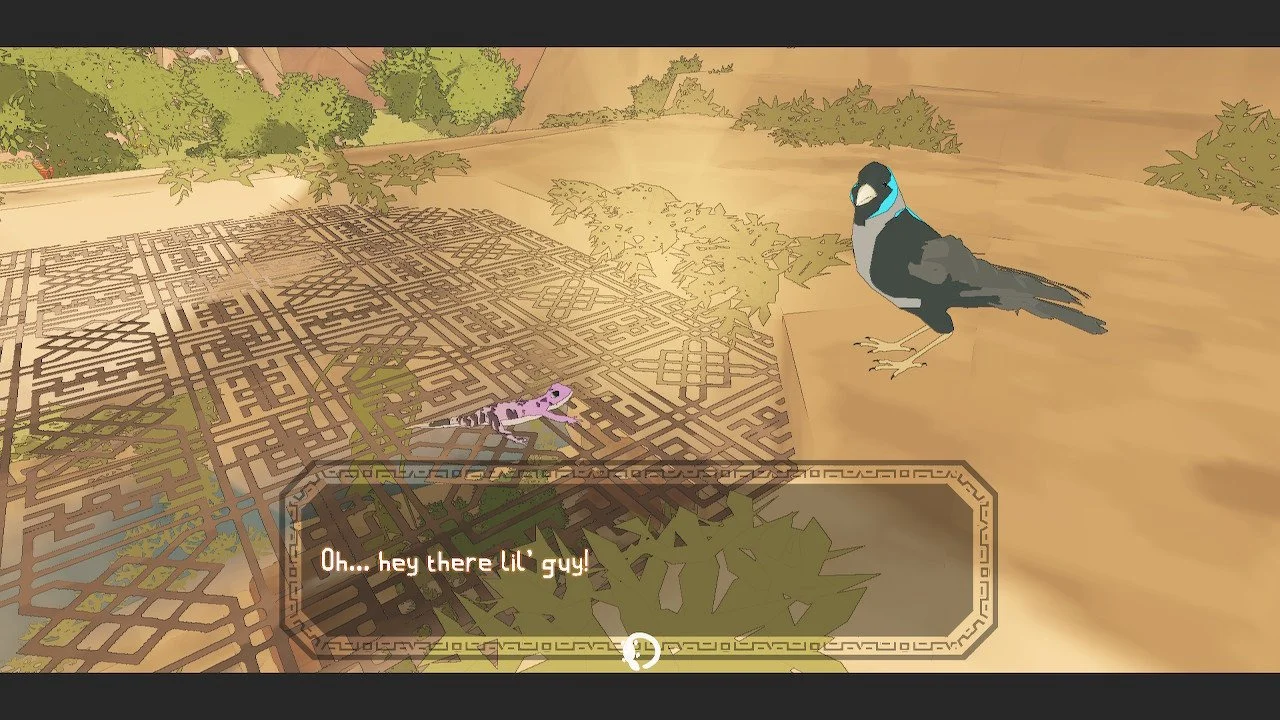
Most of the larger puzzles are interconnected in some way, and seeing these connections in real time when sailing between islands is deeply satisfying and lends the game a strong sense of place. The majority of islands have a handful of birds that act as traditional NPCs by giving hints or providing exposition, lessening the sense of isolation that you may feel as the only gecko in the land. Alongside the avian community, there’s always a new pool of insects to hunt, giving everywhere a unique ecology and something to do whilst travelling between terrestrial landmarks. Each new locale, including the ocean, has a few accompanying tracks in rotation that span a variety of instrumentations from summery flute melodies to piano-centric jazz. Jasmine Cooper’s soundtrack does a great deal to elevate the feel and mood of each area, and it’s an aspect of the game that remains consistent despite the rest of the package’s technical hiccups.
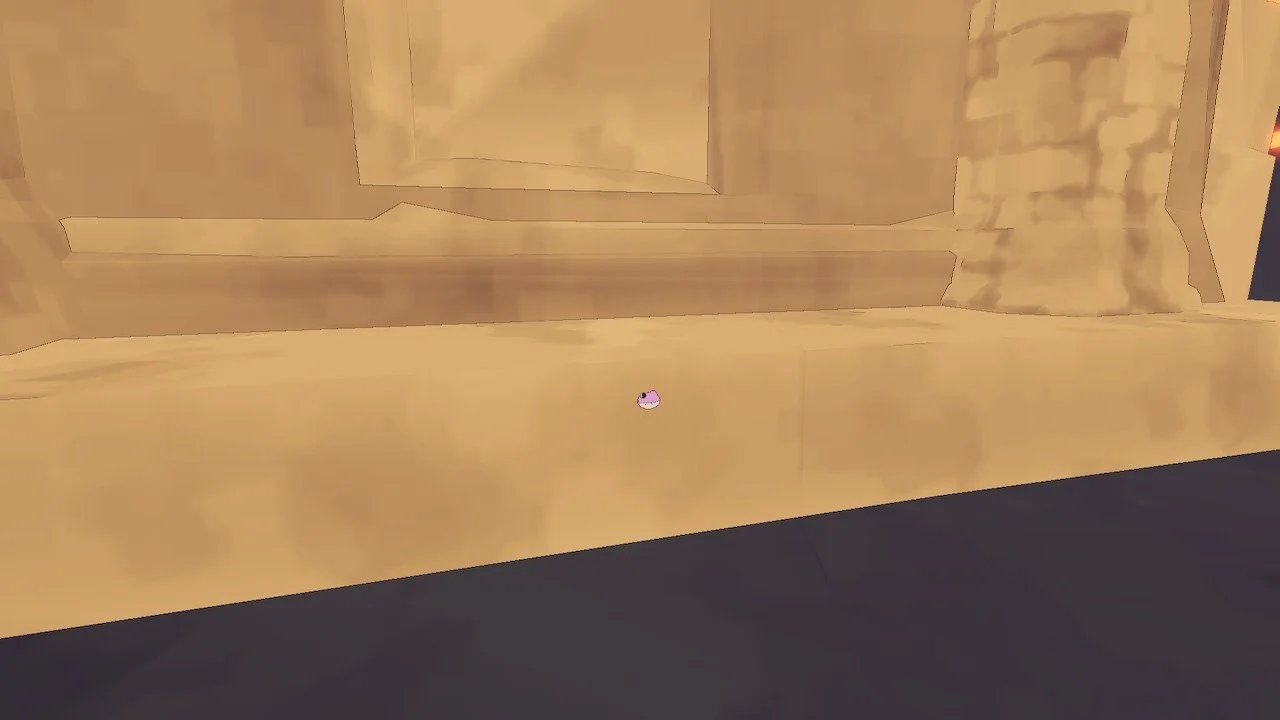
An unfortunate instance of the gecko clipping through the scenery.
Playing Gecko Gods on my base-model Nintendo Switch, I had a mostly great and relaxing time. I was pleasantly engaged from start to finish, although the game’s final stretch did invite some unwanted friction in the form of poor performance. The occasional framerate stutter and the pop-in that occurs every time you open the game were relatively easy for me to ignore, especially when I played the game in handheld mode as opposed to blown up on a 4K TV. However, the game’s final (and seemingly second largest) area never fully rendered during my time playing. The sharper and less-detailed geometry is made worse because the player gecko will often fall from surfaces when approached from an inappropriate angle, which is almost impossible to anticipate when the tiny creature is almost entirely clipped behind low-poly scenery. Furthermore, the final challenge requires platforming mastery instead of puzzle-solving mastery, meaning that the technical issues exacerbate the fact that the game’s climbing system doesn’t lend itself well to simultaneously fast and precise movement.
Gecko Gods took me around ten hours to finish, and the last one or two gave me a bit more of a headache than the rest, but I did ultimately enjoy my full experience with the game. It is a warm and cosy alternative to BoTW, Ico, and games like them with less thrills and more relaxation. Each island had me eager to determine how it connected to the rest of the world and eager to engage with a new, (mostly) beautifully rendered environment with its own ecology. Gecko Gods admirably kept its heart and its inspirations on its sleeve throughout, and I’d recommend the game to anyone who wants a nice space to simply exist in.
Gecko Gods was played on Nintendo Switch with a code provided by the publisher.
![[PATREON UNLOCK] Update Patch - May 2026](https://images.squarespace-cdn.com/content/v1/5caf2dea93a63238c9069ba4/1780593079499-PGIJE6GWD4XQGHSKHJXF/MixCollage-04-Jun-2026-06-11-PM-9246.jpg)