Review | Winter Burrow - Oh, Nuts
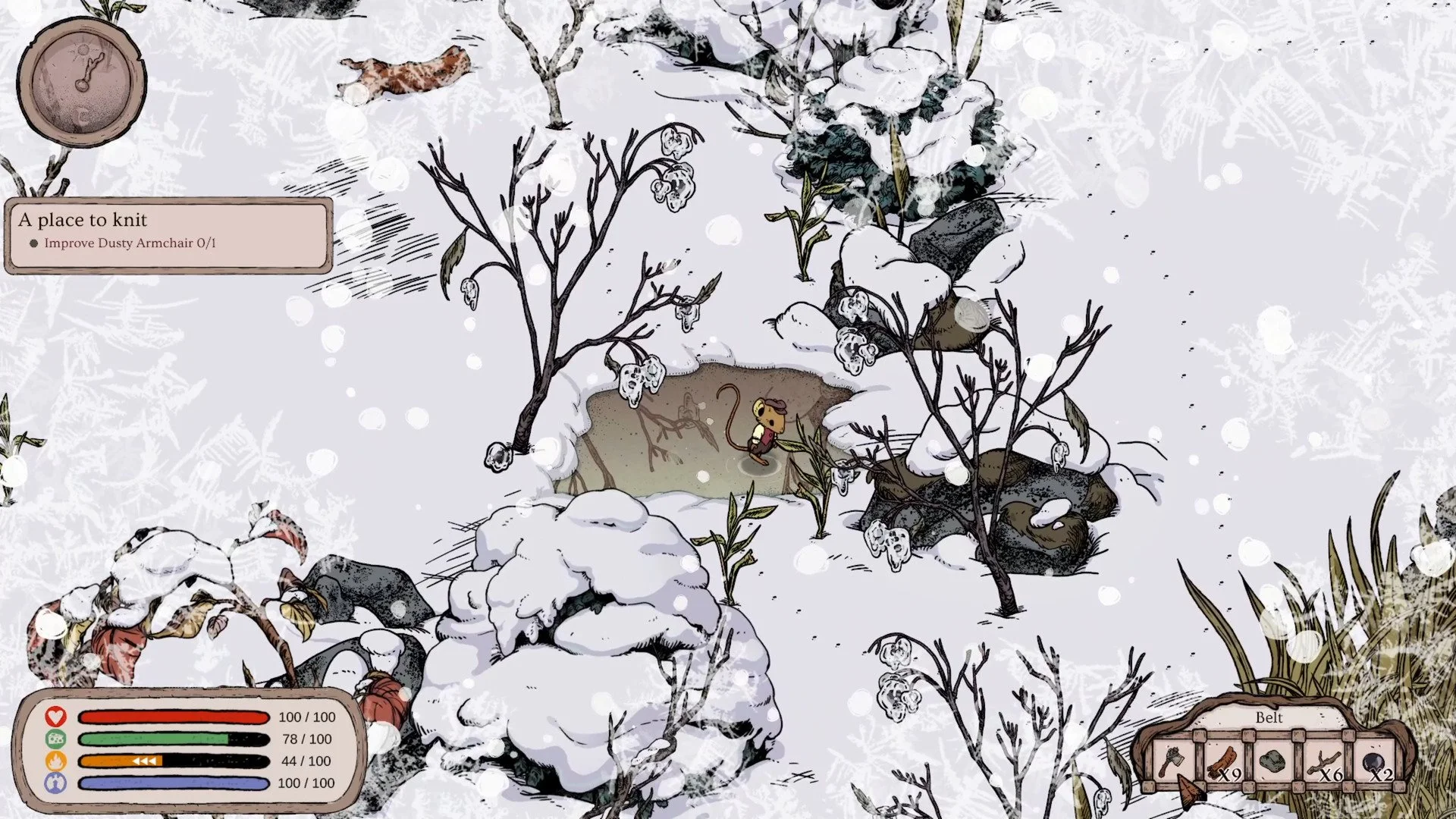
Winter Burrow tricked me. With its storybook illustration–style graphics and cute mouse protagonist, I was lulled into the sense I was settling into a cozy game perfect for whiling away cold winter evenings. Make some tea, sit by the fire, and knit some mittens. Sure, your parents might be dead, your Auntie missing, and your house decrepit, but this seems about par for mouse life anyway. “Oh it’s like Don’t Starve, but cozy and easy,” I thought. Then, I got lost. Then, the edges of my screen began to ice over as my little city mouse began to freeze to death out in the wilderness. I ran around looking for the sanctuary of my warm burrow, but my visibility was reduced by the encroaching frost, and the landscape — like real snowy landscapes — was hard to parse.
This all happened, humblingly, about five minutes into the game. Oftentimes, a game can make its truest impression on me before I know all its ins and outs, and can start thinking how to exploit its mechanics. I ultimately was correct in my initial assessment that Winter Burrow is, in fact, mechanically easier than Don’t Starve, a game with which it invites comparison by sharing the same isometric perspective and focus on crafting to overcome a hostile environment. For example, once I did stumble back upon my burrow, I was able to instantly refill the health lost to the cold at no cost with a nap. Hunger is a meter but not really a consideration, as mushrooms grow plentifully just outside the burrow. A crucial difference, though, is that Winter Burrow’s map is but a hand drawn representation of the area, and doesn’t show your location within it. In those first few minutes — as someone who hates getting lost and also easily gets lost — I experienced a certain terror that Don’t Starve has never been able to touch.
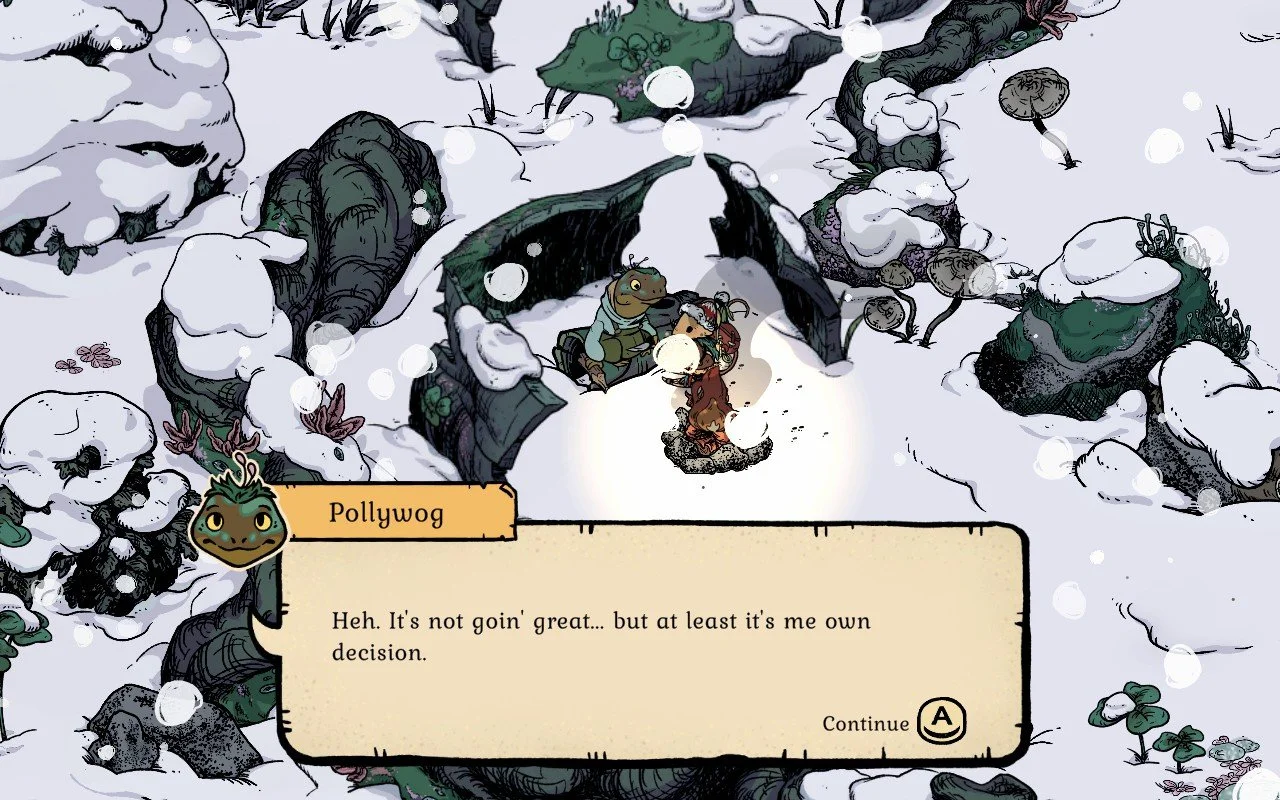
The overarching goal of Winter Burrow is to rehabilitate your parent’s countryside home, which has fallen into disrepair after they moved to the city and eventually succumbed to illness. It is primarily a game about gathering the materials to fix and furnish your new home, starting with basic resources like birch and pebbles and eventually unlocking the sets of tools required to gather hardier materials like oak and flint. The wintry landscape imposes some survival elements — you’ll need to gather, prepare and eat food, in addition to knitting warmer clothes to brave the elements for longer.
For some objectives you’ll have to travel quite far. As health and hunger are easily managed, this leaves navigational ability as the major limitation on exploration, along with warmth. How well you can find your way determines how far you can get before you need to find a source of warmth. There are navigational aids, such as leafy paths between important locations, and notable landmarks. There are also limitations on your visibility, such as snowstorms and a fairly tight camera. Your mouse leaves footsteps in the snow, which can be used to retrace your steps, but can also confuse if you cross back over your tracks. As for maintaining your temperature, the chief means of keeping warm is to bring a home-cooked meal, such as tea and biscuits, which will refill your mouse’s warmth meter when consumed. There are also campfires scattered throughout the forest that can be lit with kindling, and you’ll later unlock the ability to create your own campfires. The characters you meet out in the wilderness, who you will help to overcome their own problems, also produce a warming aura in a nod to the game’s focus on building community in the face of adversity.
A few quality of life deficiencies can detract from Winter Burrow’s otherwise relaxed gameplay. Some of the crafting menus suffer from seemingly random choices that can make things hard to find, such as rope being included under woodworking instead of knitting with the rest of the fibre crafts. That every time I hit “craft” I’m faced with a short animation of a clock, even for a couple seconds, feels like a default holdover from the crafting-game genre that makes less sense here because time is a limitless resource. Additionally, I often wished I could cook food at a campfire in the wild, so I could stay out exploring longer instead of running back to my burrow. This, coupled with the rapid speed at which warmth depletes, dragged down the pacing of exploration in further-flung environs.
There are also moments of weird narrative pacing. When you rescue your Auntie from an owl’s nest, the rescue occurs in a cutscene, jumping suddenly from a conversation with a different character. Another time, Auntie asked me if I was “still worrying about [my] hedgehog by the lake,” dismissively referring to a character, Moss the Hedgehog, we had not previously discussed. Later in the same conversation, she remembers that she actually knows this person, and even has a meaningful gift from them. Then she starts referring to them as “her” Moss, in a complete reversal of her previous aloofness. This is not the only time the game’s writing revealed that I had done something, or even just spoken to certain characters, out of its expected order.
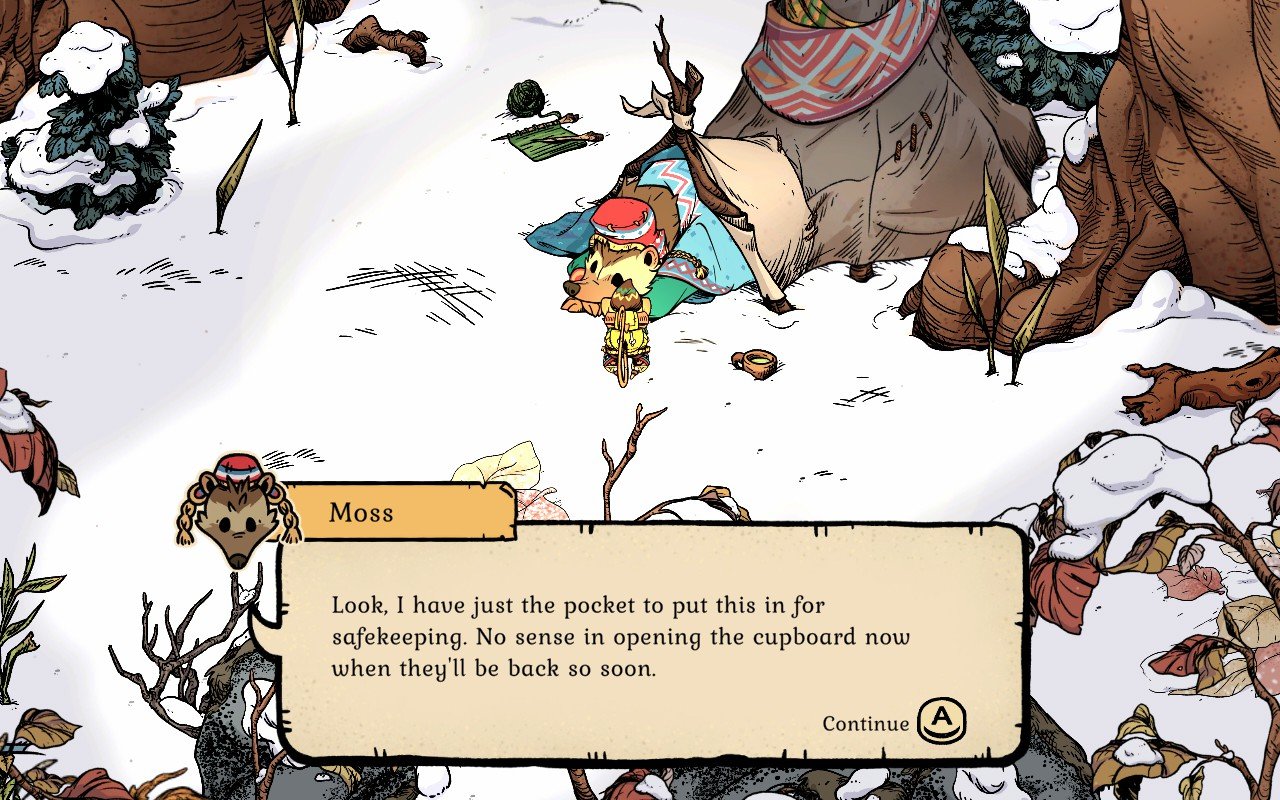
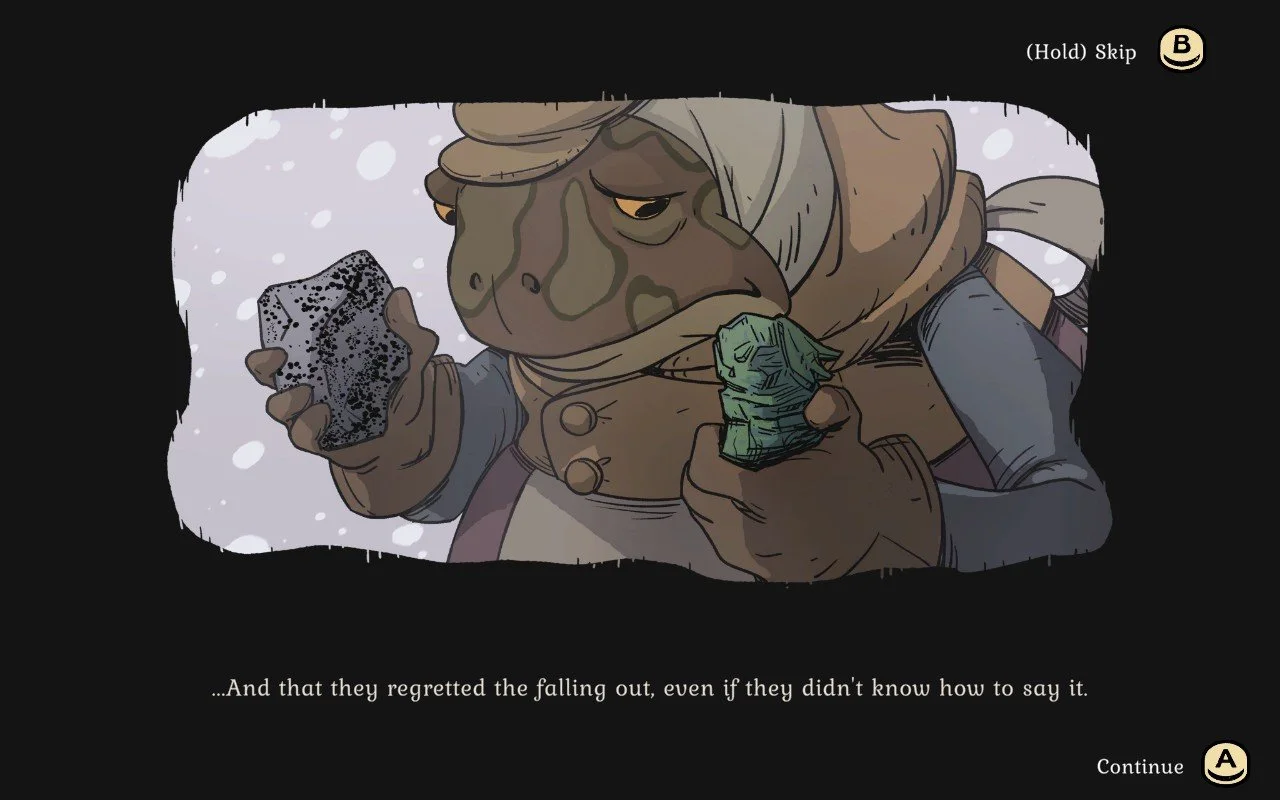
Each of the characters you meet needs your help, and helps you in turn. A common overtone is relationships that are broken in some way. Gnawtusk the forgetful squirrel needs you to find their winter stashes in order to jog his memory of where an owl took your Auntie. The other squirrels exiled him for his forgetfulness, a cruelty he doesn’t seem able to grapple with. Bufo the toad needs your help constructing a house, and eventually finding his estranged son. The aforementioned hedgehog, Moss, is a skilled weaver but is left paralysed by anxiety by the disappearance of their partner. When you encounter them, they would rather starve to death than clutter the pantry full of food that their partner has meticulously organised. There is a clear overtone of co-dependency, one partner’s overbearingness meeting the other’s learned helplessness. By assisting these characters, you help them have conversations they need to have to rebuild relationships. In this way, you build a community of mutual aid for your mouse as these new friends provide the tools and recipes you’ll need to refurbish your late parents’ ruined home.
Even though it initially caused me real panic, Winter Burrow is still a cozy game at its core. You can take your time — winter sprawls infinitely and lazily across the land. While never-ending winter is more often than not an apocalyptic symbol, here it is a blanket. Snuggle in, steep some tea, and stay a while.
Winter Burrow was played on PC with a code provided by the publisher.