Review | Amberspire - Persevering Through Preservation
As developers within the city-builder genre have sought to expand beyond the platted, orthogonal grids of the classics, it is natural to look at the environment as more than a building surface. Rather than something to be dominated and exploited, games like Synergy and The Wandering Village have asked us to harmonize with the land, whether it be planetary or Pratchett-esque megafauna. However, these games sometimes present a utopian view of environmentalism where everything works out if you just build in concert with the ecosystem. The environment, appeased, kowtows to the same expansionism cloaked in conservationism. Having the right technology and outlook would be a panacea, if only. Amberspire, released in early May, rejects this notion by placing your city in irresolvable conflict with the land — and with itself. By doing so, it teaches a deeper lesson than simple eco-utopianism can: sustainable growth necessarily comes in exchange for the pace of growth.
Amberspire — your city, on a moon known only as the Sixth Moon, orbiting the planet Amber — seeks to regain its former glory. To do so it must grow, and to grow it requires resources ranging from the mundane (brick, wax, tea) to the esoteric (quiver, horizon, void). Resources are produced by buildings, which you place, staffed by Residents, who you do not. When new Residents arrive, they often choose to settle exactly where you hoped to place a future building, and in Amberspire there is no eminent domain. Which resources your buildings generate is randomized: a kiln might produce earth, brick, or salt based on a die roll. Sometimes buildings produce Weather instead, which angers the Sixth Moon. A resource can be used to construct a nearby building, or traded for Residents or Influence. Everything in Amberspire is ultimately driving toward generating Influence, except for the moon. The moon is always driving against you.
For every three turns you spend rolling up to six dice to obtain resources, the moon rolls all accumulated Weather dice, plus additional Instability dice from events or destroyed buildings. Floodplains surge, fog encroaches, and the ground drops out from under you, exposing the infinite catacombs beneath. The land is not a blank slate, yielding to avenues and subdivisions. Nor is it something to harmonize with in an eco-utopian exercise. It is here to drag the city into the derelict necropolis under its crust. It steers my expansion, in particular away from towering grasses that produce a punishing amount of Weather dice when buildings are constructed too closely, and require an expensive Habitat to remove. Besides, reducing any of the natural components of the land — flood, fog, rust, or grass — under a threshold carries its own penalty. The disruptions of the land guarantee that optimization and efficiency, typically a mainstay of the city-builder genre, are absent here.
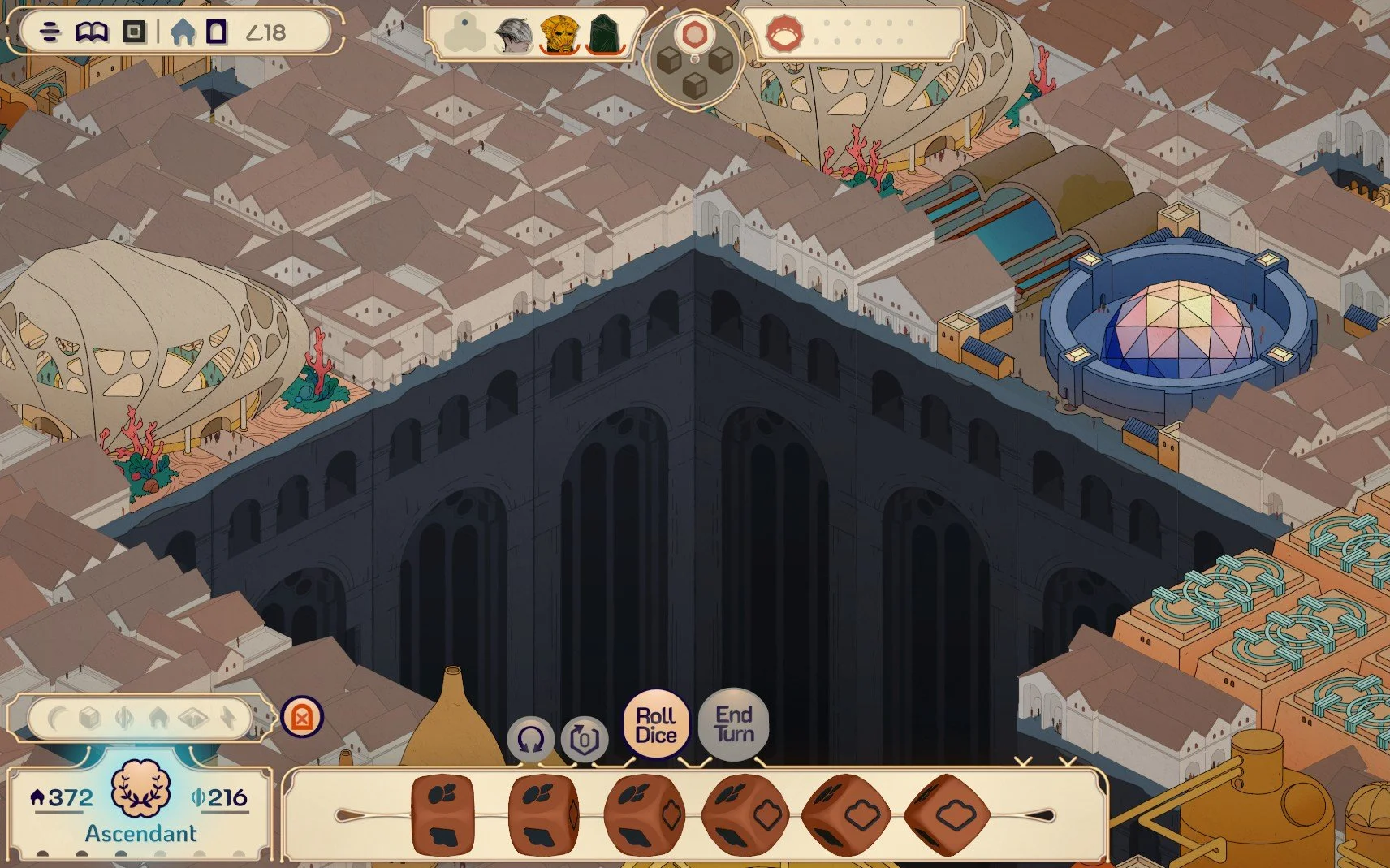
Oh this plunging chasm into an infinite mausoleum that maybe also houses a god-killing weapon? Yeah, it’s just part of living here. You get used to it.
Thinking like a traditional city planner is a sure path to frustration. Thinking like a parasite is more apt, because that’s what the city is to the moon. The parasite must get what it needs from the host while not being so aggressive that its host dies or removes it. The resulting game plays more like a tactical puzzle than a city-builder, to the point that I think it mostly exists outside the genre. The question of each turn shifts from what is best to what is possible that produces some incremental gain. Buildings have interdependencies, and they also have short ranges at which they can interact. Between randomized Resident placement and weather effects, you’ll almost never be able to place a building perfectly. To this end I badly wished for an indicator of where a prospective building could be placed. I found that my imperfect decisions gradually compounded to produce a city that didn’t always work as well as I wish it did, but which also didn’t feel like it was carved into the earth by the hand of a god.
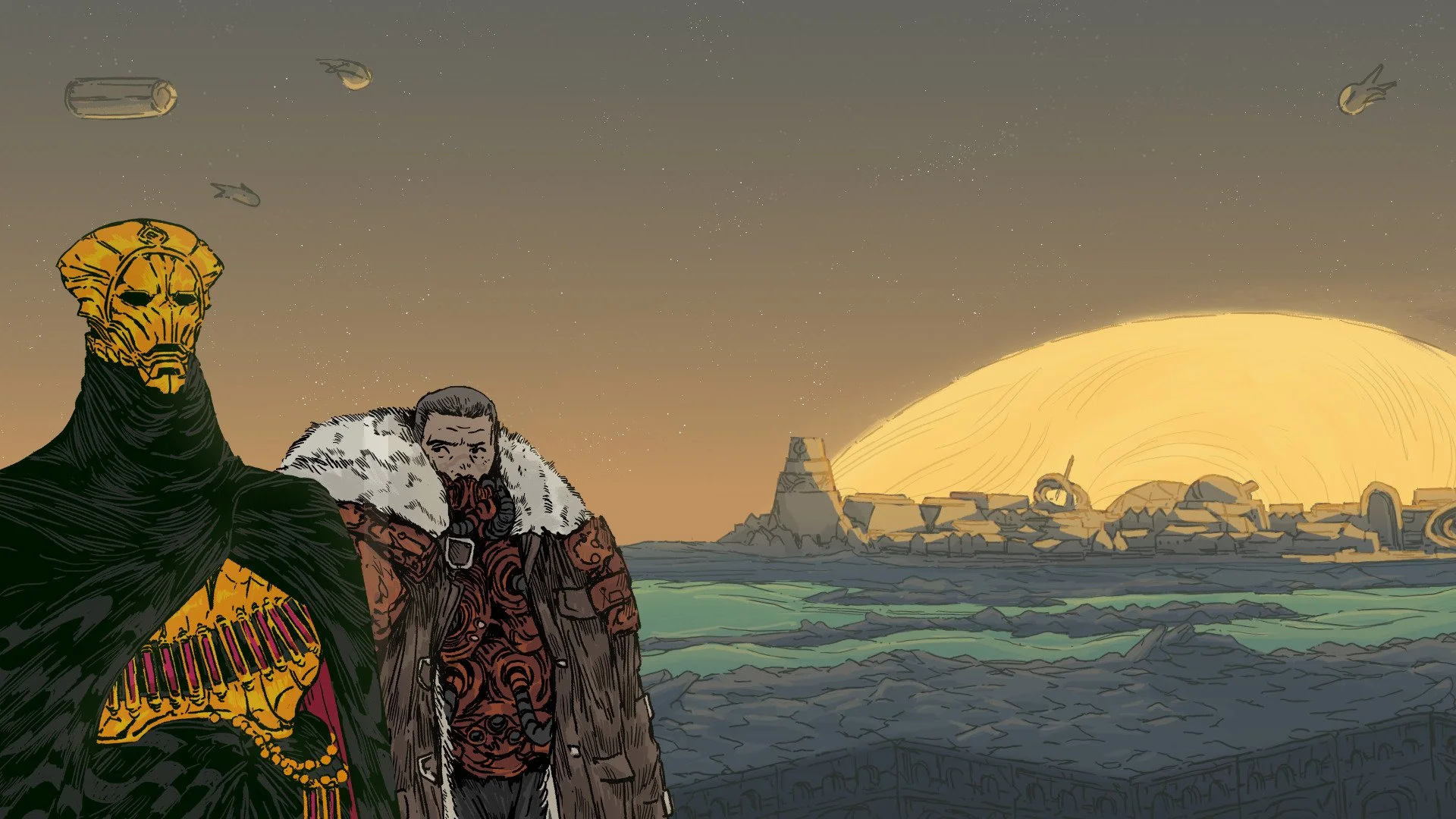
The game’s art also serves to make the city feel like its growth is by necessity rather than preordainment, by drawing from older civilizations such pre-modern Venice, Persia, and the Eastern Roman Empire. Buildings are clustered closely together, implying easy access by foot and all the incumbent alleys and interconnectedness. Although residents arrive via interplanetary travel, there are no terrestrial vehicles in Amberspire, and boulevards serve as elongated piazzas. This style seeks a medieval organicness, though it is at odds with the logical grid on which the game is played, placing the art in tension with the mechanics similarly to how the moon is in tension with the city.
Once I understood the mechanics, I did not find Amberspire to be a very hard game. My city lurched through levels of Influence effectively enough, despite my hodgepodge building placement, unlocking new buildings for me to cram in. A more influential city attracts the attention of off-world factions, with interesting designs and lore, to meddle in your matters. However, the game’s randomized elements mean that progress drags precipitously past the third tier of Influence, so it maintains a slow pace. As you unlock higher tiers of buildings, their supply chains become ever more inefficient. They also generate more events, which I almost always found to be bad for my city and often drained Influence. Events tie into factions, but I so rarely got an event to boost a faction’s strength or opinion that I left them angry and anemic, an unexplored facet. As I worked up the chain, I began to struggle with my own growing annoyance more than the moon’s environmental curveballs. Despite this, success is pretty much guaranteed if you’re willing to grind out the last tiers of Influence. Keeping the moon’s dice pool minimal means the weather is easy to deal with, but it also means expanding slowly and methodically.
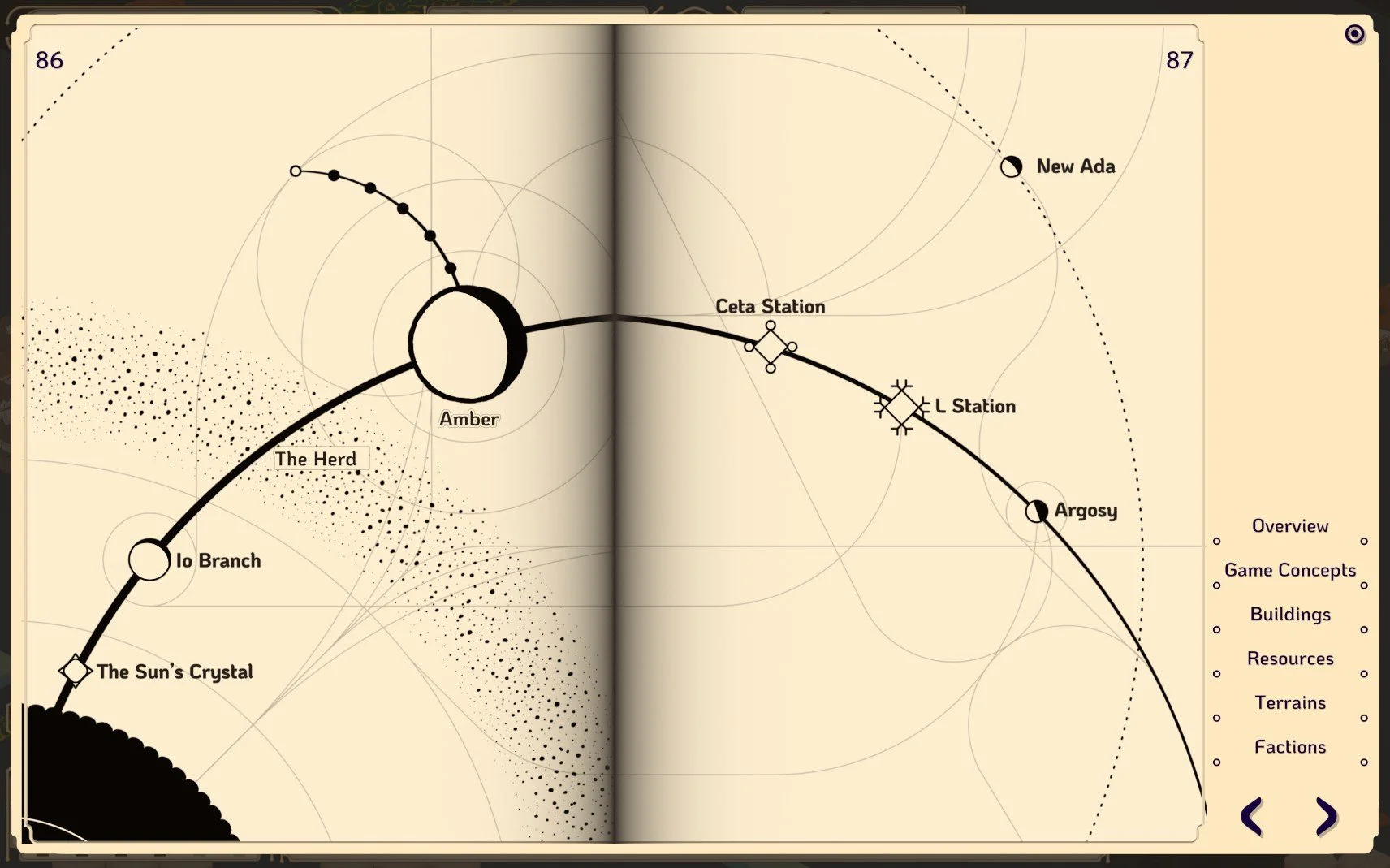
The game comes with a full manual explaining all its concepts and lore.
Some frustration is not always a bad thing in a game. On the contrary, I believe today’s games are frequently too eager to remove obstacles and friction, and in Amberspire the barriers to progression uncovered a unique perspective I think other eco-builders miss. I was frustrated because I could plot a clear path to the win condition, but I could also see the slog to get there. Buildings would wind up just out of range, and need to be rebuilt elsewhere. Events would hold me back, and randomization would foil my plans. I had an expectation of the genre that harmonization with the environment would allow my city to continue humming productively along, a checkmark in a box labeled Be Nice to the Environment. This thinking is rooted in the same capitalist logic as real-world ecological policy, where if we can just hit the emissions reduction goals and invent the right technologies, the status quo can continue unchallenged. Growth can continue unabated, albeit greener. Amberspire subverts this logic by making it impossible to resolve the tension at its core. The moon will always be arranged against the city. There are no buildings that mollify the land, only ward against it. The answer in the game, as it may be in real life, is that growth cannot be prioritized above stability. Its slow pacing, rather than a design flaw, is its strongest message.
Amberspire was played on PC using a code provided by the publisher.