Madeline Blondeau Reflects On Finding Faith At The Arcade And The Feet Of Mother Mary | Winter Spectacular 2025
The escalator carries me to the upper floor of a renovated Sears, and I’m greeted by the loud chirps and whirrs of electronic gimmickry. Lights blink, strobe, and flash; I wince a little, then my eyes adjust. A smell of human stench and processed food washes over me as I’m carried into the Vancouver Mall Round1 – two days after my 32nd birthday.
This Round1 opened a year or so after the lockdown lifted, which was also a little over a year after I moved back to the Pacific Northwest. My first run-in with the chain was the ramshackle Atlanta location in 2019; because ours is newer, it’s always had a bit of an edge from the get-go. I’m sure the Vancouver Mall location has nothing on the sprawling Japanese locations, but for what it’s worth, the management keeps it clean and updated.
But something’s rotting beneath the flashing lights – a dull dirge of decay, thrumming beneath the rhythm game cabinets. It’s the spectre of late-stage capitalism, once the arcade business’ best friend and now its worst enemy. A few years ago, this Round1 had three dedicated aisles of fighting game machines. They ran the gamut, from the expected Street Fighter and Fatal Fury to oddball picks like Battle Fantasia. It was a good way to unwind after some rounds of Dance Dance Revolution or bowling.
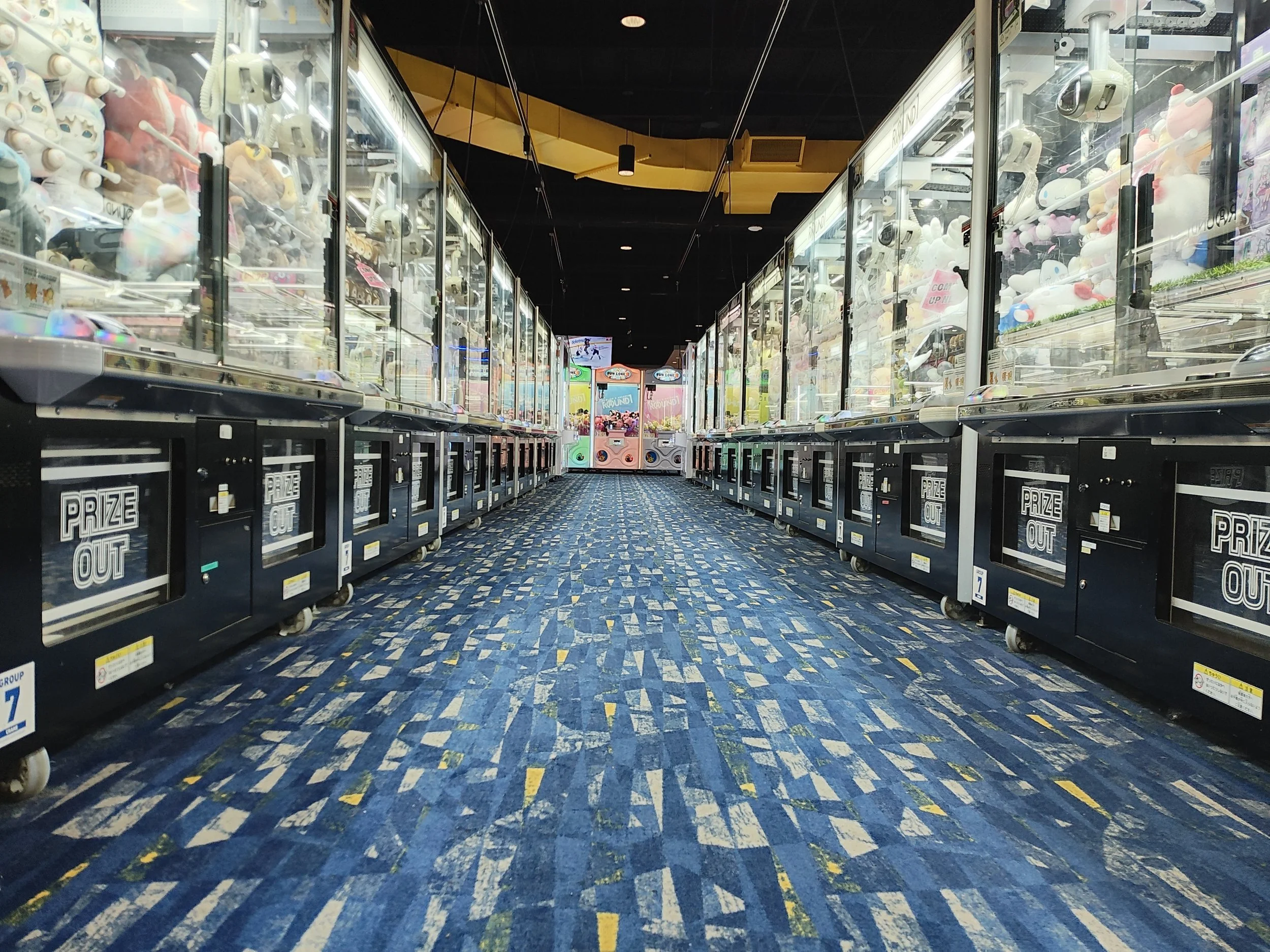
That section is gone now. There are no fighting games in Round1 – not unless you count the Raw Thrills Contest of Champions and Injustice cabinets. In the section where those games used to be are now rows and rows of crane games. Crane games, in fact, are what make up a good quarter of Round1’s floorspace. Rows and rows of sterile, translucent plastic filled with different trinkets – soft and hard – designed to coax players out of their money. Some are ‘peg and hole’ games; others are ‘knock the thing off the conveyor belt’ games. But at their heart, these are all crane games – big boxes designed to part suckers from their paychecks.
Much of Round1, in fact, is now the domain of gambling. While arcades and casinos have always been a hair’s breadth away from each other, classic arcades at least had the defense of artistic integrity. Before 2010, arcade development was still focused on linear narrative experiences. Rail shooters, racing games, and fighters were still arguably the most viable genres, and still got routine iteration from American and Japanese developers. It was rooted in the pre-2000s arcade days, where players had a built-in expectation of what an arcade was. In the cultural mindshare, you went to arcades to beat games and get high scores.
I’m not sure that’s what an arcade is to most people now – not if Round1 is anything to go by. While entertainment complexes like this have always been a different bag from traditional arcades, I spent a fair share of my childhood in Dave & Buster’s and Jillian’s alongside my local mall gaming hole. These, too, used to have real games – House of the Dead and Time Crisis, Daytona USA and Tekken. Yes, there were ticket games and crane games – but they were their own section that your little cousin could fuck off and go play around in.
But modern-day Round1 is the domain of little cousins. Loud, flashy wastes of money with promises of pretty cards, a cute stuffed animal, or tons of tickets. The Round1 prize center is one step removed from pachinko redemption – Apple TVs and mid-range appliances sit alongside anime figures and kigurumi. If you start to think about how much these things cost, how much it might cost to win them with tickets, and the average income of the American family, it all starts to get a little depressing. Prize games were my least favorite parts of the arcade, but now, the entire experience feels catered to them.
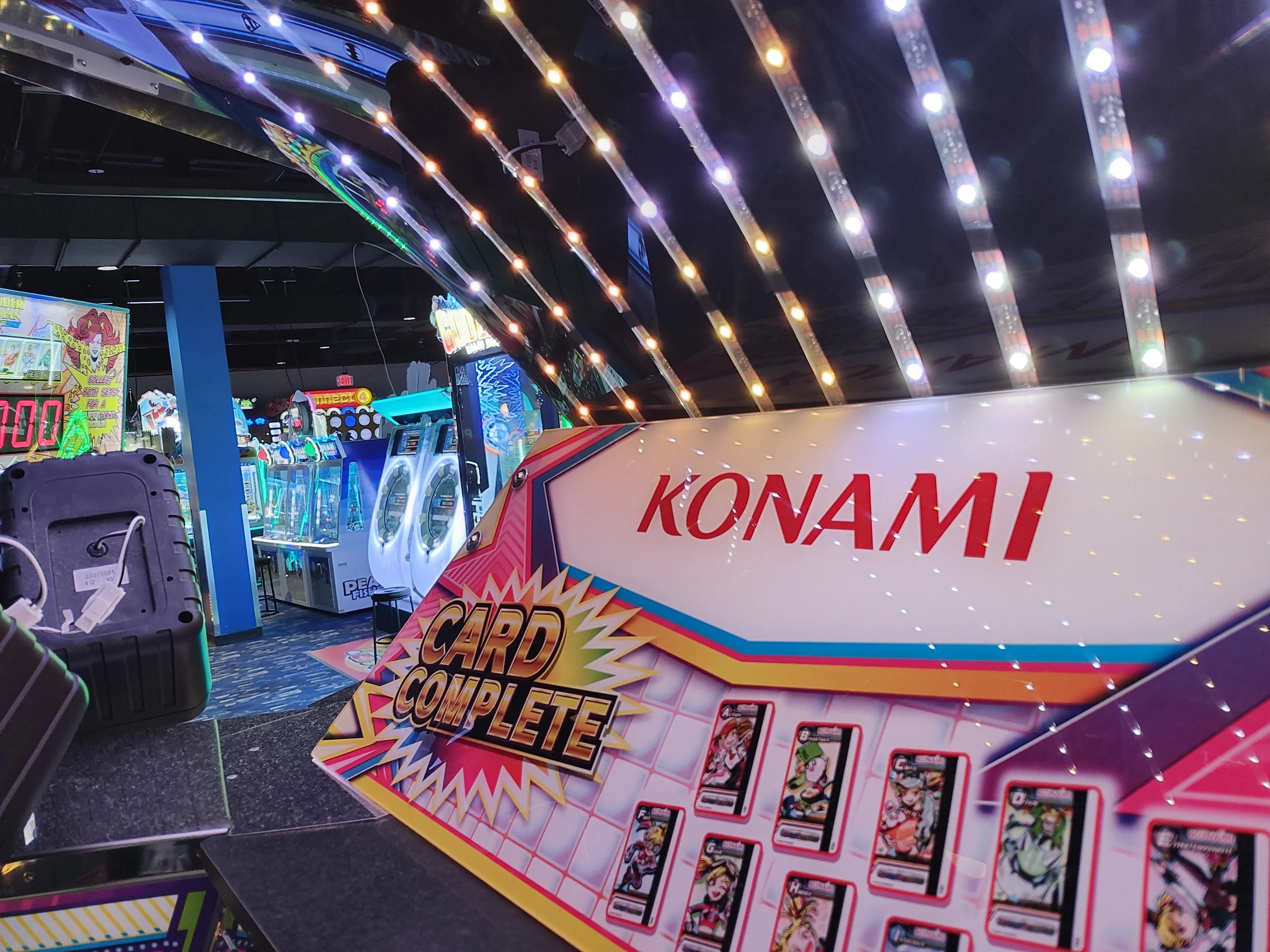
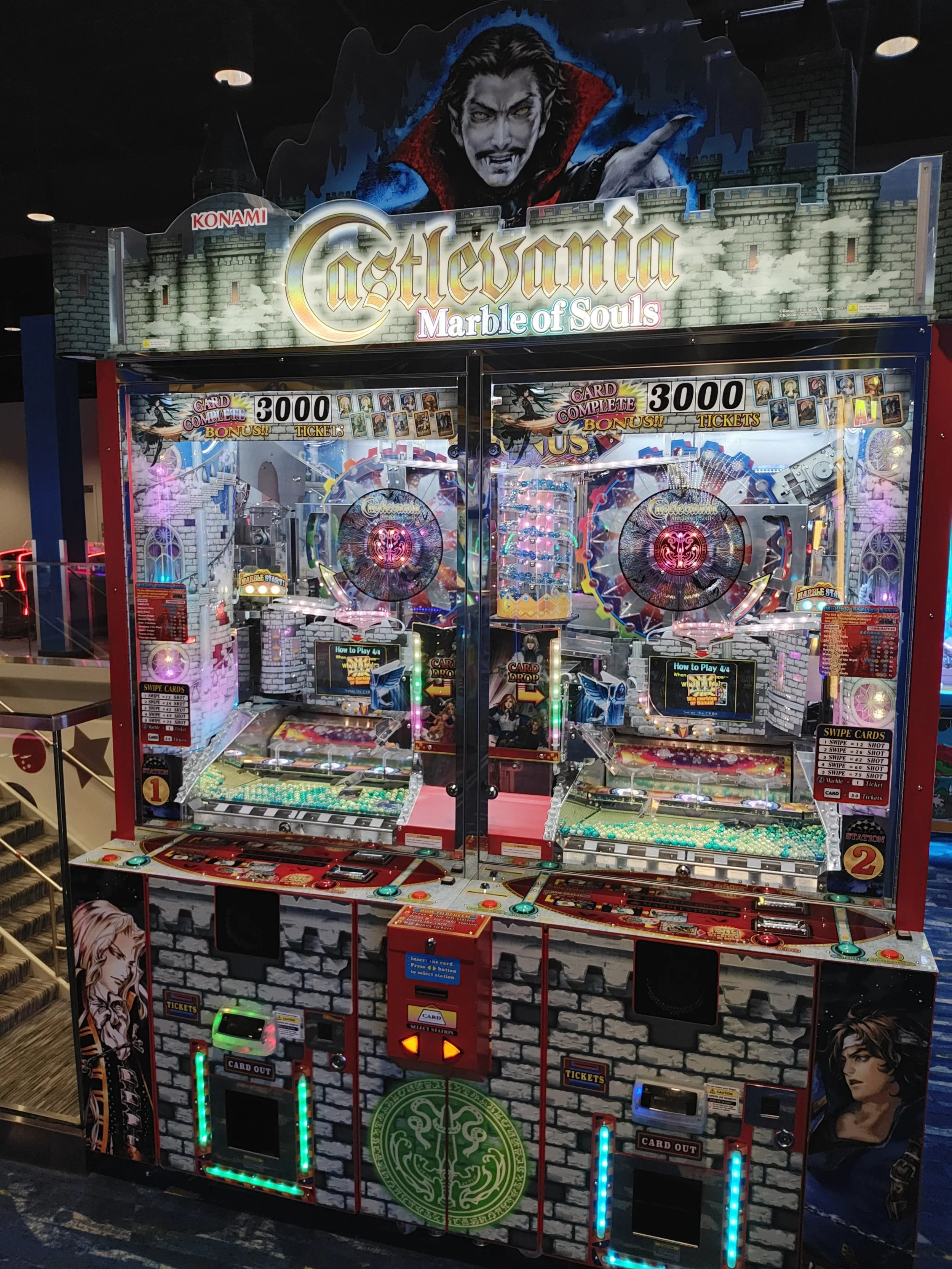
And nobody is more eager to fall in line than Konami. As a video game publisher, I think they get entirely too much hatred; as an arcade manufacturer, I think they’re the fucking anti-Christ. The one-time custodian of classics like Turtles in Time, The Simpsons, and X-Men has raided its broom closet of dead IPs to fashion their corpses into a candy-shelled eldritch contraption. What was once a seal of quality is now a promise that you’re going to get bilked for every last credit in your Round1 card.
Konami is the publisher of Gold Railroad, a cabinet that would be right at home in 47’s White House. It’s certainly gold enough – gaudy, ugly, and loud too. The entire premise is built around pumping credits into the machine to earn cards and trigger a mechanical golden train. These cards, once distributed, can be put back into the machine for obscene amounts of tickets. It’s a popular mechanic in these sorts of prize games now – gamble for a chance to get a high rarity card, then give the card back to get money. It’s the logical, chilling endpoint of gacha gaming.

This is where Konami excels now. It makes a lot of these titles, and most of them are made up of its most recognizable properties, both domestically and abroad. Power Pros Baseball has probably made more money in America as a gambling cabinet than it ever did as a standalone baseball game. And while Castlevania may be dead, it lives on through a terrible iteration on that aforementioned ‘card’ mechanic. I played a few rounds of this machine; each round costs 12 credits. I actually scored one of the ticket cards, but the machine didn’t dispense it properly, and I couldn’t do anything to dislodge it. Functionally, I wasted money for a chance to get something, and when I got it, the machine didn’t operate as expected to dispense that thing. At least slot machines work.
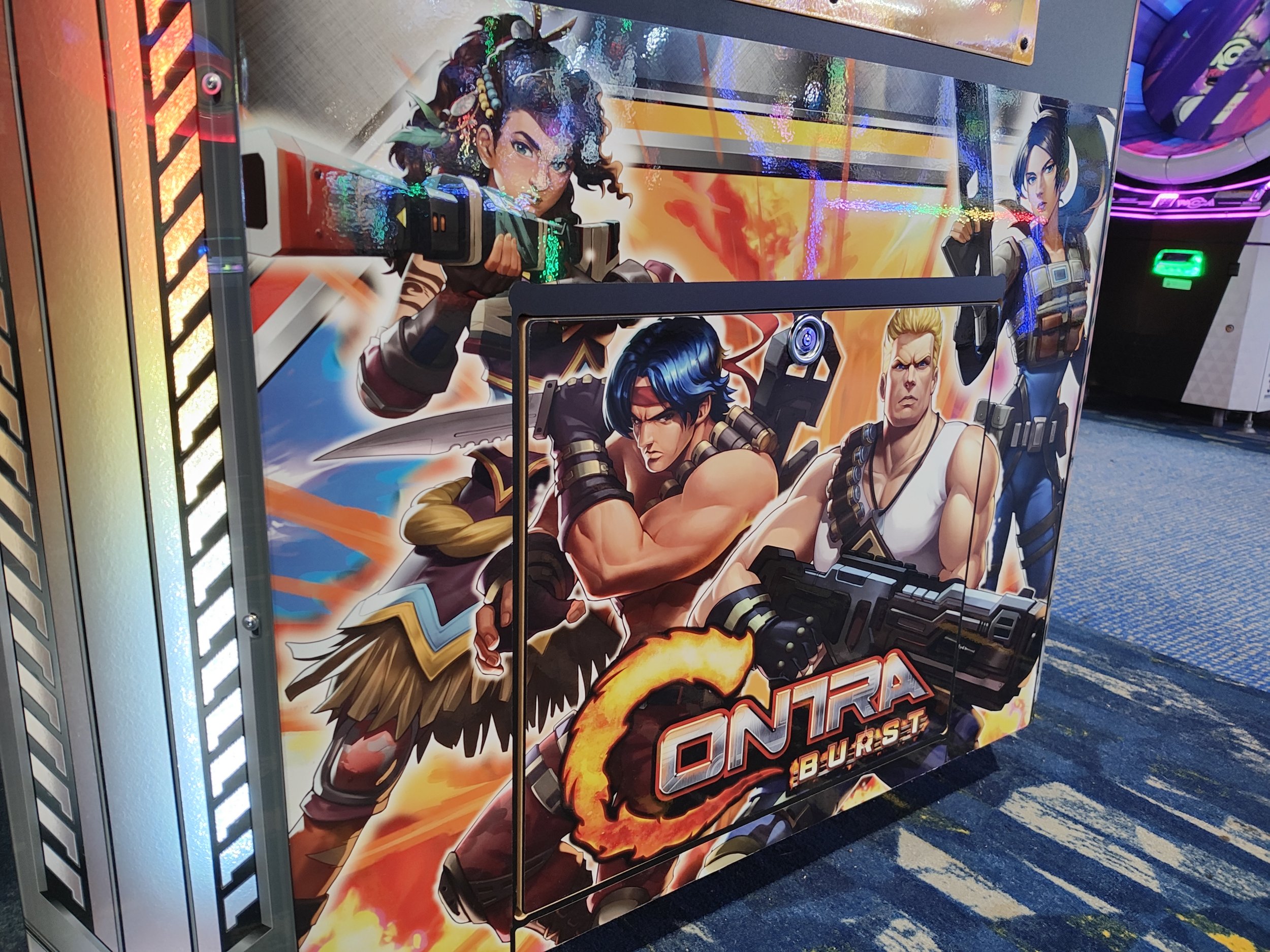
Most distressing, though, is Contra Burst – a terrible side-scrolling rail shooter that flips assets from the good, unsung Operation Galuga. While there is an original story set in the Contra universe with unique cutscenes and the like, it’s all stretched around what is – at its heart – a ticket game. The game’s stakes are rigged so that it takes players right up to the point where they’re about to get a big ticket bonus, then ups the damage requirements and throws screen-filling garbage at them. This is nothing new for rail gun games, but older titles were made simply to play – the goal was to see all the cutscenes or clear multiple routes. When you stretch what is – functionally – a broken, flat shooting gallery game over a ticket game, you get an unholy slight against game design that should not exist in a just world. But we do not live in a just world, and Contra Burst is a reminder of that.
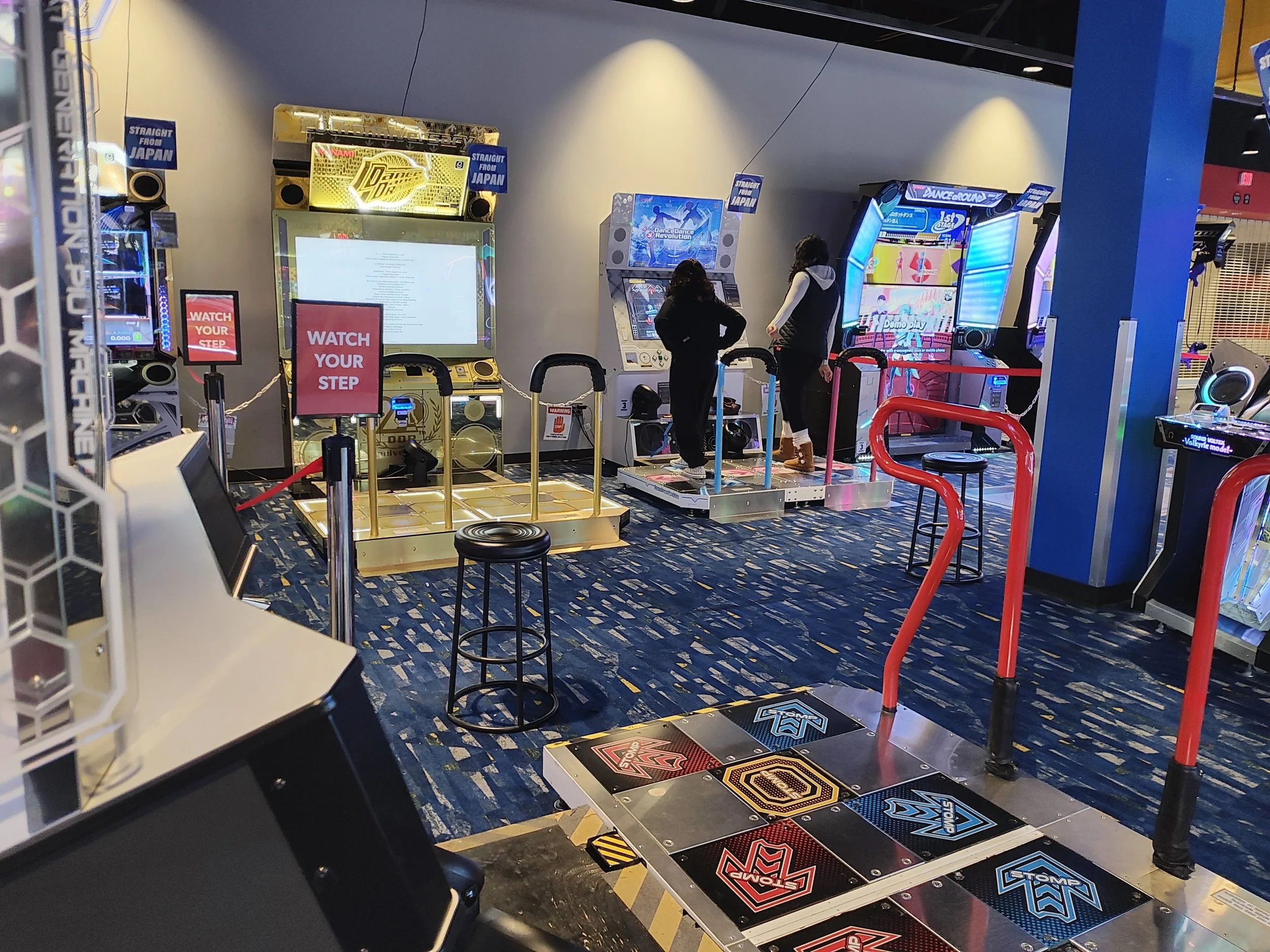
But when they’re not exploiting the labor of contract artists for gambling machines, Konami still cannot contribute meaningful fun to the modern arcade landscape. Nowhere is that more telling than in one of its signature series – Dance Dance Revolution. After a decent few years in the 2010s, going into the 2020s, Konami released a drastic overhaul called Dance Dance Revolution World. After a few rounds with it, I can confirm the game is a disgrace. It’s a bright casket for almost 30 years of video game history, encased in cumbersome menus and slathered in the ugliest U.I. to haunt a Konami rhythm game. It seems in their pivot to stripping arcades for parts and turning them into glorified pachinko parlors, whatever skeleton crew they’ve left on the Bemani games has none of the aesthetic know-how hallmark of past entries. The timing on older tracks also feels abysmal, and the newer tracks are the furthest thing from certified bangers. I’m not alone in this, either – the fanbase generally reviles the game, and has since it launched.
Because of how Konami operates, though, I will likely never get to play a good Dance Dance Revolution at this Round1 again. World – the first entry, which does not support CRTs – was released as an upgrade kit that patched the superior A entries out. Of course, management didn’t bother to change the cabinets, because that’s a costly process. So we’re now stuck with one of the vaunted DDR ‘gold cabs’ and an A2 cab that are infected with what should really be considered rhythm gaming malware.
But other rhythm games aren’t doing much better. The aging Project Diva machine is in disrepair. Voltex machines have lost their shiny new luster, and the new Beatmania has one player on it – maybe two – that I observe all evening. What especially breaks my heart is that TeToTe, one of the most exciting rhythm games of the past decade, was shuttered last year. Its cabinets sit unloved, barely played near the Konami rhythm titles. Whole swaths of the tracklist are now missing thanks to lapsed licensing rights; characters are also missing. When pre-internet games fizzled, if owners didn’t wipe the memory and put in another game – or just put in a different NeoGeo cartridge – they could be taken out of commission and still enjoyed by a private collector. Not so in this cowardly new world.
Beyond the rhythm games – just past the massive rotating Godzilla gambling card game – lie more traditional ticket games like skeeball and free throw alongside the driving games. Here’s where I’d say I had the most fun this evening. A game of skeeball never gets old – it’s one of those perfect, irreplaceable feelings that no good arcade should be without. The satisfaction of that thunk when the ball hits the ramp, and you watch it hit the place you meant it to… There are few things like it.
I do have fun in this section. Raw Thrills’ latest money-sucking geek show, Top Gun: Maverick, is actually a respectable arcade racing game with a fancy gimmick. Players are boosted into the air via hydraulic suspension as their jet fighter rocks and sways beneath curved vertical screens. The effect here is tremendous – while the game itself is pretty straightforward, and cut from the same structure as the publisher’s Fast and Furious title, it’s the sort of high-octane adrenaline blast I went to the arcade for as a kid. Expensive, explosive, larger-than-life, and over in under an hour.
Two other sit-down games are also head-turners – Hyper Cross and Kaiju Battle. Both are from Chinese developers, who I’d argue are some of the only ones keeping the dream alive when it comes to the classic arcade experience. Hyper Cross is a blistering bike game where players hop on a bucking, rumbling device that’s somewhere between a jet ski and snowmobile. Play time is generous, and the game thankfully avoids the classic arcade racer pitfall of not allowing a player to get through a race due to restrictive checkpoints. Kaiju Battle, meanwhile, is an over-the-top sit-down Unreal Engine rail shooter. Like Deadstorm Pirates or the Walking Dead cabs, players sit in a dark enclosure to man two guns and shoot through hordes of baddies. The threat here is in the name – giant monsters, and lots of ‘em. Between these and budget-priced shooting gallery Marksman, Chinese developers look to have a genuine interest in making arcade games that are more than glorified slot machines or IP-based retreads.
I’m also a fan of the new VR games trend; Sega’s VR Agent is especially impressive, though overpriced. While the optics of putting on goggles worn by every snot-nose kid and their grandma feels especially nasty in a post-COVID world, I can’t deny the carny allure of these things. Though it’s still early days on a lot of these games, we’re a long way from Beach Head – these modern VR rail shooters are kinetic, enthralling romps that deserve your attention.
Yet for all the positives, a fear hangs over me. The fear that these are, finally, the twilight years of arcades and amusement centers as I once knew them. They are the domain of those weebs walking around with armfuls of Hatsune Miku figures – dorks with ample disposable income, who don’t mind blowing $60 or more on a $30 prize figure. IPs I love will be deflowered and paraded about like fallen empresses, studded in ringed jewels forced into prolapsed breasts by their capitalist owners.
I don’t have to go here. In the Pacific Northwest, I’m spoiled for choice from mega-arcades like Next Level and Ground Kontrol to more bespoke numbers like Gizmo’s, QuarterWorld, and Galactix (and that’s not even getting into pinball or the local fighting game scene). There are people who care enough about experiencing games like this, in 2025, that they will risk money in a bad company, so people have a place to play. So – why even go to an amusement center in a region with so many hallmark gaming destinations?
There’s another notable landmark in the Pacific Northwest – a secluded monastery off Sandy Boulevard. The National Sanctuary of Our Sorrowful Mother – more commonly called The Grotto – is a sacred site kept by those who live and worship there. This is where we went the weekend after our Round1 visit. We parked a few blocks away, then walked through the neighborhoods, across the boulevard, and into the enshrouded place of worship. Outside the perimeter, far-right evangelicals warn us all that we’re going to Hell through a megaphone with a gleam in their eye. Even on home turf, some Christians find the need to use Christ’s word to terrify children with tidings of eternal damnation. I think they’ve missed the point – Matthew 18:6 comes to mind.
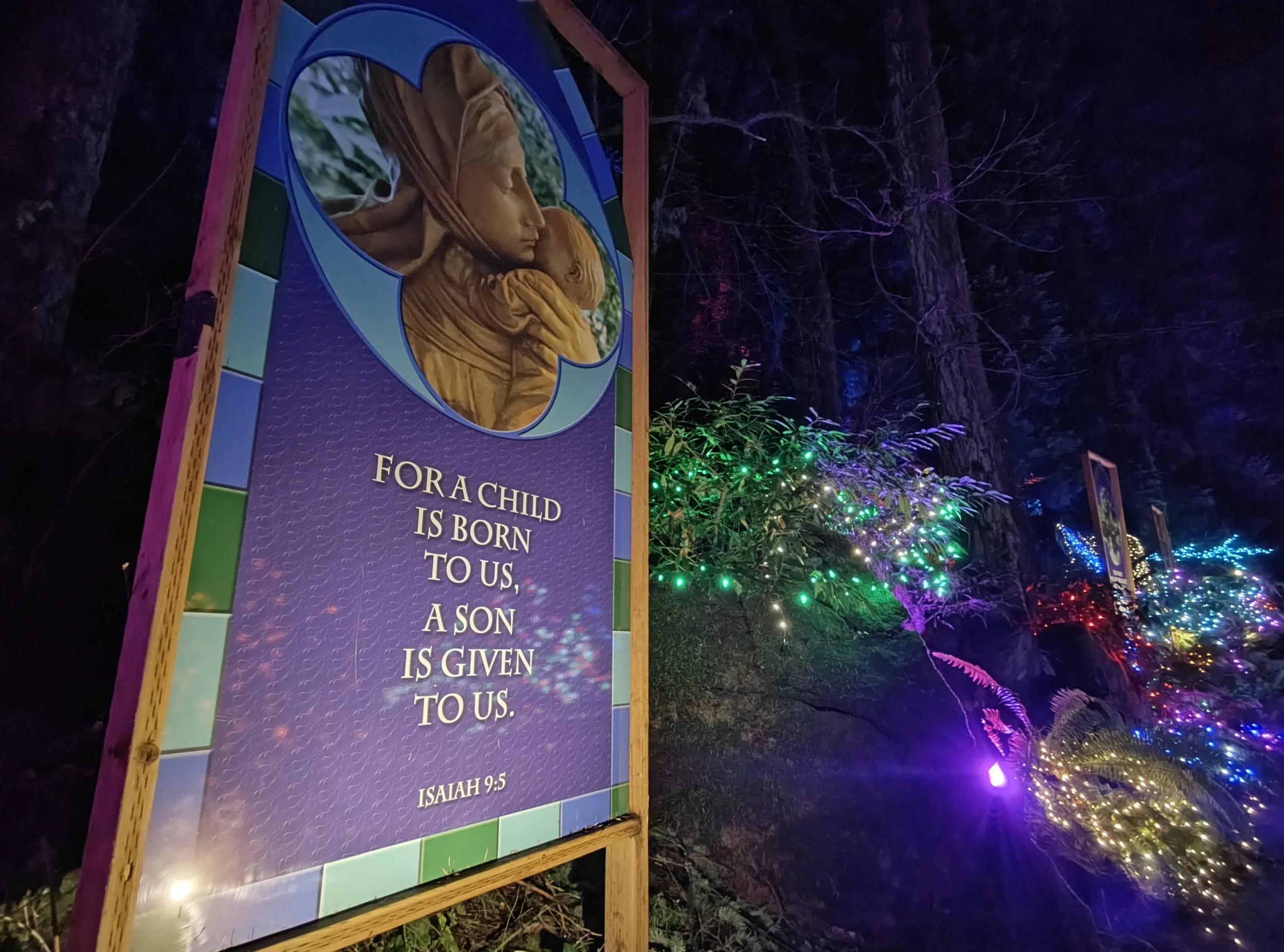
The walk in, thankfully, is much more reverent. Through the dark, I follow a path of coloured neon lights strung through the trees and foliage. Signs are uplit along the paved walkway – from beneath, speakers do dramatic readings of scripture that correspond with the text. After the first couple of signs, a statue of Christ – glowing, white – appears on the hill above. His arms are open wide, welcoming, beckoning us into His mother’s home. I continue, His gracious welcome making me feel a little more at ease in the cold as I try not to dawdle and hold up the crowds behind us.
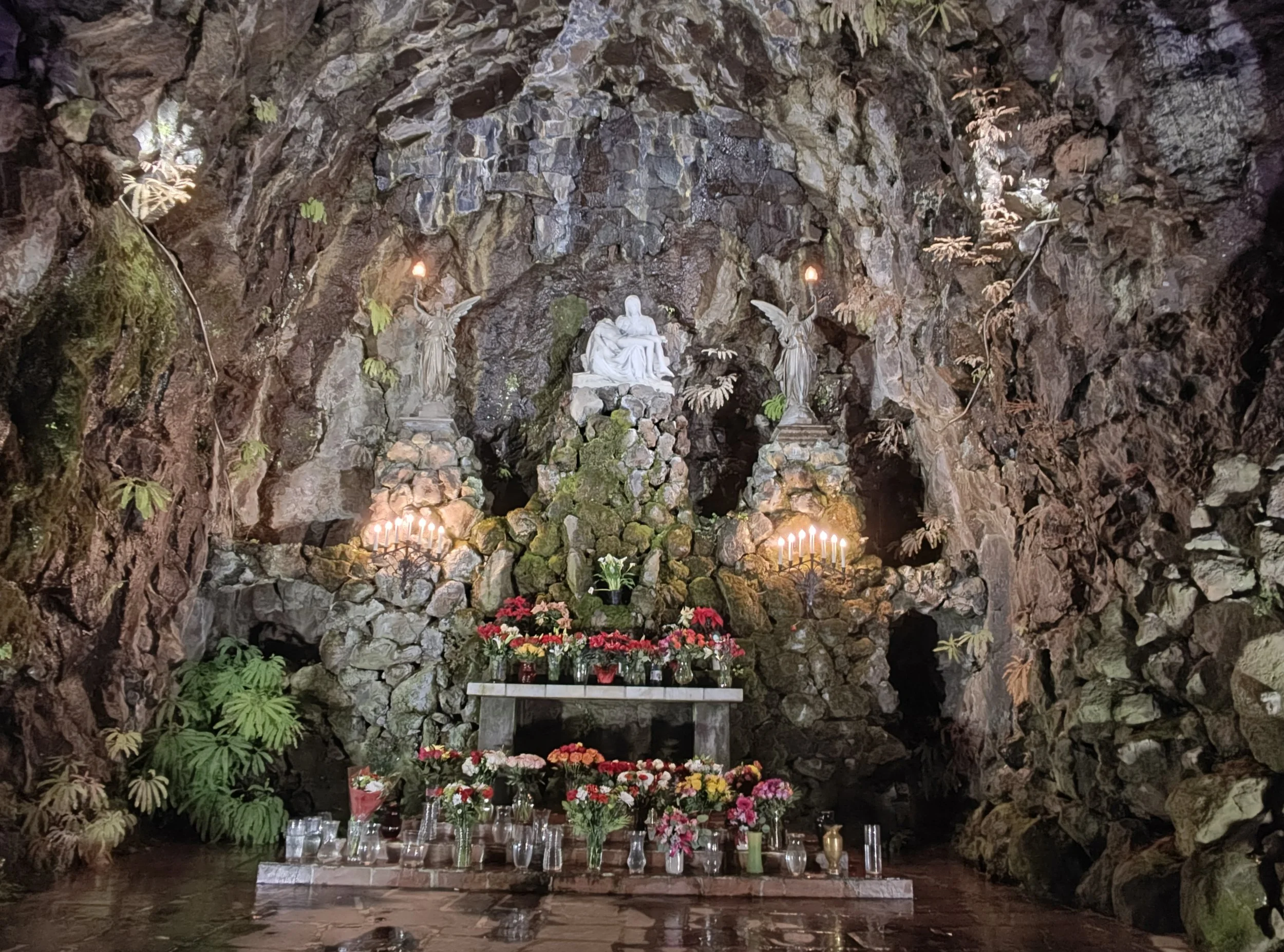
This pathway eventually lets out into a large center area, with an enormous lit tree and a large, ornate nativity display; next to it, the sanctuary’s interpretive center, a large chapel with stained glass, and a tall bell tower. Most of the sanctuary is closed off during the annual Christmas Lights celebration, a heavily marketed Portland tradition. But a central part of the proceedings is a marble recreation of Michelangelo’s Pieta, which overlooks the center courtyard. A hallmark of the Grotto, the statue is seated within a cave carved into the side of a 110-foot basalt cliff. Mother Mary and Christ are flanked by angels on either side, who hold lamps styled like torches aloft. Beneath them are shelves of candles, all lit and placed above numerous bouquets; above, a star is projected onto the magmatic rock.
The winter chill stings my stuffy nostrils as I draw in a deep inhale, then reach into the pocket of my denim jacket. Wood clatters, and I pull out the cheap rosary I’ve been using for the past year. Before I leave, I’m going to finally invest in a new one from the sanctuary; but right now, right here, this is all I need. My girlfriend at my side, we walk up two squat flights of steps to see the Pieta up close. As I come to the railing, and continue to crane my head up, the beads in my hand begin to tremble. I’m not that cold; rather, I am in awe at Her beauty. After several moments of silence, I clasp my beads and recite the Lord’s Prayer before I launch into a handful of Hail, Marys.
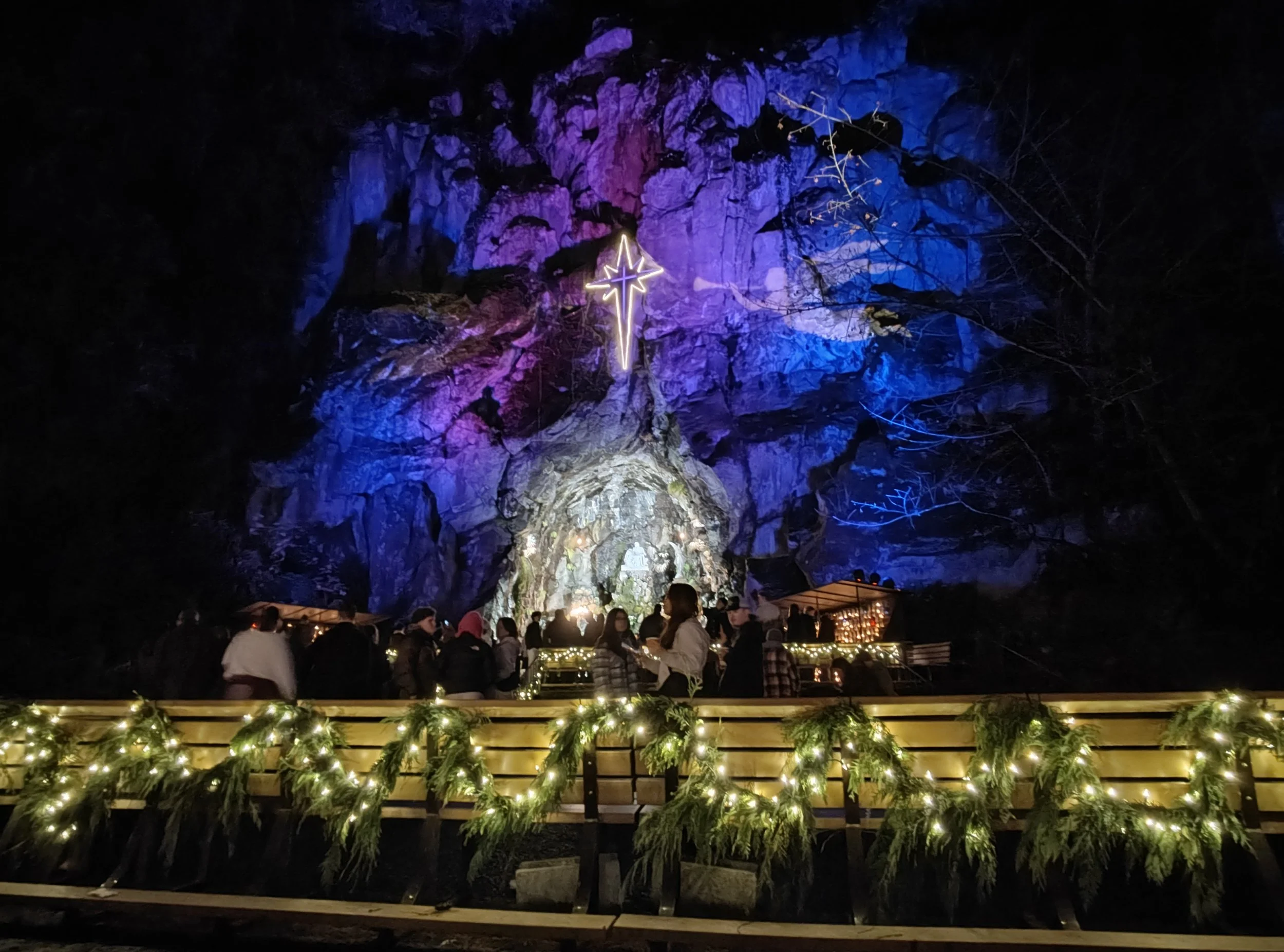
Beneath the Pieta, I grapple with the fact that I spent over a decade running from this. That until recently, I have denied beliefs central to why I even transitioned. My earliest conceptions of myself as a woman were in church pews, on my knees with my eyes closed as I imagined what veils and habits might feel like. As I look up at Mother Mary and think of her sacrifice – the loss of Her son, Her only son, bleeding out in her arms from wounds dealt by a fascist nation-state – the weight of my belief holds me in place. Chatter around me dulls; even on this busy night, I feel the air go still. The corners of my eyes begin to burn, as my throat clenches and chest opens wide in tingling, radiant warmth. My vision tunnels, and the only thing I can perceive, in honesty, is Her – countenance frozen in contemplative, graceful grief. Glowing and gorgeous, as she always has been.
In that moment, I look up at Mary, and it feels as if She can see right through me. Years of living in sin to a lover who molested me, in a body that was dishonest, addled from alcoholism, and a lifelong eating disorder. Mary can see through it all – and through Her own suffering, incomprehensible to a woman without a womb, She spares a moment for me. Every ounce of suffering up to that moment feels lifted from my shoulders. My own cross, dashed to splinters beneath the might of Mother Mary’s mournful stare. I turn around – a crowd of people has gathered, and sound has returned. Carolers sing “What Child Is This?”. Her Son is remembered for another year.
I choose to keep my faith. Not because anybody is forcing me to, or because I think it makes me better than anyone else. I believe value and wisdom dwell in the teachings of Christ, and what historical documentation we have of His life makes me feel immensely grateful for mine. Further, I have belief that these teachings – as well as the Old Testament and the Apocrypha – have more worth, grace, and beauty in them than Christian Nationalists would have our culture believe. These charlatans are here to test us – to wrest Christ’s teachings from our hands and pervert them into terminally un-hip tracts to fit their wicked intent. It is the obligation of those who believe to do so loudly and without shame. If His sacrifice meant anything, we must be willing to stand up against those who would use His words to lead His flock astray.
It is the lamest thing in the world, in the online trans mecca, to be a Christian girl who listens to country music and watches pro wrestling. Conversely, you won’t catch me at an average country show or local church because of the types who go to those places where I live. But I’ve learned that you can’t live to fit a scene – unless you’re a fucking poser, anyway. You need to be authentic to a fault, and go where your heart guides you. Over the past two years, I’ve found my way back to the woman I should’ve grown into, and it is my faith that’s helped me back to that core identity. Through that core self I feel I can more thoroughly and fully enjoy art again – that I can actually have fun watching movies or playing games with a secure sense of self. Not to impress anyone, but just to complicate and enrich my understanding of the world. After all, I did not transition to get attention – to shock people, to push the envelope. I did it because I did not feel normal before, and now, I feel like I actually can.
Which is funny, because in online trans terms, I worry that makes me sort of a freak. You just can’t win!

But eventually, you have to stop trying so damn hard to make up an image that fits in with what people online tell you being trans, or Christian, or a gamer, or an anime fan is. I spent so long in arcades and anime cons, growing up, running from who I was to try and fit in. I leaned hard into otaku culture for much of my life, wearing it as a loud signifier in hopes that it would make me feel full. I played certain games, bought certain things, and used certain slang because I was so deeply insecure about who I was. It felt necessary to hide behind this identity – and all the expensive tastes that came with it – that, on some level, prevented me from actually appreciating the art I was supposed to care about.
Because deep down, I was running – running from the Christ-loving cowgirl dyke dressed in black with Tanya Tucker playing from her earbuds. A girl who matched my upbringing of sneaking into farms and wandering around forests, swimming in granddaddy’s lake, and canoeing down rivers with my dad. The real dirt beneath the fingernails of my existence – not the paint I’d so hastily lacquered it over with. Now that I can bring that woman to Round1, for all her faults, I can still see the beauty. It’s not about getting those expensive prizes, or mourning the IPs you liked being turned into flashy cash-grabs. Building my identity on the shifting sands of capitalism is only doomed to disappoint.
Being at the arcade – any arcade – is about making the most of what’s there, and finding the meaning through the noise. Learning the ropes of Mai Mai in a frantic rhythm with my fiancé next to me, grinning ear to ear. The joy on my girlfriend’s face when we both get enough tickets from skee ball for Cardcaptor Sakura keychains. The genuine, pretty laughter and warm smile on our friend’s face as they bounce between games with reckless abandon. This is why we gather – why we come to these places, for all their faults and all their sins. When you actually live in the moment, and don’t encase yourself inside a conception of the person you think everyone is seeing, the world becomes a less hostile place. You can see the silver linings, and have confidence that good things do remain through the malaise at large.

But to do this requires faith. At risk of sounding like a youth pastor, it’s a similar sort of faith it takes to follow a rabbi who got killed by the Romans a few thousand years ago. To see the evil wrought in His name – from the Dark Ages to the Trump administration – and still choose to follow Him for his profound contradictions and poetic observations. The knowledge that Christ existed, died, and had His word misappropriated so much gives me full confidence that anything is possible. Because for all the vile, repugnant bigotry done in His name, the teachings found their way back to me – a prior practicing Pagan! – and brought me back to the Bible. That feeling of lineage and pedigree gives my heart an anchor to keep me grounded and focused.
In the Pacific Northwest, those thriving arcades – new and old – have been makeshift chapels as I continue my search for a true place of worship. They’re communal spaces of like-minded, accepting people where we can share common interests and discover new facets of them side-by-side. Some of these people also go to these amusement centers and share the same lament at their current state. Yet we continue to go – continue to keep the faith that they will remain places to go play and make memories, not gambling dens for well-off nerds. That new technology and different players getting into the industry means we continue to move in a direction that’s honest to the medium, and why we love it.
We must keep that faith, too, for games at large. Because if we kid ourselves for a moment into thinking that home gaming, too, has not been captured by gambling interests and fly-by-night cash grabs, we’ve truly lost. But if we also kid ourselves into thinking that corporate consolidation, high-profile disappointments, GenAI charlatans, and Microsoft’s inability to stop giving Israel tools to slaughter Palestinians make this whole enterprise worthless, then we’ve also lost. This industry has been torn down and built back up more times than I can count at this point, and why? Because that’s the nature of capitalism, unfortunately. It’s a system designed to destroy itself until everything has to be melted down and redistributed – the scales rebalanced, so on and so forth. Then we do it again, in an inefficient jig that has to let up someday, but – like that song from Lamb Chop – seems to never end.
But gaming is more than an industry. We need to believe this and hold it close to our hearts. Gaming is more than slot machines, gacha games, and $800 consoles. Electronic entertainment is an artform that is just now reaching a stage that looks close to maturation – games like Donkey Kong Bananza and Silent Hill F are logical endpoints to decades of mechanical and narrative innovation in the medium. Meanwhile, titles like Hades II and Crypt of the Necrodancer show that big success can be found outside the terms of mainstream, triple-A gaming – that there’s still an audience for 2D, mechanics-focused games that experiment with form and function. Plus, smaller indie developers have more tools at their disposal than ever to make whatever they want and sell it at their own price; while this is a hard way to make a living, that’s okay. Art has never been the easiest way to make a living. To struggle for our craft is a sign that we care about it, because if we truly must make something, it will be made regardless of how hard we have to fight for it.
Arcades are not dead. Games are not dead. God is… actually, I’m not touching that one. My point is, these things we believe in are only antiquated and dilapidated if we let them be. Things we love may die and be stolen from us, but it’s on us to make and find the things we want to take their place. The idea of a “post-gaming culture” is pure loser shit because it implies gaming was ever owned by phonies like Phil Spencer or Geoff Keighley. It’s been the domain of geeks and weirdos – crackpot inventors like Satoru Iwata, Gunpei Yokoi, Kenji Eno, Ed Annunziata, SWERY, Suda51, Toby Fox, Onion Games, Zun, and too many more to count. If you ever cared about this enterprise before it was cool, now is not the time to give up – now is the time to change what you’re playing and find something new. Trust me – you will.
That’s true of arcades, too – big or small. I can get the classic arcade experience I want at several places in town. If we’re sticking with the church analogy, then these are chapels – bespoke places of worship that jive with me, spiritually. But then, there’s the institution – the Catholic Church, i.e., the Dave & Buster’s or Round1 of the arcade world. They are places full of malfeasance, yes, with historically dicey backgrounds and ethically dubious perspectives that feel designed to amass vast fortunes. They are also places of aesthetic beauty and community, with wondrous corners to peek into and unforgettable memories to forge in their darkened halls. And within them – human beings, with souls and hearts and hopes that we might find kin with.
But you have to work for it. You must steel yourself, and be willing to brush up against things that anger, mystify, or otherwise vex you. Only with an open heart can beauty be found in the places we are warned to avoid. And only through seeing things with that heart can a greater truth be found, which can enrich and enliven your world in unforeseen ways. If I can have faith in Christ, I can have faith in arcades. And if I can have faith in arcades, then the gaming industry doesn’t look so bleak. So if the gaming industry doesn’t look so bleak, I want to be here for just a little longer – to document the changes, through thick or thin.
To keep the faith when everyone else has thrown their controllers out with the rosary.